TOP STORIES
CARTOONS
GOOD DEBT
PENSION CRAZY
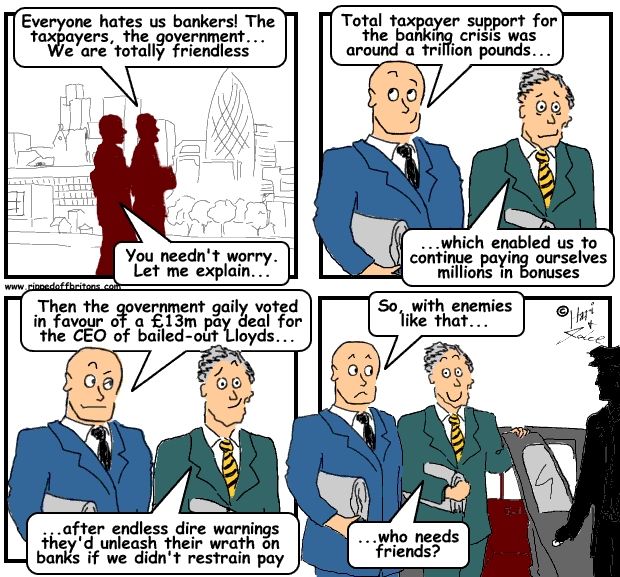
BANKSTER PAY
MPs' 2nd JOBS
TAX IS THEFT?!
FAILING SCHOOLS
AFFORDABLE NHS
1m WORK IN POVERTY
JAIL THE ACCOUNTANTS
RICKETS IS BACK
UN-NATIONALISED RAIL
LOW WAGE BRITAIN
BANK OF MUM & DAD
UK: A PRISONER OF CUTS
TAXING LIES
WATER CANNON BORIS
UNIVERSAL C.. OCKUP
FULL TIME JOBS? WHERE!
Showing posts with label Bonus. Show all posts

Sunday, 30 November 2014

Sunday, November 30, 2014 Posted by Hari No comments Labels: , , , , , , , ,
Is it time to stop bashing bankers? Have the crooks already been biffed out of the ring? Are we just hindering the new saintly bankers? As they clean up after the few bad apples who spoiled it for everyone else?
Of course not. And in saying this we are in good company:

Even the Governor of the Bank of England no longer believes in the "few bad apples" theory of rotten bankers. In November 2014 the Governor, Mark Carney, said:

"The succession of [banking] scandals means it is simply untenable now to argue that the problem is one of a few bad apples. The issue is with the barrels in which they are stored."

The Bank of England tweeted Carney's sentiments to its 120,000 or so Twitter followers to make sure as many as possible heard. Here it is, so you can retweet it too:
The Treasury minister responsible for the City of London said in July 2014:

"I think there's quite a long way to go to really change the culture.... I think we are still going to see a lot of cringeworthy announcements."

A report on "The Culture of British Retail Banking" in November 2014 by the Cass Business School and the think tank New City Agenda (founded by cross-party luminaries) stated banking suffers from:

"A toxic culture decades in the making [that] will take a generation to clean up."

This same report refers to an ethics study done in June 2013, several years after the banking crash, showing the big retails banks still swimming in a red sea of bad ethics.

The report helpfully provides a catalogue of scandals, starting when the banks started to crumble in 2007, that shows no sign of abating:


We end the list with "et cetera" because the report was written before the £2.6 billion in fines for FOREX rigging were imposed in November 2014.
 

Doubtless there are more skeletons waiting to emerge from the banks' vaults. For example, the banks are still in denial about the destruction of small and medium businesses by the Interest Rate Swaps scam. Though thanks to pressure from the Bully Banks organisation and reportage including television documentaries by the BBC's Panorama and Channel 4 News and others it is likely the banks will be brought to account.

Sadly even the highly critical "Culture of British Retail Banking" report we referred to above has a dangerous seed of delusion in it, stating:

"The good news is that banks have made a positive start. The ‘tone from the top’ is there. But this alone is not enough. There needs to be a sustained focus on driving change down through all levels of the organization."

The "tone from the top is there"!? Really? Do they really think there is an officer class of saintly bankers struggling bravely against a host of sinning lower ranking staff? Certainly it would be easier for the authorities to believe they have put "decent people" in charge, so the authorities can sit back and relax. However even if the people at the top now weren't at the top during the worst banking excesses, they were certainly at the next level down. Promoted over decades of banking rip-offs, up through the ranks for being really good at all those banking rip-offs.

Their presence was made felt when in 2014 RBS was reported to have paid bankers in its Global Restructuring Group (GRG), accused of profiting by killing off UK businesses, £17million in bonuses. £17million for activities RBS bosses tried to smoke-screen when raised by Parliament's Treasury Select Committee. Resulting in a letter of abject apology from the RBS Chairman when the RBS top bosses were caught out.

Bankers' dodgy behaviour is driven by excessive pay. Does anybody with power want to do anything about pay? The banks themselves don't: the Parliamentary Commission on Banking Standards report published in June 2013 stated average pay per head in 2012 was actually much higher than it was at the height of excessive pay in 2007 just before the crash:
Nor does the British Government, who fought long and hard against EU plans to cap bankers' bonuses, only giving up in November 2014. Holding the trough up to bankers' noses wouldn't go down so well with the voters in the 2015 General Election.
Willie Sutton.jpg
Willie Sutton

Why do crooks go to banks? Slick Willie Sutton, American bank robber, explained "because that's where the money is". As it was then, so it is now.

People will be crooks if the rewards are great enough. Deal with the rewards, and the crooks will deal with themselves.

Until that happens, it will be too soon to 'move on' from bashing bankers. 

Saturday, 15 November 2014

Saturday, November 15, 2014 Posted by Hari No comments Labels: , , , , , , , , , , ,
According to the Guardian newspaper between 2009 and 2013 banks paid £166 billion in fines and compensation for sins ranging from LIBOR fixing, to PPI mis-selling, to money laundering, to gold price fixing, et cetera. This figure doesn't include fines from 2014 onward including FOREX fixing et cetera.

According to the Office for National Statistics £136 billion was paid in bonuses to UK staff in the financial services sector between 2004 and 2013, when much of the dodgy dealing was being done.

Fines are paid by shareholders (for Lloyds and RBS that includes us taxpayers), but bonuses are paid to individual staff. Does the UK regulator require individual naughty bankers to hand back some of the bonuses they gained doing things that earned £166 billion in fines? We hope the next graph will make this clear:

After all the tough talk of 'clawing back' banker bonuses, what happened? The UK's financial watchdog the Prudential Regulation Authority (PRA) bravely decided clawback would only apply to bonus awards made from 1st January 2015! 

The PRA explained:

"many firms would not have the capacity to introduce such a requirement into existing employment contracts without employee consent and/or might be open to challenge for doing so. In order to ensure a consistent and even application of the clawback requirement across industry, the final rule requires the application of clawback only to awards made on or after 1 January 2015."

The PRA couldn't impose bonus clawbacks because the bankers didn't want to give the bonuses back.


The FCA's statement on "Tackling the root causes" of Forex rigging again shows its complete inability to tackle the root cause:

"The remediation programme will require firms to review their systems and controls and policies and procedures in relation to their spot FX business to ensure that they are of a sufficiently high standard to effectively manage the risks faced by the business."

In its analysis of 'root causes' the FCA does not mention bad bankers. Which sounds rather like advice for a failing school. It is right that schools must seek "systems and controls and policies and procedures" to understand and help the most wayward children rather than simply punish them with lines and detentions. Bankers are not children. The most wayward bankers do need lines (i.e. writing cheques to return their bonuses) and lengthy detentions (i.e. jail time).

If the UK authorities still think new "systems and controls and policies and procedures" will prevent the bankers behaving badly, they are wilfully mistaken.

The FCA's press release on its record £1.1 billion fines for FOREX rigging, imposed in November 2014, stated the punishment was for misbehaviour between 1 January 2008 and 15th October 2013:
"Between 1 January 2008 and 15 October 2013, ineffective controls at the Banks allowed G10 spot FX traders to put their Banks’ interests ahead of those of their clients, other market participants and the wider UK financial system. The Banks failed to manage obvious risks around confidentiality, conflicts of interest and trading conduct."

You will have noticed this particular period started AFTER the great banking crash, and continued for a year AFTER banks had been caught out with their LIBOR rigging shenanigans. Evidently there were no lessons learned, and no new systems, controls, policies nor procedures that made any difference.

The attitude of the excessively paid with respect to regulations and controls can be seen in this exchange about tax avoidance schemes between a tax consultant and MPs in a parliamentary committee:


Q103 Ian Swales [MP]: How many of the schemes you have marketed are now illegal?


Aiden James [tax consultant]: Most of them.


Ian Swales: Most of them?


Aiden James: All of them, I suspect.


Q104 Ian Swales: All the schemes you have marketed are now illegal, so you are now looking for the next loophole-is that a fair description of your business?


Aiden James: That is how it works, yes.

.....

Q110 Stephen Barclay [MP]: The model, if I am understanding correctly, Mr James, is that most of the schemes that you introduce get closed down within a relatively short period of time.


Aiden James: Yes.
Q111 Stephen Barclay: So then you aggressively target a client base and get as many as you can through in a short period of time on the basis that HMRC cannot pass retrospective legislation. Therefore, your clients will get a tax window where they can reduce their tax until HMRC wake up and close that scheme down, by which time you have moved the game on to the next scheme. Is that a fair summation?

Aiden James: I would agree with all that you said apart from "aggressively market". 

So long as people are offered massive rewards with no real personal risk they will without a shadow of a doubt find a way to beat the "systems and controls and policies and procedures".

The solution:
  • Reduce the reward: eliminate bumper pay.
  • Increase the risk: go to jail.
The reality: George Osborne spent yet more taxpayer money paying for lawyers to fight the EU cap on, you guessed it, banker bonuses!

Sunday, 21 September 2014

Sunday, September 21, 2014 Posted by Hari 1 comment Labels: , , , , , , , ,
It used to be the case that when unemployment fell wages rose. Bank of England figures show this has been true up to the last recession, but stopped being true since the recovery that started in 2013. According to Ben Broadbent, a deputy governor of the Bank of England, 

“average pay growth [in 2014] is almost 2% points – more than four standard deviations – weaker than the 1993-2012 regression line (Chart 10)."

Statistically “four standard deviations” means this 2% deficit is extremely unlikely to be due to random chance. As James Bond, had his civil service career taken him into the Office of National Statistics, would have put it “four standard deviations is enemy action”.


So what is happening? A report by the think tank Centre For Cities provides some insight. While the number of both high pay and low pay jobs has been increasing, the number of mid pay jobs has been falling. A trend that has existed for decades:

The increase in 'high pay' has been faster than the increase in 'low pay'. Which is good nationally, but is not much comfort for those shifting down into low pay jobs.

The impact of this is different in cities across the country. In some places 'mid pay' jobs are mainly being replaced by 'high pay', while in others the jobs tend are moving into the 'low pay' category:
The overall impact of this can be seen in the graph below by the Inequality Briefing think tank, who commented: 

Middle-income earners are not getting their fair share of the proceeds of growth"The economy has grown by almost 50% since 1994, while ‘GDP per head’ – the value of the UK economy divided by the number of people living in the UK – has increased by nearly 40%. 

But over the past two decades ‘median incomes’ (‘those who are exactly in the middle of the income distribution - they earn more than the poorest half of the population but less than the richest half) have only risen by 20% - and have fallen dramatically since 2009, despite the economic recovery. This suggests that as the UK gets richer, it is mainly people at the top who are benefiting."

The types of jobs in an economy change all the time. This is generally a good thing. But all sorts of people find themselves on much lower pay for reasons outside their control.  "Self service" technologies have cut swathes of jobs from supermarkets to libraries to highstreet banks. The newspaper CityAM reported that "most bank branches could close over the next 10 to 20 years". Newly created high-pay jobs requiring new high-value skills tend not to go to middle aged redundant bank staff.

The Welfare State aims to provide a decent standard of living for everyone. When a politician offers to sacrifice the welfare state in return for lower taxes, think hard before you vote for them. You may not need high quality free health, education etc now. But you, or your children, or other people whose mid-pay jobs have evaporated, may need them in the future.


Tuesday, 29 April 2014

Tuesday, April 29, 2014 Posted by Jake No comments Labels: , , ,


SOURCE GUARDIAN: Barclays AGM - shareholders large and small protest over pay and bonuses
One in three shareholders failed to support the bank's remuneration report, which showed that bonuses rose 10% despite a 32% fall in profits. The Barclays chairman, Sir David Walker, had promised a year ago to restrain top pay. One private investor, who expressed his irritation at the bank's dividend payments, poor performance and £5.8bn cash call to bolster its finances last year, told the packed AGM: "We're paying for Manchester United but we are getting Colchester United." Annual investor meetings are usually dominated by private shareholders who hold small amounts of votes. But one major City investor, Standard Life Investments, which owns almost 2% of Barclays, spoke out to say it had voted against the pay deals. Alison Kennedy, a director at Standard Life Investments, told the board: "We are unconvinced that the amount of the 2013 bonus pool was in the best interests of shareholders. Walker tried repeatedly to defend the bonus payouts, which resulted in 481 Barclays' bankers being paid more than £1m last year.

SOURCE DAILY MAIL: Osborne blocks taxpayer-owned RBS from doubling bonuses (but staff will still get payouts worth a YEAR'S salary)
Royal Bank of Scotland has been banned from paying bankers bonuses worth twice their salaries by the government. The Treasury said the huge payouts could not be made while the troubled lender was still part-owned by the taxpayer. But staff at RBS will still receive bonuses worth an entire year’s pay, and 77 people will be paid more than £1million. The troubled bank reignited the row over pay in February when it revealed plans for huge bonuses, including £237million for its investment bankers, despite slumping into the red with an £8.2billion loss.

OUR RELATED STORIES:

Saturday, 26 April 2014

Saturday, April 26, 2014 Posted by Jake 2 comments Labels: , , , , , , ,

"the love of money is the root of all evil"
1 Timothy 6:10

This biblical quote means people aren't bad for nothing: to be really bad they need to be really well paid. Of course not all well paid people are evil, but that's the jist of it.

However, if someone tells you paying huge salaries is the only way to hold on to the best people who can make all of us more prosperous, tweet them this post. The statistics show they are wrong.

On the day between Good Friday and Easter Day in April 2014 the DailyMail reported:


“Barclays has been under fire for raising bonuses at its investment bank to £1.6billion, up 13 per cent, despite a 37 per cent fall in the division’s profits and regardless of vows to cut its pay bill.”


The bosses of Britain’s top companies pretend they are forced to pay humungous money to keep the best people. They claim that keeping these people, by paying them lots of money, makes all of us richer.
Is this actually true? Let's take a look at the statistics:


Compare the UK and German wages of the 99thpercentile (the group earning 99th highest out of 100). Figures from the EU’s Eurostat, give the equivalised disposable (see below for definitions) household incomes. These show in 2012 (most recent figures available when writing this post) the German elite took home nearly 25% less than their UK equivalents. 
[Note the following definitions:

  • “Disposable Income”: income after direct taxes and state benefits are taken into account.
  • “Equivalised”: takes into account the size of the household. The household income is divided by a factor depending on the number of people in the household (1 (first adult) + 0.5 (each other adult) + 0.3 (each child)). For example, a household of 2 adults and 2 children, you would divide the total income by (1 + 0.5 + 0.3 + 0.3) = 2.1
  • So, for a 2 adults & 2 children household an equivalised income of Euros 70,000 = an actual income of 70,000 x 2.1 = Euros 147,000 ]

So do our more expensive bosses and investment bankers justify their pay by making us all richer than the Germans? No, the average disposable household income per person is higher in Germany than the UK:

Perhaps our highly paid bosses make our nation richer than Germany, even though that wealth doesn’t turn up in our pay packets? No, GDP per capita figures from the World Bank show while we were ahead during the banking boom we fell well behind during the inevitable banking bust:
Perhaps our highly paid bosses are having to work extra hard because the rest of us Brits are much lazier than the Germans? No,  figures from the ONS and Eurostat show this too is not true. The average British worker works 15% longer hours than your average German.
OK, let's try again. Perhaps it's because even though Brits work long hours they spend a lot of it doodling and dandling, and are jolly unproductive. Or possibly it's a problem of too much job protection - i.e. an inflexible labour market (too difficult to hire and fire). No, according to a report by the Boston Consulting Group (BCG) UK productivity-adjusted wage costs are way lower than Germany. And in terms of labour market flexibility we are streets ahead of the Germans right up there with the USA. (The BCG report aims to puff the USA, and so has no motive for exaggerating the allures of the UK).
The figures show that paying UK bosses much more than German bosses doesn't improve things for all of us. The figures show that exceedingly high pay benefits only the exceedingly highly paid.

However, the real problem is not the size of the huge salaries given to these people. 

The problem is the type of people who are inevitably and deliberately attracted by the huge salaries: people who measure themselves by money. Britons are soundly ripped off by banks, energy companies and others to generate profits to justify the pay of these people. A report by KPMG in 2014 states:

"Conduct failings and remediation of past mis-selling issues still dominate the banking agenda and costing a fortune. For 2013, it represents approximately 80 percent of the cumulative profits of the five banks" [The five banks referred to in the report are Barclays, HSBC, Lloyds Banking Group, RBS and Standard Chartered]


The problem is other people believe they too must measure themselves with money. So the incomes of the poorest stagnate to pay for the rises of the better off.


The problem is people who measure their worth by their money believe people with less money are worth less. We see this particularly in the corrosion of public services. If you don’t have the money to pay for your own lawyer, doctor, university education, security, transport, then that’s tough. This is the attitude that drives George Osborne's public spending cuts.


Office of Budget Responsibility

Excessive rewards are at the root of the rip-off culture. Banking scams ruining individuals and companies, energy scams leaving people freezing to death in the winter, and more. While you don't need to pay huge salaries to get the best people, you do have to pay humungous salaries to get people to ruthlessly rip off their fellow Britons!

Saturday, 15 February 2014

Saturday, February 15, 2014 Posted by Jake 2 comments Labels: , , , , ,
Does Great Pay come with Great Performance? In our earlier post we showed evidence from Verum Financial that the link between pay and performance doesn't actually exist. 

Which explains why ordinary executives get extraordinary salaries.But that in itself doesn't explain why salaries of the top 1% have been booming away while pay for the 90% has stagnated.


The Verum report also sheds light on this. Their analysis shows that pay for poor performance has a more insidious effect than simply giving extraordinary pay to ordinary people. The undeserved pay bonanza doesn't only annoy us ordinary Britons, it also annoys the real high performing executives who see the low performers getting rewarded for lowly performances.

The graph below shows that the variation in bonuses of high performing executives and the herd is much less than the variation in their performances. In plain terms the donkeys get paid not much less than the lions.


This has two inevitable consequences:
a) High performers demand more than their low performing fellow directors.
b) Low performers get more to keep up with their high performing fellow directors.


The Verum report comments:

"This would go some way to explaining the ‘ratcheting’ effect of executive director pay and why pay has tended not to fall when other metrics such as cash-based metrics and post-tax metrics including profit after tax or profit attributable to shareholders have shown sharp declines."

Company remuneration committees, who set the pay of the directors, collude on this. They don't want their dopier directors paid less as that would be an admission that they have dopey directors.

And they don't want to sack their dopier directors, because many of those on the remuneration committees are also pretty dopey and remember being told in school:


"judge not lest ye be judged".


Saturday, February 15, 2014 Posted by Jake No comments Labels: , , , , ,
According to the High Pay Centre, by lunchtime on Wednesday the 8th of January 2014 the average FTSE100 company director had earned as much as the average Briton will in the whole of 2014. At this rate of pay, the average FTSE100 boss earns in a year what an average Briton earns in a lifetime. Is (s)he worth it?

Apologists for excessive pay assert that pay is set by the market, and that high pay rewards high performance. Is that true? Or is it actually a case of executives capturing the company revenue stream and diverting it into their pockets?

A report titled "An Analysis of FTSE 100 Company Director Pay" by Verum Financial Research provides evidence contradicting the 'pay for performance' assertion. The report  looks at the statistical correlation between pay and a series of executive performance measures. It finds that there is a moderate correlation between pay and two of the more manipulable (i.e. dodgy) measures: Profit After Tax and Return On Equity. The report finds that correlation with three more meaningful measures are actually negative (i.e. the worse your performance the more you get paid): Cash Return On Invested Capital (CROIC); Operating Cashflow; Cash As A Percentage Of Profit.


Examples of why 'Profit After Tax' and 'Return On Equity' are dodgy measures of performance:

a) Profit After Tax: there is a moderate positive correlation of 0.6. The more Profit After Tax, the more the executive pay. Which perhaps explains why big companies try so hard to dodge tax. The less tax you pay, the more 'profit after tax' is left.

b) Return On Equity: there is a moderate positive correlation of 0.57. One way of boosting Return On Equity is to borrow vast amounts of money (just as the banks did, leading to the banking collapse). To understand this, think of two hamburger stalls:
  • John has £1,000 of equity. He buys £1,000 burgers wholesale for £1 each, and sells them for £1.50 each, making a return of £500. His return on equity is £500/£1,000 = 50%.
  • Den also has £1,000 of equity. He borrows £9,000 and buys £10,000 of burgers wholesale for £1 each. He sells them for £1.50 each, making a return of £5,000. His return on equity is £5,000/£1,000 = 500%.
By borrowing lots of money Den has a Return On Equity ten times what John has managed. If Den can't sell the burgers and can't pay back the loan then he goes bust. Unless, of course, he is a bank in which case the nation goes bust bailing him out. The Correlation of pay to both of these measures is a moderately strong 0.6. So the executives know it's worth them borrowing and dodging, particularly in FTSE100 companies where they are risking other people's money in the business; other people's money will pay for their lawyers and will pay their fines; other people's money will pay them a golden goodbye if they are sacked.

Graph illustrates an example 0.6 correlation
Less easily manipulated measures show no correlation with pay. As the Verum report states:

The least correlated metrics tend to be those that focus on cash and cash returns including cash return on invested capital (CROIC), cash flow from operations, and cash as a percentage of profit. 
Cash return-based metrics are particularly important to investors as cash flow figures are less easily influenced by creative accounting techniques.

 The measures referred to by Verum as being particularly important to investors are:
a) Cash Return on Invested Capital: correlation of -0.1
b) Operating Cashflow: correlation of -0.25
c) Cash as % of Profit: correlation of -0.35

As the graph illustrates, it is well worth a FTSE100 director allowing these measures to slip. Not because he doesn't care about them, but because they don't take care of him.

Graph illustrates an example -0.2 correlation
Any decent statistician will tell you that correllation doesn't prove causality (just because two things happen doesn't prove one caused the other). In FTSE100 boardrooms the causality is all about the cash. 

What the evidence of the correlation does show is high pay is not reserved for high performance.

https://blogger.googleusercontent.com/img/b/R29vZ2xl/AVvXsEiIFnrboOmTXuwoEJnR1kogdAYS0AmSftDwkCSQguw5UNyF9jDW-iQr5y8r-BZ4uEVrfjz6A4k3l_1Q49MFMqfAB4fNBHXTm-_0K4ZSER1N2HPcCkyjYHZ2xvzWvqAGCibQ0ow19qPrrrYL/s1600/Jun+2013+TUC+UK+pay+drops+%C2%A352bn_col.jpg

A QUICK LESSON ON CORRELATION FOR THE STATISTICALLY CHALLENGED:

The "correlation" measures how closely the "pay for performance" assertion is followed. If the rule is followed perfectly (i.e. the better your performance the higher your pay) the correlation is 1.00. 

If the opposite of the rule is perfectly followed (i.e. the worse your performance the higher your pay) then the correlation is -1.00. 

If pay has no relationship at all to performance than the correlation is 0.00. In this way correlations range between +1.00 and -1.00 depending on how the rule is followed or ignored. 

According to the British Medical Journal, correlations, positive or negative, may be considered thus:

  • 0-0.19 is regarded as very weak, 
  • 0.2-0.39 as weak, 
  • 0.40-0.59 as moderate, 
  • 0.6-0.79 as strong
  • 0.8-1 as very strong correlation

We have illustrated the correlations using graphs snagged from a student message board discussing correlation that we randomly came across when looking for graphs illustrating correlations. The graph appears around the internet, so we aren't sure who to credit. The full set of graphs is given below:

 
Embedded image permalink 

Share This

Follow Us

  • Subscribe via Email

Search Us