TOP STORIES
CARTOONS
GOOD DEBT
PENSION CRAZY
BANKSTER PAY
MPs' 2nd JOBS
TAX IS THEFT?!
FAILING SCHOOLS
AFFORDABLE NHS
1m WORK IN POVERTY
JAIL THE ACCOUNTANTS
RICKETS IS BACK
UN-NATIONALISED RAIL
LOW WAGE BRITAIN
BANK OF MUM & DAD
UK: A PRISONER OF CUTS
TAXING LIES
WATER CANNON BORIS
UNIVERSAL C.. OCKUP
FULL TIME JOBS? WHERE!
Showing posts with label Inflation. Show all posts

Tuesday, 3 February 2015

Tuesday, February 03, 2015 Posted by Jake No comments Labels: , , , , ,

SOURCE DAILY MAIL: Education spending to be cut in real terms after the election. Cameron admits 'difficult decision' will be hard for schools
David Cameron came under attack yesterday over his promise to protect funding for schools after it emerged his plans would see spending per pupil fall in real terms. Speaking at a school in Enfield, North London, yesterday, Mr Cameron made his pledge not to cut the funding per child because good schools ‘need money’. But his pledge that the amount of funding per pupil would be ring-fenced in the next Parliament started to unravel as he admitted spending would not increase in line with inflation. By the end of the next Parliament, this would mean a cut in real terms of around 7 per cent to the schools budget for children aged between five and 16, according to the Institute for Fiscal Studies. Mr Cameron said the Government ‘won’t tolerate failure’ and would raise achievement in 3,500 schools rated ‘requires improvement’ by the watchdog Ofsted. He said every secondary school in this category would be expected to become an academy. Russell Hobby, leader of the National Association of Head Teachers, attacked the proposals as ‘ill informed’ and a decision to ‘declare war on schools’.

SOURCE GUARDIAN: Reality check - is David Cameron promising schools more cash or less?
Luke Sibieta, director of programmes at the Institute for Fiscal Studies, fleshed out that picture with more detail. Because the number of pupils is going up between 2015 and 2019, the budget in cash terms will go up by the same amount, as Cameron promised. But even allowing for the extra cash, Sibieta estimated that the real value of the overall schools budget would be eroded over the next parliament because it would not keep pace with inflation. That would amount to a shortfall of about 7% in real terms. On top of that, there are new pressures on school budgets that will reduce the money available in real terms further. Employer pension contributions have been increased for schools by 2% to ensure the schemes are better funded – that money will have to come from the schools budget. As will an extra 3% for employer national insurance contributions, which have changed as a result of the new single-tier pension. Taken together, that amounts to a cut of 12%, when inflation and the consequences of teacher pension and national insurance contributions are factored in.


Tuesday, 18 November 2014

Tuesday, November 18, 2014 Posted by Hari No comments Labels: , , , , , ,


SOURCE GUARDIAN: 300,000 more people live in poverty than previously thought
The study by the Institute for Fiscal Studies (IFS) for the Joseph Rowntree Foundation said the government method for calculating absolute poverty – the number of people living below a breadline that rises each year in line with the cost of living – incorrectly assumed that all households faced the same inflation rate. But in the six years from early 2008 to early 2014, the cost of energy had risen by 67% and the cost of food by 32%. Over the same period the retail prices index – a measure of the cost of a basket of goods and services – had gone up by 22%. Therefore, the soaring prices for food and fuel over the past decade have had a bigger impact on struggling families who spend more of their budgets on staple goods. The IFS report said the poorest 20% of households spent 8% of their budgets on energy and 20% on food, while the richest 20% spent 4% on energy and 11% on food. In contrast, poorer households allocated 3% of their budgets to mortgage interest payments, which have fallen by 40% since 2008 due to the cut in official interest from 5% to 0.5%. Richer households spend 8% of their budgets on servicing home loans. As a result, the IFS concluded that since 2008-09 the annual inflation rate faced by the poorest 20% had been higher than it was for the richest 20% of households. That meant the official measure of absolute poverty understated the figure by 0.5% – or 300,000.

OUR RELATED STORIES:

Tuesday, 26 August 2014

Tuesday, August 26, 2014 Posted by Hari 1 comment Labels: , , , ,


SOURCE BBC NEWS: Food poverty: Faculty of Public Health issues malnutrition health warning
More people are suffering from malnutrition as a result of worsening food poverty, experts have warned. The Faculty of Public Health said conditions like rickets were becoming more apparent because people could not afford quality food in their diet. Data from the Health and Social Care Information Centre showed the number of those admitted to hospital in England and Wales had risen from 5,469 to 6,520 over the past year. Vice president of the Faculty of Public Health, John Middleton, said food-related ill health was getting worse "through extreme poverty and the use of food banks". The faculty recently claimed that UK food prices had risen by 12% since 2007. It also noted that in the same period, UK workers had suffered a 7.6% fall in wages. The main symptom of malnutrition is rapid weight loss - usually 5-10% within a few months. Other signs include: weak muscles, constantly feeling tired, an increase in illnesses or infections, children will not grow as quickly, and will show changes in behaviour becoming irritable, sluggish and anxious. Meanwhile, Durham Police and Crime Commissioner Ron Hogg told BBC Radio 4's Today programme some people were resorting to committing crime "simply to live". "The evidence shows that shoplifting and theft in general is rising exponentially and there must be a reason for that," he said, adding that it was important to address the causes of such crimes. Health Minister Dan Poulter said the government had "given local authorities a £5.4bn budget over two years to help them manage public health issues, including malnutrition, in their areas." He also said the rise in malnutrition could be partly due to better diagnosis and detection by health professionals of people at risk.


OUR RELATED STORIES:

Wednesday, 20 August 2014

Wednesday, August 20, 2014 Posted by Hari No comments Labels: , , , ,
Can KJ, Chris and Fee find a silver lining?...
SOURCE GUARDIAN: Rail fares to rise by average of 3.5% in JanuaryRail fares will rise by an average of 3.5% in January, with some increasing by up to 5.5%, adding hundreds of pounds to the cost of commuters' season tickets. Calls for the government to curb planned rises intensified as Labour said it would cap fares on every route and indicated it was considering an election pledge to cap increases at the rate of inflation. Protests took place at stations across the country as campaigners pointed out that ticket prices have risen nearly four times as fast as wages. The 2015 rise will mean fares have gone up by a quarter since the coalition government took power.

Saturday, 19 April 2014

Saturday, April 19, 2014 Posted by Jake No comments Labels: , , , , , , , ,
In April 2014, just before Easter, newspapers including the Express and the Telegraph reported:

“March’s UK inflation figures suggest that the six-year squeeze on real earnings is finally over”

For the first time in 4 years prices were not rising faster than wages. Were they right about the squeeze being over?

Actually, in the 5 years upto March 2014 price rises have outstripped wages in 57 months out of 60.


This has left us on average 8% worse off than 5 years ago. 


ONS figures show the effect this has had on spending. In real terms (at 2012 prices) average household spending fell between 2001 and 2012, while average houshold income was actually higher in 2012 than 2001.


Incomes up but spending down? What happened? Two limits had been hit:
  • The spending of the wealthiest is limited by running out of things they want to buy. 
  • The spending of the poorest is limited by the money they have to spend. 

Giving the wealthy more doesn't result in more spending. However taking away from the poor does result in less spending. Result: higher average income, lower average spending.


At the Downing Street Easter Reception in April 2014 David Cameron said


"Jesus invented the Big Society 2,000 years ago...I just want to see more of it."

Cameron is perhaps thinking of Matthew 13:12 quoting Jesus:


"For whosoever hath, to him shall be given, and he shall have more abundance: but whosoever hath not, from him shall be taken away even that he hath."

Perhaps Cameron thinks Jesus was talking about wealth. The Tories have given the wealthy more with cuts to direct taxes (income tax) and corporation tax, and taken from the poor by increasing indirect tax (VAT) and cutting welfare. 

Perhaps Cameron doesn't understand that Jesus was actually talking not about wealth but about understanding.Thereby uncomprehendingly proving Jesus' point.

Taking a longer view on the cost of living, the data shows that we are now back in the same position we were in 2004. For some there never was a cost of living crisis. For others the crisis still has a few years to go.


Friday, 18 April 2014

Friday, April 18, 2014 Posted by Jake 1 comment Labels: , , , , ,
KJ and Chris get the answer from someone who obviously knows...

SOURCE DAILY MAIL: Pay rises scrape ahead of inflation - but only if you work in the private sector AND get an annual bonus
Wages including bonuses were on average 1.9% higher in February compared to the same month in 2013, said the Office for National Statistics, while the consumer price inflation rate for that period was 1.7%. But pay including bonuses was only 1.7% higher when you look at the three months to February and compare it to the same three months of the previous year, suggesting on this measure that real incomes actually flatlined. Furthermore, public sector workers saw pay increases of only 0.9% and the average wage excluding bonuses was only 1.3% higher in February. GMB general secretary Paul Kenny said: 'The recovery under way is welcome but we have a very long way to go to climb out of the hole caused by the recession.' Part of the growth is simply because the UK population has increased. Kenny added: 'Given the increase in population, GDP per head is still 5.8% below 2007 levels. This is the root cause of average earnings being down 13.8% in real terms since then. The pay of the bottom 50 per cent of the workforce is still being squeezed.' The news comes as millions of health and local government workers gear up for possible strikes in protest at pay increases of 1%.

Saturday, 5 April 2014

Saturday, April 05, 2014 Posted by Jake No comments Labels: , , , , , , , , , ,
It's the oldest trick in the book. Convince your competitor to lower his guard, and then biff him.  

Adam Smith, the capitalist icon, believed everyone scuffling selfishly for their own benefit would result in an ‘invisible hand’ distributing a nation’s wealth pretty fairly. 

Smith’s advice was based on the reality that you can’t trust anybody else to pull for your benefit. You can only really trust people who are pulling in the same direction as you. And any student of tug-of-war will know it is all much less strenuous if the other side simply drops the rope and stops pulling.


Graphs from the “Budget 2014: Background Briefing”, produced by Parliament's impartial House of Commons Library, show how ordinary Britons have been tricked into dropping the rope in the great economic tug-of-war. It also shows how those who want Britain to be a more prosperous place, whether of the left or of the right, should stiffen up and grab the rope again.


From Budget 2014: Background Briefing
The Budget Briefing report shows between 2007 and 2014 average earnings have dropped more than 12% in real terms. The same graph shows that household consumption (i.e. spending) has almost returned to its peak level. Consumption that has been helped by household debt rising to record levels according to a report in November 2013 by Iain Duncan Smith's "Centre for Social Justice".

A separate graph using ONS data shows that the fall in wages is not a short term effect of the recession triggered by the banking crash. In the decades since the 1960's the share of GDP paid to employees has dropped from around 60% down to around 54%.


Graph of Compensation of employees as % of Gross Domestic Product: CP SA (Quarterly)
(The ONS defines "Compensation of employees" as wages, salaries and social contributions made by employers).
Falling wages are the result of companies pulling their end of the rope to maximise their profits, while the employees just get yanked along. The graph below by the CIPD shows the change in real terms of the average (median) hourly earnings for various categories of employees between 2008-2013.


Change is real median hourly earnings between 2008 and 2013

This also explains the government's attacks on benefits. The problem was never about benefits rising so fast that the nation couldn't afford them. It was all about making sure benefits, which are largely paid to working people, keep down with wages.

Another graph from the same Budget 2014 report shows that even the rightest winger should lament the fall in household incomes - whether from wages or benefits. The graph shows the recovery has been driven by household spending. 

Osborne, pulling cussedly at his end of the rope, thinks he has found a wizard way of getting people to keep spending without giving them any more money: give them access to their pension pots! Having already spent the equity in our houses, liquidating them with the easy mortgages that led up to the Banking Bust, we are now invited to spend our pension savings. Getting ordinary people to spend more and receive less may have a great short-term effect on growth, but will end as horribly as experience should have already taught us. 

The IMF predicts a stonking 2.4% rate of UK GDP growth in 2014. Growth that, with caps on benefits, changes to pension indexation from RPI to the lower CPI, and poor wage growth, will not be shared with ordinary Britons. Not unless ordinary Britons pull in their own direction as hard as the companies, executives and politicians do in theirs.

But how can all us individual Britons become a force against corporate Britain in this economic tug-of-war over wages? First we have to realise that better wages are in the national economic interest, and that we need to pick up the rope again to pull in our direction. 


Then we need to find others who are pulling in the same direction, and we need to join them. They are already there, in the form of the unions.

The Tories have appealed to Britons to be unselfish and accept less for the good of Britain. "We are all in it together" they tell us. For Adam Smith's "invisible hand" to distribute the wealth of the nation more fairly we need selfish forces pulling in every direction. Be selfish for the good of Britain - join a union!


Saturday, 15 March 2014

Saturday, March 15, 2014 Posted by Jake 1 comment Labels: , , , , , , , , ,
The Financial Conduct Authority (FCA, previously the FSA) and OFGEM are the pantomime twins of regulation in Britain: Tweedle-dumb and Tweedle-dumber. 

The FCA waving its Vorple Sword is regarded by the banks as no more threatening than a cheer-leader wielding a furry pom-pom. The litany of bankers' interest rate rigging; pension annuity scams; insurance scams etc. goes on with no sign of any banker swapping his pure wool pinstripe suit for an acrylic stripey prison jersey.

At least the FCA can claim it is getting tricked by different scams all the time. OFGEM, evidently the dumber of the twins (it must be truly mortifying to be dumber than the FCA!), has managed to be deceived for years by one central fib: the soaring wholesale price of energy. 

For years energy companies have blamed consumer price hikes on World energy markets. Data published by OFGEM in October 2013 (why did it take them so long to do something so obvious?), and by NPower in January 2014 (why did they do it at all?) show wholesale prices simply have not been shooting up.

Combining this data from OFGEM and NPower, and retail prices from Consumer Futures reveal:
 
a) Using NPower's figures (in real terms) since 2007, customer bills have increased by 18% in 2013, and predict a 40% increase by 2020, while wholesale costs have actually fallen. In this NPower report instead of blaming wholesale prices NPower blames everything else except profits:


b) Using OFGEM's wholesale figures between 2011 and 2013, customer bills have increased by upto 28% while wholesale prices have only increased by 4%.

The Office of National Statistics reported a 29% increase in "excess winter deaths" during the winter of 2012-13. 2012 being, according to figures by OFGEM, a year of near record profits for the energy companies:


***Below: How in recent years wholesale prices were blamed for customer price hikes:

Price rises in the summer and autumn of 2011 were blamed by energy companies on volatile wholesale markets:
"UK wholesale gas prices have risen by around 30%, reflecting unrest in the Middle East and North Africa and increased global demand for gas, in part due to closures of nuclear plants in Japan," said British Gas
"With reduced quantities of North Sea gas, we are now forced to buy energy on the volatile global wholesale market. World events have pushed up prices and we believe this trend will continue....I know it hurts everyone when we put up prices and I wish we did not have to," said Npower.

OFGEM courageously caved in, stating in a 2011 report:
"Wholesale energy costs have continued to rise, particularly for gas, where for example the price of this winter's gas is around 40% higher than last winter's.
This increase has been driven by global rises in oil and gas prices. This has contributed significantly to recent increases in customers' bills."

In the Autumn of 2012 the same excuse was rolled out:
"Britain's North Sea gas supplies are running out and British Gas has to pay the going rate for gas in a competitive global marketplace," said Mr Bentley [MD of British Gas].
Speaking to the BBC, Mr Bentley pointed out that although wholesale prices are actually currently lower than a year ago, British Gas, like most utilities, fixes the price at which it buys gas well in advance, and these fixed prices had risen.

This drivel was lapped up wholesale by the Department of Energy and Climate Change (DECC), who stated in 2013:
"DECC suggested that the main drivers of recent increases are: wholesale energy costs, estimated to have contributed at least 60% of the increase in household energy bills between 2010-2012."

Friday, 3 January 2014

Friday, January 03, 2014 Posted by Jake 2 comments Labels: , , , , , ,
Fee and KJ predict what will happen next...


SOURCE GUARDIAN: The CBI, Britain's biggest business lobby group, says "Pay your workers more"John Cridland, director-general of the CBI, Britain's biggest business lobby group, criticised many of the 240,000 companies he is paid to represent for failing to pass on their new-found prosperity to employees. He told employers – whose FTSE 100 bosses are paid 136 times the national average – that they must ensure that all citizens benefit from the recovery. The GMB union warns that the real value of national average earnings has fallen by 14% since the start of the recession in 2008. Real earnings have dropped by more than 20% in London, with workers in Hammersmith and Fulham experiencing a 49% decline. By contrast, the average FTSE 100 boss collected £3.7m last year. Just three months ago Cridland attacked the Labour leader Ed Miliband’s plans for an increase in the minimum wage as a "real setback for Labour's pro-enterprise credentials". He said many companies could not afford to pay employees more than the £6.31 minimum wage for adults, and £5.03 for those aged 18 to 21. Miliband has said he will offer companies tax breaks if they commit to paying workers the living wage, which is set at £7.65 an hour.

OUR RELATED STORIES:

Tuesday, 22 October 2013

Tuesday, October 22, 2013 Posted by Jake No comments Labels: , , , ,

SOURCE CONSUMER FUTURES: Percentage change in average energy bills since 2007. Timings of energy suppliers' price changes. Current prices.

SOURCE GUARDIAN: The energy secretary, Ed Davey, called on electricity and gas suppliers to act rapidly to reveal their true profitability to customers and the energy regulator, as the government spent another day on the defensive over soaring bills. He said: "We need more transparency from the big six." He argued that companies such as Centrica, which owns British Gas, "need to be held to account for the profits they make and they need to declare them in a much clearer way".

OUR RELATED STORIES:

Friday, 6 September 2013

Friday, September 06, 2013 Posted by Jake No comments Labels: , , , , , , ,
Chris is with one of our top CEOs...


SOURCE SKY NEWS: 20% of British Workers earning 'Below Living Wage'The think tank The Resolution Foundation said it meant that a total of 4.8 million Britons, 20% of all UK employees, were paid at a level below the rate deemed necessary for a basic standard of living, an increase from 3.4 million in 2009. They said: "Britain has a sorry story to tell on low pay. Only a handful of our close competitors do worse and the large majority have much lower rates of low pay - sometimes half as much."

OUR RELATED STORIES:

Friday, 26 July 2013

Friday, July 26, 2013 Posted by Jake 1 comment Labels: , , , , ,
Chris tells KJ the answer...
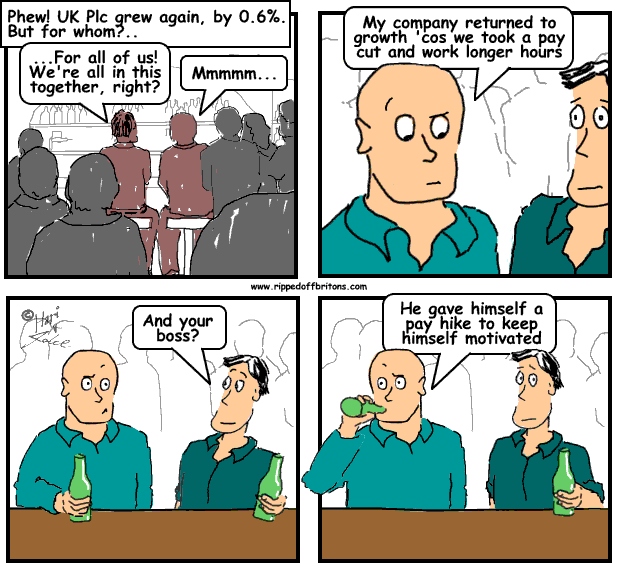
SOURCE BBC NEWS: UK economy 'on the mend' after 0.6% growth, says chancellor
"These figures are better than forecast," said Mr Osborne. "Britain is holding its nerve, we are sticking to our plan, and the British economy is on the mend - but there is still a long way to go and I know things are still tough for families." Shadow chancellor Ed Balls welcomed the growth figure "after three wasted and damaging years of flat-lining", but warned that "families on middle and low incomes are still not seeing any recovery in their living standards" because wage rises were failing to keep up with increases in prices.

OUR RELATED STORIES:

Friday, 15 March 2013

Friday, March 15, 2013 Posted by Jake No comments Labels: , , , , ,
KJ, Chris and Fee get all confused...


SOURCE TELEGRAPH: Bitter taste for drinkers as beer is watered down to save money
John Smith’s Extra Smooth will be reduced from 3.8% alcohol to 3.6% - and the price per pint is set to rise. The change is not just because of the rising costs of production, and reduced beer sales in Austerity Britain, but in response to high tax rates. The government’s attempt to tackle problem drinking includes a lower rate of duty on beers with lower alcohol content. The change should save Dutch brewers Heineken, who own the brand, £6.6m in duty per year. A third of every pint now goes to the tax man.

OUR RELATED STORIES:

Tuesday, 12 March 2013

Tuesday, March 12, 2013 Posted by Jake No comments Labels: , , , , , , , , ,
Cameron tells Justin Welby to stop meddling in things he only half understands...


SOURCE TELEGRAPH: Archbishop of Canterbury attacks Government welfare reforms
The Archbishop of Canterbury, Justin Welby, and the Archbishop of York, Dr John Sentamu, have backed a letter to The Sunday Telegraph written by 43 bishops who say the benefits cuts will have a “deeply disproportionate” effect on children. They say the legislation will remove the protection given to families against the rising cost of living and could push 200,000 children into poverty.

OUR RELATED STORIES:
Friday, 25 January 2013

Friday, January 25, 2013 Posted by Jake 4 comments Labels: , , , , ,
Can KJ change Fee's mind?..


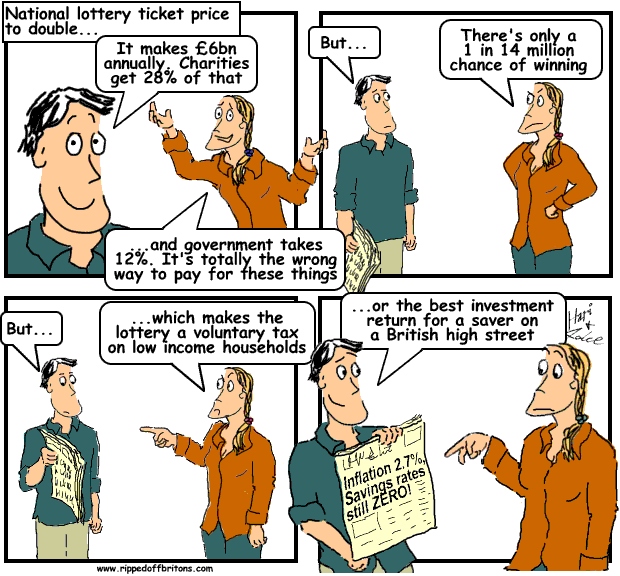
SOURCE GUARDIAN: National lottery ticket price to double
Camelot said the payout for the average Saturday jackpot would increase from about £4.1m to £5m. It defended the change, saying that charities, retailers selling tickets and government coffers would all benefit from the price rise. Around 60% of UK adults play the Lotto regularly, and annual sales across the lottery products account for more than £6bn annually. Charities and other good causes get 28% of lottery revenue, while 12% is paid to the Treasury. Small shops, which pocket 5% of sales, will also benefit. The lottery is a voluntary tax on low income households, say critics.


OUR RELATED STORIES


Wednesday, 14 November 2012

Wednesday, November 14, 2012 Posted by Jake 2 comments Labels: , , , ,
Cameron grills his Energy Secretary, Ed Davey...


Energy price manipulation 'could account for at least 50% of bill rises'
Since whistleblower Seth Freedman's allegations that the wholesale price has been manipulated, energy price comparison experts believe this could have an impact on the amount consumers and businesses pay for their power supply. GUARDIAN

Sunday, 12 August 2012

Today's guest post is by Toby Lloyd, Head of Policy at the housing and homelessness charity Shelter. It explains how we can cut the £22bn spent on housing benefit. The main reason why it's that high is because of the high cost of rent caused by this country's housing bubble. If we build more homes we'll bring down the overall cost of housing, and therefore bring down the housing benefit spend. We already know we can afford to build more houses: that £22bn housing benefit spend is around twenty times more than we currently spend on building affordable homes. We'd actually end up saving money.

So why is the government pumping a further £80bn into loans, including mortgages, which will keep the housing market overpriced?

Housing charity Shelter says "Let's spend less on housing"?!

By Toby Lloyd, Head of Policy, Shelter
The news has been worryingly free of house price stories of late, forcing some papers to fill pages with minor distractions like the Olympics, Leveson and the great summer weather.
Thankfully the IMF has come to the rescue of editors everywhere, with its annual report on the UK economy suggesting that house prices still need to fall by 10-15% now-ish – and by up to 30% to get back to trend.
Inevitably, the response from some quarters will be for the Government to do something, which always comes with a price tag.
With budgets everywhere being slashed, you don’t get many charities calling for their patch to be cut. We tend to make the case for why our bit should be spared the axe.
But I reckon we should be spending far less than we currently do on housing ourselves as a nation.
Firstly, there’s the fact that we spend £22 billion a year on housing benefit – about twenty times what we spend on building affordable homes. As we’ve argued before, this is a ridiculous state of affairs – but you won’t fix it by cutting housing benefit for those who have the temerity to be unable to afford sky-high private rents.
You fix it by ensuring more people don’t need benefit just to keep a roof over their heads, which means building more affordable homes, and by making the homes we already have more affordable.

Calling for more public investment into home building runs straight into the arguments about whether more public borrowing is a good idea (it’s cheap right now, there’s lots of spare capacity and unemployment) or economic and political suicide (there’s a public debt crisis out there, polling shows the public support deficit reduction).
So the consensus seems to be that we need more private investment – and more private borrowing. On 5 July there was a further £50bn of quantitative easing, then a few weeks later the new Funding for Lending scheme was launched, promising to pump £80bn of credit into loans, including mortgages. And this is where it gets worrying.
What both sides of the debt debate ignore is the fact that private debt is still astronomically high. More borrowing for productive enterprise – i.e. to create real growth – may be needed, but mortgage borrowing doesn’t do this. As this natty animation below shows, most of it goes into inflating the price of existing homes – ensuring that all those rentysomething wannabe first time buyers remain priced out for good, unless of course they have family rich and generous enough to help them. Do we really want to go back to a model of property ownership based strictly on inheritance rather than earning? The cunning plan to pump more credit into mortgages seems more orientated to promoting a new house price boom than stimulating economic growth.

When our housing costs are already the third highest in Europe, why should we want to make it worse?
Household gross debt chart
 The IMF report also shows that UK household debt is the highest in the G7 at over 100% of GDP – and the vast bulk of that is mortgages. As the IMF pointed out in April, the countries that are suffering the worst recessions are those that built up lots of household debt though housing bubbles. The new report includes some truly scary graphics on p23 of the role of the housing market in our current economic woes.
So there you have it: we need to spend much less on buying homes in future – not only would this enable us to spend the money on growth-fuelling investment, it might even allow us to buy, rent and build more homes without busting the bank, literally.

Share This

Follow Us

  • Subscribe via Email

Search Us