TOP STORIES
CARTOONS
GOOD DEBT
PENSION CRAZY
BANKSTER PAY
MPs' 2nd JOBS
TAX IS THEFT?!
FAILING SCHOOLS
AFFORDABLE NHS
1m WORK IN POVERTY
JAIL THE ACCOUNTANTS
RICKETS IS BACK
UN-NATIONALISED RAIL
LOW WAGE BRITAIN
BANK OF MUM & DAD
UK: A PRISONER OF CUTS
TAXING LIES
WATER CANNON BORIS
UNIVERSAL C.. OCKUP
FULL TIME JOBS? WHERE!
Showing posts with label advertising. Show all posts

Wednesday, 5 March 2014

Wednesday, March 05, 2014 Posted by Jake No comments Labels: , , , , , , ,
There is nothing like a government to prove the old adage of "lies, damn lies, and statistics". 

In March 2014 a BBC Newsnight programme reported that the Tories were holding back a government report that would expose as untrue a key statistic being used to rouse a rabble of votes with tough talk on immigration. The report is said to show Tory claims that "for every additional 100 immigrants… 23 British workers would not be employed" were a gross exaggeration.


Get Adobe Flash player

The Tories were criticised in July 2013 by the Office of National Statistics for misusing statistics to back a claim that the benefits cap was pushing people back into work. In February 2013 Andrew Dilnot, chairman of the UK Statistics Authority, criticised the government for being economical with the truth about the UK economy's debt and deficit figures.

The Advertising Standards Authority has long since washed its hands in relation to political fibbing. They regard Political Advertising as beyond their control:


"For reasons of freedom of speech, we do not have remit over non-broadcast ads where the purpose of the ad is to persuade voters in a local, national or international electoral referendum. Complaints about political advertising should be made directly to the party responsible for that advertising."


The key to statistics is not so much what they say, but who is saying it. The Office for National Statistics - still not privatised at the time of writing this post - provided an interesting statistic in its report on "Measuring National Well-Being - Governance 2014". The report shows that over the last 10 years fewer than 1 in 3 of us actually believe what the government tells us.


Which is about the same percentage that actually voted for the winning party in this period:


Tuesday, 16 July 2013

Tuesday, July 16, 2013 Posted by Jake No comments Labels: , , , , , ,
Cameron checks whether Jeremy Hunt has got his sums right. He has!..
SOURCE GUARDIAN: Big tobacco has got its way – now let's find what big alcohol is up to
The coalition has dropped plans for plain packaging amid murky circumstances. Public health measures such as this and minimum alcohol pricing deserve better than death by lobbyist.

OUR RELATED STORIES:

Tuesday, 1 January 2013

Tuesday, January 01, 2013 Posted by Jake 2 comments Labels: , , ,
We at Ripped-off Britons aim to provide you with well sourced facts and data so you can digest and pass them on by word of mouth, by email, by re-tweeting.

But there's a limit to what we can do. So we invite you to find relevant articles and recommend them to us for publication on our blog.

We ourselves look around for suitable material ourselves, and have already gratefully accepted contributions from a number of guest authors. But there are only so many hours in a day available from our other duties. So we invite you, our readers, to suggest articles you have come across by doing the following:


  • Email us a link to the article, to suggestions@rippedoffbritons.com
  • We will check out the article, to see if it fits in with our campaigning
  • If it does, we will contact the author and invite them to contribute the article to Ripped-off Britons
  • If the author accepts our invitation and we publish the article, we will invite you to select a Ripped-off Britons cartoon of your choice, which we will print and sign and post to you. (Perhaps not as liquid as cash, but it's the only sort of Quantitative Easing we can afford, and a sight less dodgy than the Bank of England's).
The articles we seek need to be more than unsupported assertions. We want evidence to back up the assertions, such as:


  • Quotes from recognised sources
  • Data from respected organisations
  • Well presented graphs and graphics
Campaigners like us are in competition with those who sell their rip-offs. Rip-offs that include dodgy financial products; gouging energy and transport price hikes; mendacious political stances. In this competition, in spite of the overwhelming financial power of advertisers, impecunious campaigners can still punch above our weight. According to a survey by Nielsen (a research company that aims to provide “the most complete understanding of what consumers watch and buy”):

“Although television advertising will remain a primary way marketers connect with audiences due to its unmatched reach compared to other media, consumers around the world continue to see recommendations from friends and online consumer opinions as by far the most credible.”

Which still means us campaigners are at a vast disadvantage, but less vast than you might think. 

The difference, dear reader, is you. People believe you far more than they do a costly advertising campaign or a weasel government statement. In contrast, corporate executives hoping to swipe your money and government ministers hoping for promotion and for private clients for their "cab for hire" services are greeted with the scepticism they deserve.

To give you an idea of the size of the challenge campaigners face in the tug-of-war between information and disinformation:

Britons on average see 1,400 adverts each month, according to the “review of television advertising and teleshopping regulation” report by OFCOM.


According to research by Nielsen and Brad Insight UK the ten sectors with the biggest advertising budgets spent £6.2 billion in 2010 to persuade you to part with your money:


In most sectors the top 10 spending companies did the bulk of the advertising. Incredibly, the top 10 spending retail companies threw nearly as much money into adverts as the whole of the finance industry:


The helping fist provided by successive governments in the mugging of consumers is evident from the ironically named "Consumer Protection from Unfair Trading Regulations" that legalises the ripping off of half the population. As it is by OFCOM’s regulations that allow up to 1 minute in 5 of television time (12 minutes per hour) for adverts. 

And in terms of advertising, the budgets are increasing. According to the Institute of Practioners in Advertising (IPA), "In 2011, total adspend (including direct mail) increased by 2.7%, to £16.1bn (current prices)"


In their book published in 1885, Thomas Smith and J.H.Osborne observed it takes twenty views for an advert to catch its target:
  1. The first time people look at any given ad, they don’t even see it.
  2. The second time, they don’t notice it.
  3. The third time, they are aware that it is there.
  4. The fourth time, they have a fleeting sense that they’ve seen it somewhere before.
  5. The fifth time, they actually read the ad.
  6. The sixth time they thumb their nose at it.
  7. The seventh time, they start to get a little irritated with it.
  8. The eight time, they start to think, “Here’s that counfounded ad again.”
  9. The ninth time, they start to wonder if they’re missing out on something.
  10. The tenth time, they ask their friends and neighbours if they’ve tried it.
  11. The eleventh time, they wonder how the company is paying for all these ads.
  12. The twelfth time, they start to think that it must be a good product.
  13. The thirteenth time, they start to feel the product has value.
  14. The fourteenth time, they start to remember wanting a product exactly like this for a long time.
  15. The fifteenth time, they start to yearn for it because they can’t afford to buy it.
  16. The sixteenth time, they accept the fact that they will buy it sometime in the future.
  17. The seventeenth time, they make a note to buy the product.
  18. The eighteenth time, they curse their poverty for not allowing them to buy this terrific product.
  19. The nineteenth time, they count their money very carefully.
  20. The twentieth time prospects see the ad, they buy what is offering.
In the modern day, with the great diversity of media channels, advertisers assail us many more than 20 times pledging that if we do what they tell us we will be better off. We hope that you will support us to compete and punch above our weight with our cartoons and articles in your conversations, emails and re-tweets.

Sunday, 2 December 2012

Sunday, December 02, 2012 Posted by Jake 4 comments Labels: , , , , , ,
In January 2012 the Office of Fair Trading (OFT) launched an investigation on “Retail food pricing and promotional practices”. The investigation was closed on 30thNovember 2012, when  the OFT courageously announced
“The OFT has made no finding that the supermarkets have breached the law or were engaging in misleading promotional practices.”
That the supermarkets did not breach the law is not a surprise. British consumer protection law in the form of the “Consumer Protection from Unfair Trading Regulations” is a charter for rip-offs. The law explicitly states that deception is perfectly legal so long as it only deceives the less than average consumer


Incredibly it is also explicitly legal under this law for a trader to knowingly engage “in a commercial practice which contravenes the requirements of professional diligence” so long as his actions are not “likely to materially distort the economic behaviour of the average consumer with regard to the product under regulation”.  Blimey! 

But while the law only protects the more than average half of Britons, the Office of Fair Trading provides detailed guidance so even the most brutishly stupid retailer will understand how to skirt around consumer protection law if he is so inclined. A kind of 'no retailer left behind' scam tutorial.

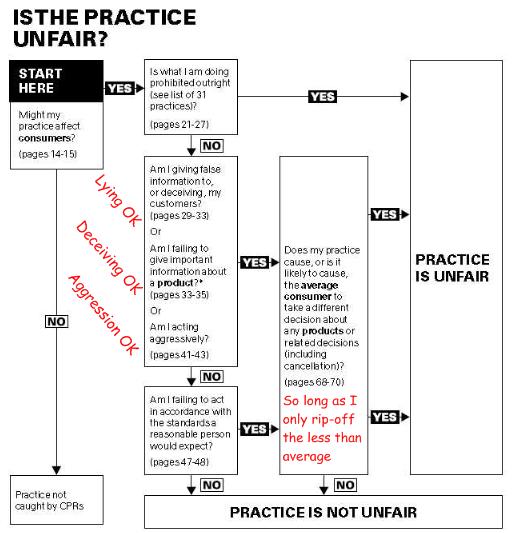
To help the dimmer retailers OFT's guidance provides pictures to make sure retailers don't need a moral compass to navigate the law. The law identifies 31 practices that are banned under all circumstance. But apart from those 31, anything goes so long as it only hits the 'less than average'.


Although the above graphic from the OFT's "Guidance on  the Consumer  Protection from Unfair Trading  Regulations  2008" states that it is "Unfair if they cause consumers to take a different decision", the law itself clarifies that this only protects the "average" consumer as stated in these extracts from the legislation


  • A commercial practice is unfair if…..it materially distorts or is likely to materially distort the economic behaviour of the average consumer with regard to the product. 
  • A commercial practice is a misleading action if…. it causes or is likely to cause the average consumer to take a transactional decision he would not have taken otherwise. 
  • A commercial practice is a misleading omission if, in its factual context…. it causes or is likely to cause the average consumer to take a transactional decision he would not have taken otherwise. 
In short, if only the less than average consumer – amounting to half the targeted customers – is tricked then that is fine.

Further help for the fraudulently inclined is provided in the OFT roadmap below. Our annotations on this OFT roadmap for retailers on how to tell "Is the Practice Unfair" are in RED:

It is rather touching that the OFT can't bring itself to say the practice is "FAIR", only that it is "NOT UNFAIR" and therefore legal.


We have written about this phenomenon in banking, insurance, pensions, energy, transport, mobile phones, and now supermarkets. So back to the Supermarkets investigation. In its conclusion the OFT proudly trumpeted:
“Eight supermarkets have agreed to a set of OFT principles to address concerns over special offers and promotions for food and drink.”
Sounds promising? So when do these principles come into force? And how harshly will they be enforced?  The OFT is helpful here too, but not to us ripped-off Britons, stating:
“The principles do not 'come into force' on any particular date. They clarify existing guidance and should not be seen as rules with an implementation date.”
So the eight supermarkets have simply said they will stop ignoring what the OFT has already been saying. 

What is truly revealing is not that the supermarkets pull off stunts to rip us off. Not much surprise there. What is truly revealing is these stunts, even when put under the regulatory microscope by the OFT, are found to be legal!


As we have pointed out in previous posts, British law regards Britons as the lawful prey of businesses. The law regards us rather as a gamekeeper regards pheasant and grouse: we are worth protecting because we make such good eating. The law is happy for us to be ripped off so long as it is only the ‘less than average’ half of us that are the victims. It is the law of the jungle. 

However, the law of the jungle has a benefit. It makes species stronger by natural selection.


Consumer law does not make anybody stronger. The law refusing to protect the 'less than average' simply unleashes rippers-off, licencing them to rip off the vulnerable. By allowing retailers to rip us off it gives a competitive advantage to them over retailers who are honest. Driving honest retailers out of business. Making the 'retailing species' more corrupt.

To be fair to the OFT they just enforce the law created by Parliament. If the law says it is legal, then it is the law that is the problem.

Wednesday, 18 July 2012

Wednesday, July 18, 2012 Posted by Jake No comments Labels: , , , , ,
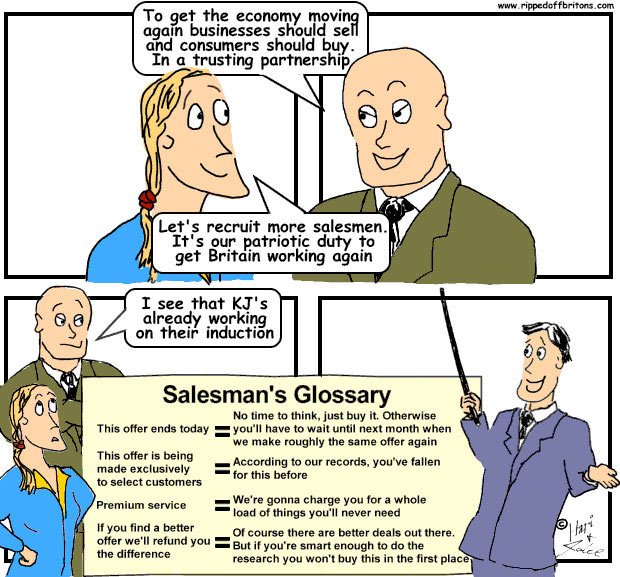
KJ sticks to the oldest sales trick in the book...

Wednesday, 26 October 2011

Wednesday, October 26, 2011 Posted by Jake No comments Labels: , , , , , , , ,
Chris and his wife try and find the best bargains while shopping in a supermarket

Sunday, 23 October 2011

Ripped-off Britons: Sales speak explainedThe right to rip-off Britons is enshrined in British law, most explicitly by the ironically named Consumer Protection from Unfair Trading Regulations”. It is not our contention that the rip-offs we write about in this blog are illegal – just that they are rip-offs. But that is the problem: as you will read in the rest of this blog, the rip-offs are not in breach of the Consumer Protection from Unfair Trading Regulations so long as they rip-off no more than half their target market.


The preamble in this legislation tells us that the law will protect the “average consumer” (and of course all those smarter or better informed than average). It helpfully goes on to qualify this “average consumer” as being “reasonably well informed, reasonably observant and circumspect”.


It further states that:
“In determining the effect of a commercial practice on the average consumer where the practice is directed to a particular group of consumers, a reference to the average consumer shall be read as referring to the average member of that group.”

...going on to say:

“(a) where a clearly identifiable group of consumers is particularly vulnerable to the practice or the underlying product because of their mental or physical infirmity, age or credulity in a way which the trader could reasonably be expected to foresee,

and


(b) where the practice is likely to materially distort the economic behaviour only of that group,

a reference to the average consumer shall be read as referring to the average member of that group”

Thus, in words comprehensible to the average trader, the legislation makes clear that the trader is permitted to rip off the "below average" half of the population. If the trader, be he a high-street banker or a purveyor of sweeties, is selling specifically to a mentally infirm or credulous group then he is permitted to rip off the more infirm and credulous half of the group.

The act goes on to stipulate explicitly what a trader may and may not do:

  • A commercial practice is unfair if…..it materially distorts or is likely to materially distort the economic behaviour of the average consumer with regard to the product. 
  • A commercial practice is a misleading action if…. it causes or is likely to cause the average consumer to take a transactional decision he would not have taken otherwise. 
  • A commercial practice is a misleading omission if, in its factual context…. it causes or is likely to cause the average consumer to take a transactional decision he would not have taken otherwise. 
  • A commercial practice is aggressive if….it significantly impairs or is likely significantly to impair the average consumer’s freedom of choice or conduct in relation to the product concerned through the use of harassment, coercion or undue influence


The act continues that a trader is guilty of an offence if:
  • (a) he knowingly or recklessly engages in a commercial practice which contravenes the requirements of professional diligence under regulation 3(3)(a);
and
  • (b) the practice materially distorts or is likely to materially distort the economic behaviour of the average consumer with regard to the product under regulation 3(3)(b).

Never underestimate the power of an “and”. Einstein, in one of his quips about the world we live in, thought compound interest was the most powerful force in the universe. I think it is “and”, and/or perhaps “or”. Two little words that make almost anything possible. In this case the “and” tells us that the trader is legally allowed to use any tactic he wants, be it unfair, misleading, aggressive, reckless, unprofessional so long as the “average consumer” won’t be tricked by them. Anyone “less than average” is fair game to be recklessly coerced, misled, and handled unfairly. On them it’s open season 12 months a year!


To understand the implications of the legislation:
If we lined our population up in order of each one’s ability to do hard sums and understand tricksy small-print in a ‘terms and conditions’ contract putting the smartest in Edinburgh with the line heading south to London, the average guy would be the one in the middle, in the city of Leeds.

The laughably called “consumer protection” legislation leaves unprotected the half of the population lined up south of Leeds in this map:

So, how easy is it to trick an “average consumer”?

Well, the UK government did a revealing study in 2003, “The Skills for Life survey”. The purpose of the survey was to understand the literacy and numeracy skills in the UK population. To achieve this, the survey classified people according to their level of academic ability.

For our overseas readers, and some of our fellow ripped-off Britons who haven’t had to have anything to do with school for a while, here is a bit of base information you will need to understand the graphs below:

National           Approximate School
Standard          Level Equivalent
Entry 1             Key stage 1 (ability expected of a student age 5-7)
Entry 2             Key stage 2 (ability expected of a student age 7-9)
Entry 3             Key stage 2 (ability expected of a student age 9-11)
Level 1             GCSE D-G (ability expected of a student age 11-14)
Level 2             GCSE A*-C (ability expected of a student age 14-16)

GCSE = General Certificate of School Education, usually taken by 15-16 year olds in the UK. Students can achieve pass grades from A* at the top down to G, or else fail the test.

The Skills for Life survey looked into the literacy and numeracy levels of the UK population and found the following:

In real numbers
Literacy:            16% at Entry Level 3 and below   =          5.2 million adults
                        Reading age of 11 years and below.

Numeracy:        46% at Entry Level 3 and below =            15 million adults
                        Numeracy age of 11 years and below.

Across Britain, those who fall into the “less than average” group, unprotected by the “Consumer Protection” legislation, include millions of people who have the mathematical and reading ability of a junior school child. Banks, energy companies, insurers, mobile phone companies, and all the other lawful businesses in Britain have a free hand with these Britons.

You may think that this bottom 50% probably don’t have enough money to make them worth ripping-off.  You would be wrong. Confusing money with wealth is a mistake the blue-chips don’t make. They understand that while the bottom 50% of the population have negligible wealth, they do 30% of the nation’s spending (figures from the Office of National Statistics).

30% of all the spending in Britain is a lot of money. And the courts look very sympathetically on organisations that go hunting this “less than average” customer base – as the banks found when they defeated the Office of Fair Trading in their case against excessive bank charges. Throwing out the OFT’s case, their lordships stated:


So long as the contract gives the terms and conditions somewhere, in language that is “plain and intelligible” to the “average” customer then it doesn’t matter how great or grotesque the rip-off is. In law it cannot be said to be “unfair”, and is therefore “fair”.

And that’s the law in Ripped-Off Britain. 


Wednesday, 20 July 2011

Wednesday, July 20, 2011 Posted by Jake No comments Labels: , , , ,
KJ and Chris discuss the getting into the murky business of will writing

Monday, 18 July 2011

Monday, July 18, 2011 Posted by Jake No comments Labels: , , , ,
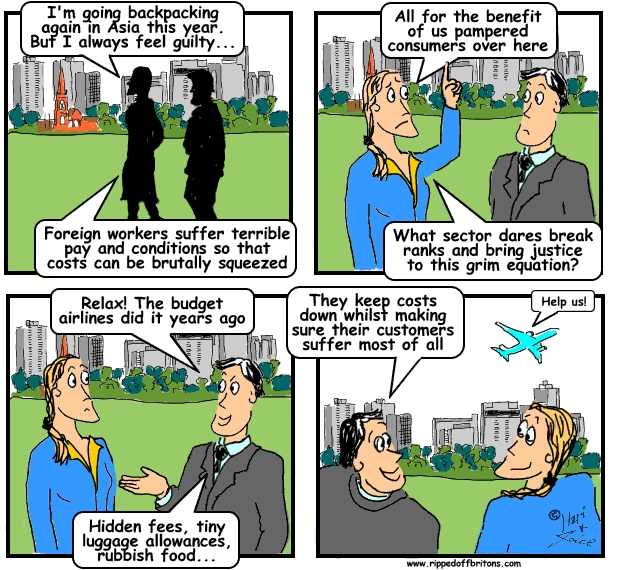
Fee needn't worry about the moral implications of cheap air travel

Friday, 8 July 2011

Friday, July 08, 2011 Posted by Jake 1 comment Labels: , ,
The gang discuss the demise of the News of the World

Friday, 17 June 2011

Friday, June 17, 2011 Posted by Jake No comments Labels: , ,
Fee considers extreme measures to increase her baggage allowance on budget flights

Friday, 10 June 2011

Friday, June 10, 2011 Posted by Jake No comments Labels: , , , ,
But are you actually covered? Fee and Chris enlighten KJ

Sunday, 27 March 2011

Sunday, March 27, 2011 Posted by Jake 2 comments Labels: , , , , , ,

Just because you aren’t rich doesn’t mean you aren’t rich-pickings. Just as in nature, so it is in the marketplace. The biggest of the beasts feed on the smallest morsels. The largest elephants munch on the delicate little leaves of trees, the biggest whales suck up microscopic plankton. One of the great secrets of Britain is though the rich have almost all the wealth, it is ordinary Britons from the moderately well off to the poor who have most of the cashflow. From the banks, insurance companies, and energy companies, with boards adorned by chivalrous knights, noble lords, and right honourable politicians, all the way across to the loan sharks, counterfeit market traders, and doorstepping shysters, they all pursue the cashflow – in the form of your average ripped-off Briton.


According to government statistics, although the poorest 50% have virtually no wealth,  they do 30% of the spending. Although the richest 10% have over 70% of the wealth, they only do 20% of the spending.


It is the biggest companies, with lovable adverts, catchy “da da da daah da daah da da da daah da daah” theme tunes, and high powered compliance-avoidance teams, that are the greatest villains. Those that understand their mutual interest gang up in associations and consortia to see off the regulators.  In it’s release in March 2011, OFGEM stated


The big players as a matter of informal policy show their contempt for regulators by simply ignoring them. They have learned that the penalties they face are a fraction of the profits they rake in. This has been learned from the rarefied heights of providing dubious tax-avoidance services to the high rollers down to ripping off single parents putting pound coins into their electricity meters.

Given as evidence to a US Congressional committee, revealing how fines are a fraction of earnings.


After all, British consumer law states that 50% of consumers are fair game to be ripped off . Not so much a loophole, more of an open gate through which the banks strode arms akimbo with full brass band “da da da daah da daah da da da daah da daah” when they beat the OFT in court over the unfair overdraft charges which make up 30% of their revenues generated from current accounts. Throwing out the OFT’s case, their lordships stated:


This means, in plain intelligible English: so long as the contract says somewhere, regardless of how well hidden, what the scam is, then it doesn’t matter what the scam is. In law it cannot be said to be “unfair”, and is therefore “fair”.

With the law backing up the scammers, it is for the buyer to beware – ‘caveat emptor’ for those with a classical education. The consumer needs to compare and contrast, read the contract, do the maths. But is your average Briton any more able to avoid predatory companies than a leaf is able to avoid the grazing elephant, or the drifting plankton to avoid the whale’s gaping maw? OFGEM’s own analysis shows that they are, on the whole, not.


It is these biases, these weaknesses in the average Briton’s decision making, that drive companies’ marketing. In search of confusing complexity, the energy providers have been growing the number of different deals on offer.

The implication is that companies don’t have to mis-sell – they don’t need to lie to their consumers. They can rely on the consumers making mistakes. In their paper, “Do [electricity retail] consumers switch to the best supplier?”


Energy companies know that they actually don’t have to compete on price, and don’t have to tell fibs – so long as they can keep the consumer confused. OFGEM/IPSOS surveys indicate:
·        60% of consumers never switch.
·        Of those that do switch, up to a third switch to a worse, more expensive, tariff.
·        Of those that do switch, only one in five switch to the best tariff, with the rest switching to less good deals.

The number of deals on offer has nearly doubled between January 2007 and January 2011.


Lie-free gotchas range from banking to insurance, to gym membership to mobile phone contracts, to just about everything. Use ‘competition’ as a cover for ‘complexity’. The Bill Monitor service, “invented by mathematicians in Oxford approved by Ofcom”, shows that there are 3,704,859 possible deals for someone wanting a £15 per month mobile phone contract from a UK provider (figure taken in March 2011). 


Banks, as always, are in on the ripping-off with complex formulae for paying interest and 'teaser rates' which offer you a decent interest for the first year followed by something derisory - knowing that billions of investor money will be left earning next to nothing because the saver never gets round to shifting their cash.


The Lloyds Bank Vantage account makes the promise of upto 4% interest on savings of upto £7,000 paid in tiers. If you do the maths, this means by keeping £7,000 continuously in your account you get an effective gross rate of 2.59%. If you have less than £5,000 then your rate drops to 2.02%, less than £3,000 your rate drops again to 1.37%. And 0.1% if you have less than £1,000.


Complexity is the mother of profit - but the profit is not for you.


Could ripping-off confused Britons be related to why Britons don’t save? Is the key issue around poverty and pensions not so much that Britons are profligate, and more that we are ripped-off?


Share This

Follow Us

  • Subscribe via Email

Search Us