TOP STORIES
CARTOONS
GOOD DEBT
PENSION CRAZY
BANKSTER PAY
MPs' 2nd JOBS
TAX IS THEFT?!
FAILING SCHOOLS
AFFORDABLE NHS
1m WORK IN POVERTY
JAIL THE ACCOUNTANTS
RICKETS IS BACK
UN-NATIONALISED RAIL
LOW WAGE BRITAIN
BANK OF MUM & DAD
UK: A PRISONER OF CUTS
TAXING LIES
WATER CANNON BORIS
UNIVERSAL C.. OCKUP
FULL TIME JOBS? WHERE!
Showing posts with label MP. Show all posts

Sunday, 15 March 2015

Sunday, March 15, 2015 Posted by Jake No comments Labels: , , , , , , , ,
When asked by a member of the audience in the BBC Question Time programme why MPs had taken a 10% pay increase, Grant Shapps MP said this was "a complete and utter myth". Shapps was correct in a slippery way. That particular Question Time programme was in February 2015, and the bumper payrise wasn't coming in for another couple of months:

a) 1% rise in April 2015 from £67,060 to £67,731
b) 9% additional rise the following month straight after the May 2015 general election, to £74,000. 

Note while Shapps, the Tory party chairman, was being characteristically slippery none of the other three MPs on the panel, from Labour, Liberal Democrat and UKIP stepped in to clarify this.

We have in other posts pointed out that an MP's basic salary is more than the wages of 95% of UK taxpayers. However, putting aside all the expenses and all the 'under the radar' consultancies and directorships, MPs have plenty of opportunities to bolster their incomes with funds from Parliament itself.

According to the Parliament website, there are plenty of other paid jobs, from Prime Minister to Assistant Whip. The list of posts as at March 2015 included 121 individuals holding 146 jobs (a small number of which are unpaid).

As well as topping up their wages with these jobs that are in the gift of the party leaders, there are more jobs in the gift of the individual MPs themselves some paying salaries in excess of £45,000. The Daily Mail reported:
"In 2010 there were 137 MPs employing family members but the figure soared to 167 last year.
The total pay bill has rocketed from £2.4million in 2010-11 to almost £3.8million in 2013-14.
It means that the average salary paid to family members has risen by a third, from just over £17,101 to just over £22,400."

The distribution of salaries paid to family members is shown in the graph below, for the year 2013/14. 
[If you want it, the data is here: http://www.parliamentary-standards.org.uk/AnnualisedData.aspx. For 2013/14 it is there in the "other data"].

Which all puts MPs pay in a whole new perspective. The next graph only shows the top few percent of UK incomes:

Marcial Boo, chief executive of IPSA with responsibility for setting MPs' pay, suggested without the hike to £74k MPs would be on a "miserly amount". Mr.Boo is reportedly paid £120k to keep tabs on MPs remuneration, so doubtless £67k seems miserly to him. We couldn't confirm Boo's pay at the time of writing, as the staff salaries document on the IPSA Transparency website page wouldn't open:

Sunday, 8 March 2015

Sunday, March 08, 2015 Posted by Jake No comments Labels: , , , , , , , ,
It is not just money the poorest get the least of. It is also life itself. Office for National Statistics (ONS) figures show life expectancy drops dramatically in areas of greater deprivation. Perhaps that's not news for many of you.


However, even more dramatic is the drop in the number of healthy years people in the lower deciles of deprivation can expect. (The ONS measures "Healthy Life Expectancy" as the number of healthy years you expect to have over the course of your life, the rest presumably being not healthy).

A male child born between 2011 and 2013 from the top (least deprived) decile can expect:

a) to live 9 years longer than a child from the bottom (most deprived) decile  


b) to have an extra 18 years of good health than a child from the bottom (most deprived) decile
Figures for female children born in 2011-2013 show a smaller gap in Life Expectancy, but a slightly larger gap in Healthy Life Expectancy.


Doubtless there are many factors involved in the loss of 'healthy years' by those suffering greater deprivation. Many of the "Elementary Occupations" are harder and more hazardous on the body than a career behind a desk wielding a mouse. These Elementary Occupations include:
 
MPs bleating for more pay claiming they sacrifice their lives for their jobs maintain a stubborn shameless ignorance of those who quite literally sacrifice years of their lives and more years of their health. MPs will still be collecting their parliamentary pay, pension and perks for years while many of their contemporaries in the bottom decile are getting flowers in hospital, or pushing them up in a cemetery.

Cheaper foods, affordable to those from the lower deciles of deprivation, are often more unhealthy. 'Lean' minced meat generally has much less gristle and fat than the cheaper stuff. European regulations define the qualities of mince:

As usual, the UK government courageously caved into the food industry lobby to open up a loophole to allow worse stuff to be sold in the UK:

  • allow lower quality "cuts of meat in minced meat that may otherwise have been discarded" 
and
  • allow "minced meat to be placed on the market with an excess of thirty percent fat for minced pork or, in the case of minced beef, over twenty percent fat."
The reality is even when austerity cuts are imposed equally on all, they do not impact all equally. Evident from the graphs above, those in the lower deprivation deciles will be hit more by ongoing cuts to healthcare. 

https://www.gov.uk/government/statistics/english-indices-of-deprivation-2010
The graph above shows the levels of deprivation in the various regions of England. (An "LSOA" is a small area, like a town, within a region - click here if you are interested to know more). A National Audit Office report on healthcare funding in England showed many deprived areas getting much less money than they should based on the government's own formula for target funding:


A child born between 2011-2013 in the lowest decile can expect a gob-smacking 18 fewer healthy years in its lifetime than its contemporary born in the top decile. This situation has developed over decades of successive governments of all complexions. 

Ultimately, political parties seeking election don't act in your interests but in their own interests. If they think they can get your vote, or at least you won't vote against them, for nothing then they will give nothing. 

For political parties to work in their own interests by working for your interests, make sure you vote for whoever will serve you best. If that means none of them, then go to the polling station and spoil your ballot (it will still be counted).

Sunday, 1 March 2015

Sunday, March 01, 2015 Posted by Jake 1 comment Labels: , , , , ,
MPs caught plotting ‘under the radar’ lobbying (on behalf of clients) for cash, are quick to use their mischiefs as an excuse to lobby (on behalf of themselves) for even more cash. 

They claim if MPs were paid more we would get better quality MPs. Their assertion being:
  • Some high powered people don't apply to be MPs because they don't want to take the pay cut.
  • If they didn't have to take the pay cut, they could become high powered MPs. 

Let's put aside the copious evidence that the existing rewards of being an MP are sufficient to pull in a plentiful number of people who consider themselves 'high powered': for instance, Oxbridge graduates are just 1% of the population but made up 27% of all MPs, and over 1 in 3 Tory MPs, in the 2010-15 parliament.


And lets overlook that there are many high powered MPs in Parliament who do the job for reasons of public service, regardless of the pay. Just as there are many high powered people with vocations to work in other relatively low paying professions.

Instead focus on that group of people who refuse to be an MP unless the money can match that of their alternative employment. 

For those who measure a person's merit by their pay:
1) a person's merit is measured by how much they earn.
2) the amount earned is only a measure of their merit within their profession, and not across professions. 

For example, if a banker earns more than a doctor that is not because the banker is 'better'. It is because the banker is in a higher paid profession than the doctor. Just as the thousandth ranked UK banker earned more than a million euros, while the thousandth ranked tennis player earned just a few thousand. 

Therefore using money as the measure, to get the 'best' we would want people paid in the top quarter (above the 75th percentile) of earnings for their profession.

A look at wage figures from the Office for National Statistics (ONS) illustrates that by paying MPs more we would actually get a worse quality of MPs. 

Higher pay would tempt to Parliament the low performers of high paying professions (bankers; lawyers; lobbyists) thus pushing out high performers of lower paying professions (teachers; IT managers; nurses...).

The graphs below shows the range of salaries for different professions. First we explain how the graph works:
  • 25% earn less than the first blue block, marked Q2 (the second quartile)
  • 50% earn less than the second blue block, the median.
  • 25% earn more than the third blue block, marked Q3 (the third quartile)

For a selection of professions, salary ranges (from the Office for National Statistics, table 14.7a) are:

Evident from this is the current MP's salary, £66k, is already above the 75th percentile for postmen; nurses; teachers; IT managers; train drivers. So an MP's pay is already enough to get the top 25% talent from those professions.

On the other hand, £66k is well below the pay of a 75th percentile lawyer, doctor, or company director. 
Even the MPs' 10% payrise in May 2015, to £74k, still wouldn't be enough to bring in the best money driven candidates from these high pay professions.

To attract money-driven top 25% (top quartile) lawyers, doctors, and company directors, the salary of an MP would need to rise to £100k. This is clearly ludicrous:

a) Based on market driven supply & demand, there has never been a shortage of people wanting to be an MP. Whether they are any good is a matter of opinion.

Snapshot, June 2013
b) The statistics show the vast majority are sheep, voting according to the party line. The market price of lamb is about £5 a kilo.

One possible solution:
1) Parliamentary candidates state in their election campaign literature how much money they need for it to be worth their while representing their constituents, signed off by the party leader.

2) The party leader is given a salary budget after the General Election of £67k times the number of MPs he or she gets. (ONS figures for 2013 show £67k p.a. is more than 94% of income tax paying Britons' pre-tax incomes). And it is left to the party leader to share this out.

All done in full public view. Now that would be fun to watch!

Tuesday, 24 February 2015

Tuesday, February 24, 2015 Posted by Jake 1 comment Labels: , , , , , , , , ,

SOURCE DAILY MAIL: MPs' salary of £67,000 is not enough for the standard of living I'm ENTITLED to, says Tory Sir Malcolm Rifkind as he defends his second jobs after 'cash for access' sting
Labour’s Jack Straw and the Tories’ Sir Malcolm Rifkind were secretly filmed discussing how they could use their contacts to benefit a private Chinese company and both boasted about charging at least £5,000-a-day. In the conversation with the undercover reporters Sir Malcolm was filmed discussing that his usual fee was 'somewhere in the region of £5,000 to £8,000' for half a day's work. Straw told undercover reporters he would expect £5,000 per day. MPs earn £67,060-a-year, but Sir Malcolm claimed this was not enough for someone of his professional background. Challenged about why he does not do voluntary work to provide experience of the world outside politics, Sir Malcolm told BBC Two's Daily Politics: 'I have two objectives, I have to have that broader hinterland as you so nicely describe it, but I do also want to have the standard of living that my professional background would normally entitle me to have.' Defending his position, Sir Malcolm said there were 'about 200' MPs who had business interests and insisted many members of the public did not want 'full-time politicians'. He said that 'many ex-ministers, former chancellors, home secretaries, prime ministers, as well as other people, have served on advisory boards' and insisted it was 'entirely proper'. Jack Straw, the Blackburn MP, told how he had used his influence to change EU rules on behalf of a private company he already works for and declares an interest in. He also claimed to have used 'charm and menace' to persuade the Ukrainian prime minister to change laws on behalf of the commodity firm, which pays him £60,000 a year. Mr Straw, 68, said he would not take on the role while he remained an MP, but could be more helpful if he were to become a peer in the House of Lords after the election.

Sunday, 22 February 2015

Sunday, February 22, 2015 Posted by Jake No comments Labels: , , , , ,
Some of our readers complain that we at Ripped-off Britons are always being negative. It's not true! We once wrote a piece explaining why we should love estate agents. And we ran another piece urging people not to be beastly to bankers. 

This time we speak positively of Church of England bishops and their letter for the General Election 2015.

Taking a sideways glance at data can be revealing. A report from the Food Standards Agency (FSA) provides a key insight into us Brits, apart from all the stuff about food standards. It's one of our most endearing and most infuriating characteristics: if we aren't reminded that we are annoyed, we forget to be. 

This is a good thing in general, but not in a general election.

Henry V, according to Shakespeare, knew it. To get his army to defeat the French at the siege of Harfleur in 1415, Henry knew it wasn't enough to simply point out the city walls. Henry had to work his soldiers up into a froth: 

"Once more unto the breach, dear friends, once more;
Or close the wall up with our English dead.
In peace there's nothing so becomes a man
As modest stillness and humility:
But when the blast of war blows in our ears,
Then imitate the action of the tiger;
Stiffen the sinews, summon up the blood,
Disguise fair nature with hard-favour'd rage;
Then lend the eye a terrible aspect;
Let pry through the portage of the head
Like the brass cannon; let the brow o'erwhelm it
As fearfully as doth a galled rock
O'erhang and jutty his confounded base,
Swill'd with the wild and wasteful ocean.
Now set the teeth and stretch the nostril wide,
Hold hard the breath and bend up every spirit
To his full height. On, on, you noblest English."


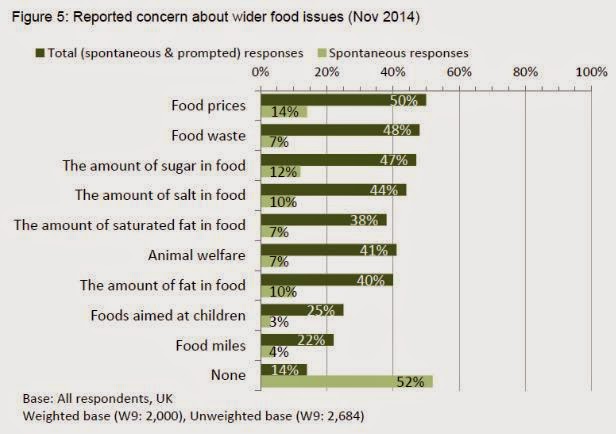
It takes quite a bit of stirring before we Britons will stiffen the sinews and give someone a hard stare. We need a heavy hint even to complain about our food: The Food Standards Agency's study asked a set of questions twice:
  • First time: Spontaneous, unprompted, "Is there anything you are concerned about?"
  • Second time: Prompted, "What are you concerned about from this list of issues? Food prices; Food waste; Sugar; Salt; etc."
For example, food prices:
  • First time: Asked what food issues in general were of concern, only 14% of responders spontaneously said they were worried about food prices.
  • Second time: Asked specifically whether they were worried about food prices, 50% of responders said they were worried.


    As you can see from the above graph, people weren't spontaneously particularly worried about sugar, salt, fat, or animal welfare. But when asked specifically about sugar, salt, fat, or animal welfare between 40% and 50% were indeed worried. Unprompted over half the people questioned had no concerns at all, falling to only 14% completely unconcerned when asked about specific issues.

    Specific blasts of irritation tend to blow in our ears at the wrong time when there isn't anything we can do about it. There's no point you flaring your nostrils when the receptionist at your GP says there aren't any appointments left. You know he can't see your nasal gesturing over the phone. Why bother raging at the self-service ticket machine when you discover an off-peak one day London travelcard went up 34%, from £8.90 to £12 in January 2015? I can tell you, the machine didn't care.

    By the time you actually can do something at an election, the rage is less than a distant memory. The urge to complain has faded.


    The Church of England Bishops hoped to remind us of some issues with their letter, following the well trodden Pauline (and Caroline) path of writing epistles to influence policy (St Paul's were much snappier, as we hope were Prince Charles'). The Bishops' 56 page(!) letter in February 2015 , followed by an 11 page explanation of the 56 pages, raises a medley of things for us to get exercised by one way or the other:
    • Our political culture, parties and democracy
    • The role of the state
    • The role of intermediary institutions
    • The role of the family
    • The economy
    • Poverty & inequality
    • Unemployment
    • Welfare reform
    • Health
    • Immigration
    • Housing
    • Education
    • Environment
    • Constitutional Reform
    • Britain’s global role
    • Europe
    • Defence and war
    • International development
    • Threat from extremism and religiously-inspired conflict

    The bishops explain their intentions for this letter:

    “This letter from the Church of England’s House of Bishops is addressed to all members of the church... we hope that others, who may not profess church allegiance, will nevertheless join in the conversation and engage with the ideas we are sharing here”

    “This letter is intended to help church members and others consider the question: how can we negotiate these dangerous times to build the kind of society which many people say they want but which is not yet being expressed in the vision of any of the parties?”

    The Bishop of Leicester stated:
    "We do not claim to offer a “God’s eye view” nor to endorse any particular political prospectus, but rather to encourage a renewed political culture in which the lessons for today can be learned.  It is our hope that this letter will serve that purpose."

    The bishops say it more gently than we at Ripped-off Britons would. Or Henry V would. 

    We dare not compete with Shakespeare. So, back to Henry V, and the General Election:

    I see you stand like greyhounds in the slips,
    Straining upon the start. The game's afoot:
    Follow your spirit, and upon this charge
    Cry 'God for...' write an X next to your preferred candidate 'and St George!'

    For the general election put aside your mild manner, put your dog on its lead, cry havoc and go to your polling station!

    Saturday, 31 January 2015

    Saturday, January 31, 2015 Posted by Jake 2 comments Labels: , , , , , ,
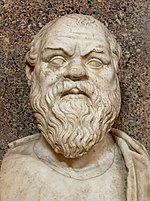
    2,400 or so years ago an ancient Greek, possibly the philosopher Socrates, said:

    "Our youth now love luxury. They have bad manners, contempt for authority; they show disrespect for their elders and love chatter in place of exercise; they no longer rise when elders enter the room; they contradict their parents, chatter before company; gobble up their food and tyrannize their teachers."

    The Rt Hon Michael Gove MP2,400 or so years later another figure from the past, Michael Gove MP formerly Secretary of State for Education, was still searching for bright ideas to get the young to do the right thing. Gove encouraged teachers to discipline wayward youths by getting them:

    "to do extra work, or to repeat unsatisfactory work; to write lines, or an extra essay...picking up litter, or washing graffiti off a wall, tidying a classroom, clearing up the dining hall."

    People often complain about the youth of today, imagining things were better when they were young. The evidence of the last few millennia suggest young people have always been really annoying.

    However, there is one way today's young have clearly fallen behind earlier generations of youngsters. According to the British Election Study, it is only since 1997 that young people really got out of the habit of voting.

    Combining data from three sources,
    we can see young people are bad at registering for the vote, and also bad at turning up to vote:
    Note that 18-24 band is 7 years wide, while others upto 84 are 5 years wide.
    More worryingly, a report commissioned by the Electoral Commission from Essex University states that the habit of not voting isn't a passing phase that the young will grow out of. It is a habit they are holding on to as they age:

    "the effective British electorate is becoming progressively older, election by election. 
    Moreover, it seems unlikely that this is a ‘life cycle effect’ in which currently young non-voters will turn into voters as they get older. 
    On the contrary, the spread of relatively high levels of non-voting to all three of the younger cohorts suggests that, over the last 30 years or so, habits of non-voting acquired in youth have tended to be carried forward into middle age – and will perhaps continue even into old age."

    Changing a person's habits, whether young or old, is very hard. But to get them to do just one thing just once is much easier. Look no further than your local supermarket to see the science of manipulating us into impulse buying. Various academic papers suggest over 50% of our supermarket purchases are unplanned. So why not get the youth to impulse vote? Even if they make the wrong choice, as tends to happen with impulse shopping, at least they get into the habit of choosing and learning from their mistakes.

    Political parties, its time to get your older supporters to get their juniors out to vote. Parents, it's time to get your voting age offspring to vote. You know what motivates them better than Nige, Nick, Ed, Dave etc.

    It's particularly worth it in certain constituencies, where 18-24 year olds can be nearly a quarter of voters:

    And it's particularly worth it in constituencies where just 1 in 20 non-voters voting for the second placed candidate would topple an MP (all other things being equal):

    According to a report for the Electoral Commission by Essex University, after the 2005 General Election:


    “The single most powerful way in which turnout in British general elections could be increased would be to increase the sense of civic duty among the young, particularly among the under 40s.”

    Surely in this 800th anniversary of the Magna Carta, this 50th anniversary of Winston Churchill's death, that can't be so hard? 

    Remind them of their Civic Duty! If you need help, then try this:


    Sunday, 25 January 2015

    Sunday, January 25, 2015 Posted by Jake No comments Labels: , , , , ,
    Some newspapers claim to be able to swing their readers like bats beating carpets. Figures from Ipsos-Mori, the polling organisation, show a clear difference in the swing magnitude between the various papers' readerships.
    While the Sun and the Daily Star have the greatest swings, they also have the lowest voter turnouts. 
    The graphs below show Sun readers appear to have shifted from Labour to Tory. The Daily Star's swing seems to be less due to readers shifting from Labour to Tory than to readers shifting from Labour to any party other than Tory.


    In the interests of balance we offer below the voting histories of each of the papers' readerships in swingingest order:


    Share This

    Follow Us

    • Subscribe via Email

    Search Us