
-
LATEST: Think you’re paying less tax now? The withdrawal of Working and Child Tax Credits leaves low earners paying a 73% marginal tax rate, and medium earners paying even more
...And this government says it cuts taxes for poor working households!
-
RIP-OFF NEWS ROUND-UP, OUR PICK OF THE LAST WEEK'S MEDIA
Drug firm Novartis tried to 'scupper' trials of a cheaper version of eye medicine
Has Austerity caused the UK’s first decline in life expectancy in 20 years?
Kellogg's effectively paid no corporation tax in the UK in 2013, +more stories...
-
YOU'RE FIRED?! We are already nearly the most easily fired people in the developed world
Only the US and Canada make it easier, says the OECD’s Worker Protection Index
-
EYE OPENER: Housing Equity Withdrawal took off in 1979. Since then almost all UK growth has suspiciously equalled the amount we took out. Looks like it’s pensions next
Osborne’s new rules allow you to spend your entire pension pot now. Same mistake, different pot
-
DID YOU KNOW? MPs are getting a 10% pay hike in May, to £74k
...and in 2010, 137 MPs put family members on parliament's payroll. Now it's soared to 167
GOOD DEBT

PENSION CRAZY

BANKSTER PAY

MPs' 2nd JOBS

TAX IS THEFT?!

FAILING SCHOOLS

AFFORDABLE NHS

1m WORK IN POVERTY

JAIL THE ACCOUNTANTS

RICKETS IS BACK

UN-NATIONALISED RAIL

LOW WAGE BRITAIN

BANK OF MUM & DAD

UK: A PRISONER OF CUTS

TAXING LIES

WATER CANNON BORIS

UNIVERSAL C.. OCKUP

FULL TIME JOBS? WHERE!


Monday, 10 January 2011

Sunday, 9 January 2011
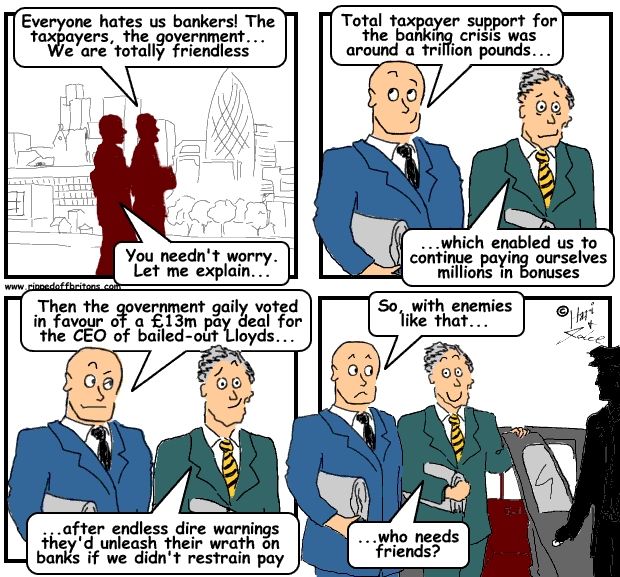 The ‘tussle for talent’ is the favourite justification given by companies, bureaucracies, and parliaments for generous perks, privileges, and pay. To say the “talent” takes the credit is obvious – that is how they are identified as “talent”. However, whether they deserve all the credit they take is a matter of opinion.
The people who allocate the ‘credit’, and thereby define who the ‘talent’ is, are the bosses of organisations. A report released in October 2010 by Income Data Services demonstrates that the bosses are sure of one thing – they themselves are enormously talented, and they tussle vigorously to reward themselves. In a time when wages are generally stagnating, the bosses determination to tussle for their own talent is evident:
Even boosting the pay of fellow employees, by declaring how talented they are, is not always a matter of generosity or admiration – it can also be to provide a smokescreen. Massive rewards to bankers distracts attention from even more massive rewards to banking bosses. The bankers may be wolves in sheep’s clothing, but in that galloping herd of talented sheepskins there are many sheep in sheep’s clothing getting away with gratifying levels of pay and perks. The degree to which this smokescreen has worked can be seen from the fact that in the years between 1980 and 2007 the pay per worker in the financial sector – i.e. all of them, not just the “talent” – rose from about par to over 1.8 times the average pay per worker. These figures on pay are from the US, which the UK strives to match.
Do bankers deserve this largesse? Not if you are listening to Andrew Haldane, Executive Director of Financial Stability at the Bank of England. His 2009 speech explained that the stellar annual returns of 16% in bank shares between 1986-2006 can be attributed solely to gambling with borrowed money. Banks made profits on money they had borrowed, which was fine so long as the roulette wheel was kind. When the bets turned bad, borrowed money had to be paid back. Banks went cap in hand to the taxpayers for bailouts or simply went bust. In the 85 years between 1900-1985 banks produced an average return of 2%. In the 110 years between 1900-2009 the return is a boring 3%.
Where the bankers go others follow. Bankers justify their pay based on the 16% returns they produced, hoping nobody notices its transitory nature. Others, executives and MPs and GPs and more, justify their pay because they work harder and are brighter than the bankers, and so need to keep up.
In a time when the “massively talented” have driven organisations into ruin and bankruptcy – banks, insurance companies, car companies, construction companies, quangos, and entire nations – who is actually best placed to say who the talent is, and how they should be rewarded?
Directors’ pay is set by fellow directors, sitting as non-execs on each-others' remuneration committees. Was the meaning of “quid” in “quid pro quo” ever more apt? Perhaps the ‘talent’ should have their rewards set by their customers? But they would never let that happen in any meaningful way. No matter how dim a light is hidden under the bushel of pay and perks, it is not so dim as to expose their talent to that assessment.
We have a very recent example of this in a survey conducted by the Independent Parliamentary Standards Authority (IPSA) on MPs’ expenses. The Parliamentary Expenses Debacle, let’s not use the ‘scandal’ word, demonstrated in stark terms how talented our MPs decided they themselves were. And how important, in the tussle for their own talent, it was for them to supplement their incomes. And how vigorously they would put their talents into that tussle. IPSA asked the public, the MPs’ “customers”, questions including how much they trusted MPs to regulate themselves (they don’t trust them), and whether they should have first class travel and taxis paid for even if cheaper alternative are available (no).
In the end, it is not the "companies" that are obsessed by paying what is needed to hold on to the "vital few", but the "vital few" who are self-obsessed, and tussle to hold on to their image of “talent” and the associated benefits.
And who pays for these benefits? You do, making your contributions every day through inflated bank charges, wretched returns on your savings, rampant gas bills, excessive taxes, and just about every other transaction you are party to.
And who pays for these benefits? You do, making your contributions every day through inflated bank charges, wretched returns on your savings, rampant gas bills, excessive taxes, and just about every other transaction you are party to.

Saturday, 1 January 2011
“And, being fed by us, you used us so
As that ungentle gull, the cuckoo's bird,
Useth the sparrow--did oppress our nest”
William Shakespeare, King Henry the Fourth, Part I
Money is the key to releasing all the skills and assets in a nation. Which is why those who manage the flow of money, the bankers and financial traders, have been able to enrich themselves in a way no other non-criminal profession has. Possession, after all, is nine tenths of the law. And once you’ve put your money into a bank or an investment, it is de facto in the possession of the banker.
You can do a lot of things with money. In fact, that is the entire point of money – you can do a lot of things with it. Money, after all, is the physical manifestation of liquidity. The economy is ultimately based on people exchanging goods and services produced by their own labour and assets for goods and services produced by other people’s labour and assets. Money is nothing more than the token used to conduct this exchange.
If money didn’t exist, the only way a carpenter could get his teeth fixed would be by finding a dentist who happened to need some carpentering. The carpenter would build the dentist some shelves, and in return, the dentist would fix the carpenter’s teeth. The dentist too would only be able to employ those tradesmen who happened to have a toothache. All our skilled carpenters, bakers, butchers, doctors, dentists, computer programmers, and everyone else would spend virtually all their time finding a counter-party who not only needed their particular skill but could also provide the particular skill they needed in exchange. And have very little time left to use their actual skills. Imagine, if the dentist’s house was burning down and the fire truck arrived, only those firemen with bad teeth would take the trouble to fight the flames!
Under these circumstances, the only way to have a Rapid Response fire brigade would be to have literally thousands of firemen waiting at the station. When there is a fire at, say, a butcher’s shop, it would require a show of hands of those fancying a pork chop for dinner to raise a crew.
Money is the token that enables people to offer their skills to anyone with money. The dentist pays the fireman, through his taxes, with money – so even those fire fighters with good teeth will save his house, chattels, and loved ones. The dentist fixes the teeth of tradesmen he has no need of, providing his dentistry skills in exchange for their money. And he uses that money to pay for, among other things, his taxes which makes sure firemen are available regardless of the state of their molars.
There is a limited demand for everything except money – because money enables the possessor to demand everything. A baker may refuse to sell his bread, but there will always be another baker who will take the opportunity to fill the gap. The stubborn baker is ultimately left with a heap of unsold mouldy bread. Similarly, a dentist who refuses to fix teeth for a day is unable to horde that day. The dentist’s asset is his skill and the time to use it – and time flies. But holding onto money is its own reward.
While there is an unlimited demand for money, there is a limited demand for bankers. It is this limited demand that enables bankers to create a rigged market for their own services. And by calling this rigged market ‘free’, they justify their excessive pay.
The free market is a wonderful thing – making many things possible, including incentivising firemen to enthusiastically save dentists’ houses. The principal is that in a free market people get paid what they are worth, because if they charge too much they won’t get any business and won’t get paid at all. The financial services industry, however, is in a unique position. It has no problem getting money, because that is what it is for – it exists to manage other peoples’ money. The top executives of the industry, finding themselves in the happy possession of the pot of money with responsibility for ladling it out, can see little reason not to serve themselves first. The limited demand for top bankers means there is no need to admit to the summit of the profession those who see otherwise.
There are three main forces constraining excess - the free market, morality, and regulation. The most effective of which is undoubtedly the free market, so long as it actually is free. Having rigged the free market and bred out, by selective recruitment, the morality, is the financial services industry now only left with regulation?
The reality is regulation is the final refuge to which we do not quite yet have to resort. We need look no further than our own FSA to see how ineffectual regulation can be. Now that governments, particularly in the USA and UK, own a substantial portion of the financial services industry the opportunity exists, for a limited time, to break the rigged market in executive pay. Vince Cable, Business Secretary in the coalition government, minister, said it himself, in his interview on the Andrew Marr Show on the 19th December 2010
Dr.Vince Cable, Secretary of State for Business, interviewed in the BBC’s Andrew Marr Show on 19th December 2010.
If we are expecting the bankers who manage our pension funds to push down the pay of bankers, then we must be bonkers. On the other hand, the British and American governments are owners of a large slice of the financial services industry following the bailouts. What are they going to do, not as legislators but as owners? Will they take the action Mr.Cable recommends, or will they divest themselves of this embarrassing power by quite literally selling out? As the US government did in early December 2010, by selling its remaining shares in the rescued Citigroup? The British government is still the controlling shareholder in Royal Bank of Scotland Group (84%), and the largest single shareholder in Lloyds Banking Group (41%). Will the UK government bluff its way through with impotent pronouncements until it too can sell out? Or will it allow the taxpayers of the UK to exert the market power that comes from this ownership in our name?
The question is, will excellent professionals work their guts out for less than £1million a year, including perks? They do in every other area of endeavour, from running major organisations, commercial and governmental, all the way to being brilliant doctors and academics, and excellent accountants and policemen. It is only in the financial services, so they tell us, that £1million isn’t enough. Will a bond trader refuse to work for £250,000 a year? If that is the rate the banking industry offers him, then what is his alternative? Do so many of them have Beckham like football skills such that they can disdain this reward, flounce away from the banking industry altogether, and earn a better salary on the pitch at Wembley?
Top bankers, shedding crocodile tears, point out that the main reason they pay themselves so outlandishly is to help themselves resist the temptations of other banks’ outlandish benefits packages. The great power of democracy, so great that it is astonishing it is allowed to survive, is that even bankers need to be able to provide some justification for what they do to the ordinary man on the street. Not to provide themselves with cover directly, but to provide a smokescreen for government inaction to avoid the judgement of the voters. The great limitation of democracy is it is vulnerable to the short attention spans of the voters. Money can buy anything. Even now we can see money being spent on public relations and obfuscation consultants with the objective of filibustering the attention spans of the voters. The chances are they will succeed, and will continue their excessive pay with scarcely a hiccup. Something the bankers and the government are smugly confident of.
Why do the bankers get away with it? Like cuckoos in the nest, feeding on the deposits of small investors and savers? In October 2008 appearing in front of a US congressional committee looking into the collapse of the banking sector, Alan Greenspan, former chairman of the Federal Reserve and former evangelist of light regulation, admitted
Testimony of Dr.Alan Greenspan to the Committee of Government Oversight and Reform, October 23 2008.
Cuckoos live their parasitic existence by disguise, making their hosts believe they are part of the family. The reality is the cuckoos push all aside, taking the largest share of what is brought to the nest – the others only get to eat once the cuckoo is full. The regulators and governments all fail, either through stupidity or wilfully, to recognise that the self-interest of powerful individuals in an institution is rarely the same as the self-interest of the institution. Even less so when they can quickly make themselves independently wealthy, as they have done in the financial services. Like cuckoos, they are just passing through.
“And, being fed by us, you used us so
As that ungentle gull, the cuckoo's bird,
Useth the sparrow--did oppress our nest”
William Shakespeare, King Henry the Fourth, Part I
Money is the key to releasing all the skills and assets in a nation. Which is why those who manage the flow of money, the bankers and financial traders, have been able to enrich themselves in a way no other non-criminal profession has. Possession, after all, is nine tenths of the law. And once you’ve put your money into a bank or an investment, it is de facto in the possession of the banker.
You can do a lot of things with money. In fact, that is the entire point of money – you can do a lot of things with it. Money, after all, is the physical manifestation of liquidity. The economy is ultimately based on people exchanging goods and services produced by their own labour and assets for goods and services produced by other people’s labour and assets. Money is nothing more than the token used to conduct this exchange.
If money didn’t exist, the only way a carpenter could get his teeth fixed would be by finding a dentist who happened to need some carpentering. The carpenter would build the dentist some shelves, and in return, the dentist would fix the carpenter’s teeth. The dentist too would only be able to employ those tradesmen who happened to have a toothache. All our skilled carpenters, bakers, butchers, doctors, dentists, computer programmers, and everyone else would spend virtually all their time finding a counter-party who not only needed their particular skill but could also provide the particular skill they needed in exchange. And have very little time left to use their actual skills. Imagine, if the dentist’s house was burning down and the fire truck arrived, only those firemen with bad teeth would take the trouble to fight the flames!
Under these circumstances, the only way to have a Rapid Response fire brigade would be to have literally thousands of firemen waiting at the station. When there is a fire at, say, a butcher’s shop, it would require a show of hands of those fancying a pork chop for dinner to raise a crew.
Money is the token that enables people to offer their skills to anyone with money. The dentist pays the fireman, through his taxes, with money – so even those fire fighters with good teeth will save his house, chattels, and loved ones. The dentist fixes the teeth of tradesmen he has no need of, providing his dentistry skills in exchange for their money. And he uses that money to pay for, among other things, his taxes which makes sure firemen are available regardless of the state of their molars.
There is a limited demand for everything except money – because money enables the possessor to demand everything. A baker may refuse to sell his bread, but there will always be another baker who will take the opportunity to fill the gap. The stubborn baker is ultimately left with a heap of unsold mouldy bread. Similarly, a dentist who refuses to fix teeth for a day is unable to horde that day. The dentist’s asset is his skill and the time to use it – and time flies. But holding onto money is its own reward.
While there is an unlimited demand for money, there is a limited demand for bankers. It is this limited demand that enables bankers to create a rigged market for their own services. And by calling this rigged market ‘free’, they justify their excessive pay.
The free market is a wonderful thing – making many things possible, including incentivising firemen to enthusiastically save dentists’ houses. The principal is that in a free market people get paid what they are worth, because if they charge too much they won’t get any business and won’t get paid at all. The financial services industry, however, is in a unique position. It has no problem getting money, because that is what it is for – it exists to manage other peoples’ money. The top executives of the industry, finding themselves in the happy possession of the pot of money with responsibility for ladling it out, can see little reason not to serve themselves first. The limited demand for top bankers means there is no need to admit to the summit of the profession those who see otherwise.
There are three main forces constraining excess - the free market, morality, and regulation. The most effective of which is undoubtedly the free market, so long as it actually is free. Having rigged the free market and bred out, by selective recruitment, the morality, is the financial services industry now only left with regulation?
The reality is regulation is the final refuge to which we do not quite yet have to resort. We need look no further than our own FSA to see how ineffectual regulation can be. Now that governments, particularly in the USA and UK, own a substantial portion of the financial services industry the opportunity exists, for a limited time, to break the rigged market in executive pay. Vince Cable, Business Secretary in the coalition government, minister, said it himself, in his interview on the Andrew Marr Show on the 19th December 2010
Dr.Vince Cable, Secretary of State for Business, interviewed in the BBC’s Andrew Marr Show on 19th December 2010.
If we are expecting the bankers who manage our pension funds to push down the pay of bankers, then we must be bonkers. On the other hand, the British and American governments are owners of a large slice of the financial services industry following the bailouts. What are they going to do, not as legislators but as owners? Will they take the action Mr.Cable recommends, or will they divest themselves of this embarrassing power by quite literally selling out? As the US government did in early December 2010, by selling its remaining shares in the rescued Citigroup? The British government is still the controlling shareholder in Royal Bank of Scotland Group (84%), and the largest single shareholder in Lloyds Banking Group (41%). Will the UK government bluff its way through with impotent pronouncements until it too can sell out? Or will it allow the taxpayers of the UK to exert the market power that comes from this ownership in our name?
The question is, will excellent professionals work their guts out for less than £1million a year, including perks? They do in every other area of endeavour, from running major organisations, commercial and governmental, all the way to being brilliant doctors and academics, and excellent accountants and policemen. It is only in the financial services, so they tell us, that £1million isn’t enough. Will a bond trader refuse to work for £250,000 a year? If that is the rate the banking industry offers him, then what is his alternative? Do so many of them have Beckham like football skills such that they can disdain this reward, flounce away from the banking industry altogether, and earn a better salary on the pitch at Wembley?
Top bankers, shedding crocodile tears, point out that the main reason they pay themselves so outlandishly is to help themselves resist the temptations of other banks’ outlandish benefits packages. The great power of democracy, so great that it is astonishing it is allowed to survive, is that even bankers need to be able to provide some justification for what they do to the ordinary man on the street. Not to provide themselves with cover directly, but to provide a smokescreen for government inaction to avoid the judgement of the voters. The great limitation of democracy is it is vulnerable to the short attention spans of the voters. Money can buy anything. Even now we can see money being spent on public relations and obfuscation consultants with the objective of filibustering the attention spans of the voters. The chances are they will succeed, and will continue their excessive pay with scarcely a hiccup. Something the bankers and the government are smugly confident of.
Why do the bankers get away with it? Like cuckoos in the nest, feeding on the deposits of small investors and savers? In October 2008 appearing in front of a US congressional committee looking into the collapse of the banking sector, Alan Greenspan, former chairman of the Federal Reserve and former evangelist of light regulation, admitted
Testimony of Dr.Alan Greenspan to the Committee of Government Oversight and Reform, October 23 2008.
Cuckoos live their parasitic existence by disguise, making their hosts believe they are part of the family. The reality is the cuckoos push all aside, taking the largest share of what is brought to the nest – the others only get to eat once the cuckoo is full. The regulators and governments all fail, either through stupidity or wilfully, to recognise that the self-interest of powerful individuals in an institution is rarely the same as the self-interest of the institution. Even less so when they can quickly make themselves independently wealthy, as they have done in the financial services. Like cuckoos, they are just passing through.
Tuesday, 28 December 2010
Having just reached our fiftieth “Ripped-Off Britons” cartoon in the Guardian, and with the imminent end of 2010, we would like to wish our readers a better New Year than the last one. Why are we so mean-minded? Why not wish you all prosperity? Prosperity is a dubious thing to be wished in a Britain where prosperity has become a threat wielded by the well connected to fend off justice and regulation.
Britain’s treatment of BAE Systems, our country’s biggest remaining manufacturing company, perhaps provides the clearest example. An arms dealer whose defence against prosecution for corruption is not innocence, but loss of prosperity and jobs. A defence that continues to succeed to such a great extent that while some investigations are completely abandoned, even the recently ended legal case in the British High Court was not about whether and to what extent the perpetrator should be punished, but about whether and to what extent the victims should be punished. The Serious Fraud Office, having capped the fine and issued a blanket get-out-of-jail card to BAE over their mischievous, we dare not use the C word, sale of a military air-traffic control radar to a country with virtually no air-force had also agreed that any further fine should be paid by the people of Tanzania. In the form of a deduction from their £30m in compensation money. The SFO clutches at BAE’s straw promise that it has reformed. After all, it’s always worth clutching at straws if someone else is drowning – isn’t it? And BAE’s stench drifts in over the channel from distant lands. In Britain the company only brings prosperity and jobs.
The Financial Services Industry, on the other hand, craps on its own doorstep. For years we have known that we are ripped off by providers of financial services from every angle. As customers we are ripped off by rapacious charges for our borrowings and pitiful returns on our savings. As pension fund holders we are ripped off by the excessive extraction of profits to pay for ridiculous bonuses, leaving our pension funds with meagre compensation for the excessive charges and pitiful returns we suffered to create those profits. And we are comprehensively ripped-off as taxpayers, as has been seen by the massive fines imposed on the industry by the less compromised US authorities, most recently on Deutsche Bank, for aiding tax evasion, and threatened most recently on Ernst & Young for aiding and abetting the ‘Repo 105’ tactics of big banks to hide their swingeing debts culminating in the Credit Crisis.
And yet we in Britain can’t do anything about this, because the Financial Services Industry threatens to decamp to ever more pliant countries, taking their jobs and prosperity with them. The recent revelation by the RSA that for the same lifetime’s investment a Dutchman gets 50% more pension than a Briton because of the excessive charges made by UK fund managers elicited not even a whimper from our watchdogs. Other consumer protectors perform little better. When Npower overcharged its clients for their gas supplies, OFGEM managed to get a £1.2m refund for the victims – leaving it to a posse led by a retired art teacher to pursue the remaining £68.8m that was eventually refunded in October this year.
Regulators provide scant protection for us ripped-off Britons. Whether you are an arms dealer, a banker, a power supplier, or indeed a high street store, there is always some trade association or consortium that will roll out its appalling spokespersons to see off the watchdogs. Under investigation by the OFT for misleading pricing, the British Retail Consortium’s defence was not that their pricing was not misleading, but that British consumers were too smart to be misled by them: “Consumers aren’t stupid” they said. Hyena can justifiably argue that antelope are too fast to require protection. On average this is true – and yet you rarely see a hungry hyena, who live well on the less than average deer. British Retailers don’t require all consumers to be “stupid”, they only require that the vulnerable minority remain unprotected.
Regulation, we are told, is the enemy of prosperity. The FSA, with its catastrophic regulation of the financial services sector, the OFT with its incompetent handling of companies from banks to energy suppliers to shops, the SFO, with its pusillanimous pursuit of the likes of BAE, OFCOM’s tender treatment of phone companies, OFGEM’s cosiness with energy companies, they all bleat that they don’t want to threaten our prosperity by being heavy handed.
Trade associations, regulators, and politicians all rely on our short memories to allow the rip-offs to continue. In the name of prosperity they are firm and forthright in their apathy. Unfortunately, the prosperity is theirs and not ours – be it excessive bonuses, keeping the career doors revolving between regulator and regulated, or comfortable directorships and consultancies for the retired political classes.
So we ripped-off Britons are left to see to our own safety. Our cartoon takes a small part of its inspiration from a tactic used by Cato the Elder, a senator of ancient Rome, who ended his speeches regardless of the topic with the statement “Carthago delenda est”, Carthage must be destroyed.
“The price of bread in the forum is too high. And Carthage must be destroyed”
“The disposal of garbage, from vegetables to corpses, in the Avantine is deplorable. The stench in Rome would be immediately reduced if a weekly chucking into the Tiber was implemented. And Carthage must be destroyed”
“And to conclude, the Senate must surely wish to pass on its best wishes to Caecilius Claudius Metellus on the birth of his son. May the boy live long and prosperously, may his fields burgeon, may his cattle prove fecund. And Carthage must be destroyed.”
We look forward to a year of cartooning reminders that we are being ripped-off. Not the rip-offs by small-time shysters and the statutory criminal classes. But the far greater legalised rip-offs by many of Britain’s most respected companies and professionals. And by reminding you of the rip-offs, make you grumpy. For the politicians fear your grumpiness far more than they fear your anger. Anger is hard to coordinate over an extended period. Keep your grumpiness glowing, and keep it ready as a threat for the next election!
So, from Hari and Jake, as well as a better year than the last, here’s wishing you thirty seconds of cartoonish grumpiness every few days in the new year.


