TOP STORIES
-
LATEST: Think you’re paying less tax now? The withdrawal of Working and Child Tax Credits leaves low earners paying a 73% marginal tax rate, and medium earners paying even more
...And this government says it cuts taxes for poor working households!
-
RIP-OFF NEWS ROUND-UP, OUR PICK OF THE LAST WEEK'S MEDIA
Drug firm Novartis tried to 'scupper' trials of a cheaper version of eye medicine
Has Austerity caused the UK’s first decline in life expectancy in 20 years?
Kellogg's effectively paid no corporation tax in the UK in 2013, +more stories...
-
YOU'RE FIRED?! We are already nearly the most easily fired people in the developed world
Only the US and Canada make it easier, says the OECD’s Worker Protection Index -
EYE OPENER: Housing Equity Withdrawal took off in 1979. Since then almost all UK growth has suspiciously equalled the amount we took out. Looks like it’s pensions next
Osborne’s new rules allow you to spend your entire pension pot now. Same mistake, different pot -
DID YOU KNOW? MPs are getting a 10% pay hike in May, to £74k
...and in 2010, 137 MPs put family members on parliament's payroll. Now it's soared to 167
CARTOONS
Tuesday, 13 September 2011
Tuesday, September 13, 2011
Posted by Jake
No comments
Labels: banks, British Bankers Assoc, budget cuts, credit crunch, FSA, inequality, jobs, Osborne, regulation, taxation
Monday, 12 September 2011
Monday, September 12, 2011
Posted by Jake
4 comments
Labels: Article, Guest, Inflation, regulation, the government, transport
By Alexandra Woodsworth,campaigner at Campaign for Better Transport.
Britons are already some of the most ripped-off in the world when it comes to rail fares. The UK’s railway is fragmented and up to 40% less efficient than its European counterparts, making it highly expensive to run. Passengers are paying the price for this inefficiency. Fares have been steadily increasing over the past twenty years, with some season tickets now costing the equivalent of a fifth of the average UK salary – and unfortunately it’s set to get much worse.
The government has decided to raise the cap on regulated rail fares from 1% above the RPI inflation rate to 3% above RPI from January 2012. Inflation is still running high, which means that tickets are on course to rise by 28% over the next four years, or over £1,300 more for some season tickets. With millions of workers facing pay freezes, rail fares are now increasing four times faster than wages – making the cost of doing a day’s work increasingly unbearable.
Government figures show that the planned fare increases from 2012 are likely to result in fewer people using the train. Instead of managing the railways as an essential public service, open to everyone, trains are in danger of becoming a luxury affordable only to the rich.
This isn’t just a problem for fed-up passengers. Access by affordable public transport to limited jobs is essential to the health of the UK economy, and reducing this access undermines the Government’s objectives of getting people back into work. We are running the risk of pricing people out of the labour market in London and our other major cities, and damaging the UK’s competitiveness in a global marketplace. Claims of ‘green government’ are also ringing hollow, as – even with high petrol prices – driving becomes the cheaper option than going by train.
The Government says that these fare rises are needed to pay for investment in new trains and other improvements. But in most cases, passengers are paying vast sums now for changes that are many years off, or will in fact never see the benefits because the investment is taking place on routes they never use. At any rate, this is a spurious argument: the improvements the government has committed to are already in the budget. In reality, raising fares is an austerity measure designed to reduce government spending on the railways, and shift the burden further onto fare-paying passengers. In recent years, the split has been about 50/50, and the government has said that passengers should pay 75%. But with fares already rising above inflation each year, the government’s contribution is falling steadily, and the chart below shows that we are on course to reach the government’s target, without the need to lift the cap to RPI+3%.
Source: Realising the Potential of GB Rail: Final Independent Report of the Rail Value for Money Study (McNulty review), May 2011. http://www.dft.gov.uk/publications/realising-the-potential-of-gb-rail/
So how can these hikes be justified? Some scream that taxpayers shouldn’t pay a penny towards a service they don’t use. These critics conveniently overlook the fact that public services like the railways don’t only provide benefits to those who use them. Railways provide a host of social and environmental goods, and help to deliver a range of the government’s objectives, that must be recognised when addressing the question of who should fund them. This is recognised by many of our European counterparts, where state support has helped to create modern, efficient, affordable railways.
Here in the UK, fares regulation – established to protect passengers from the profit motive of private companies, and ensure affordable travel by public transport – has been turned on its head and is being used to make money for a government that promised fair fares when it came to power. Just how much money is currently impossible to fathom. The rules on fares and funding are labyrinthine and not understood even by industry experts, and fare revenue data (how much is raised, on what routes, and who it goes to) is deliberately withheld from public access, making it impossible to hold both government and train companies to account. And passengers facing huge hikes in regulated fares shouldn’t look to the train companies to be magnanimous and fill the gap by providing other kinds of affordable tickets – historically, unregulated fares have risen much more sharply than regulated tickets.
Squeezed in the middle, passengers are rightly outraged; not only at what rising fares will do to their household finances, but because they don’t seem to be getting anything in return. Overcrowding, delayed and cancelled trains, cruel and unusual penalty fines – it’s all bad enough, let alone having to pay hundreds of pounds more each year in return for the privilege of being packed like a sardine on a train that often won’t even get you to work on time.
Commuters more used to muttering under their breath or firing off a sarky tweet are being galvanised. Over the summer, they descended in their hundreds on train stations across the country, protesting for fair fares and gathering signatures on a petition demanding that the government reverse the planned fare hikes. But the true commuter rage is likely to be seen in January, when passengers turn up at the ticket office and find out just how much more they’re being ripped off this time.Join the campaign at www.fairfaresnow.org.uk
Alexandra Woodsworth is public transport campaigner at Campaign for Better Transport.
Thursday, 8 September 2011
By Deborah Hargreaves, Chair of the High Pay Commission
By 2030, Britain will be back to levels of inequality last seen in the Victorian era if pay trends go unchallenged. The High Pay Commission’s recent interim report found that the top 0.1 per cent of earners will take home 10 per cent of national income by 2025 and 14 per cent by 2030 on the present trajectory.
The public is angry about the yawning gap that has opened up between rich and poor. In an ICM poll for the commission, 72 per cent of those questioned felt that high pay made Britain grossly unequal. Concerns are legitimate. FTSE 100 bosses are paid 145 times the average wage and, on current trends, this would rise to 214 times by 2020. Corporate leaders have seen their pay quadruple in the past 10 years, while average earnings increased at just 0.1 per cent a year.
Meanwhile, share prices dropped. This decoupling between pay and company performance is of great concern. In the poll, 73 per cent said they had no faith in business or government to tackle excessive pay.
There are strong moral arguments to make against inequality, not least that it creates an elite with access to a range of high-end private services and little concept of the difficulties faced by the public during economic austerity. But there is also a strong economic argument against devoting the lion’s share of rewards to those at the top: it is a very inefficient allocation of resources. Wealthy people tend to save more of their income, which means there is little trickle-down to the rest of society. If the spoils were divided more equally, those in the “squeezed middle” would spend more and help get the economy back on its feet.
Several factors have contributed to the arms race in pay at the top. Perhaps surprisingly, some corporate governance reforms introduced to improve executive accountability to shareholders appear to have pushed pay up. For example, publication of data on executive packages has seen the growth of an industry devoted to comparing pay levels. This means executives can demand they earn as much as rivals and remuneration committees aim to be in the top quartile for pay. That is not to say we should have less disclosure, only that it could be done better.
At the same time, attempts to link executive pay to company performance by increasing the discretionary portion of business leaders’ packages appear to have led to ever-rising awards. In return for accepting performance-linked packages, executives seem to have demanded compensating increases in base salary.
Performance elements of the package have also increased sharply. Last year, the average top award that could be achieved under all share-based incentive schemes in the FTSE 100 was 328 per cent of salary compared with 174 per cent in 2006.
At the High Pay Commission we suspect that performance-linked incentives are a lot weaker than claimed, with many designed to pay out in too broad a range of circumstances. We are conducting our own research this summer into the issue.
[Latest publication 6th Sep 2011: "What are we paying for: Exploring executive pay and performance"]
We believe that reforms to challenge the inexorable rise of top pay are overdue and this is echoed by a growing public backlash. In fact, our interviews with top earners have often thrown up suggestions that the system is unsustainable and should be tackled. But insiders appear reluctant to break rank.
A range of options could be brought forward. Reform of remuneration committees is a compelling idea that is gaining momentum. Elections to the remuneration committee, and particularly the inclusion of employee representatives, could shine some light on the process and put a brake on awards.
We back the publication of pay ratios – top bosses to median pay – as advocated by Will Hutton’s review of public sector pay. If disclosed in a uniform way, these could inform the debate. However, the imposition of a statutory ratio on companies could have adverse consequences such as the outsourcing of low-paid jobs.
More important for shareholders is the simplification of executive packages. These have become so complex that they are difficult to understand, require a lot of investors’ time and remain opaque. What is wrong with a base salary along with some share incentive? If shares were held until retirement or resignation, that would provide a long-term focus for the executive.
These are all areas we will be looking at in detail over the coming months; any proposals will need to be tested carefully. But we are concerned that the laissez-faire approach of the past 10 years has become unsustainable and believe action is required.
Deborah Hargreaves is chair of the High Pay Commission
The public is angry about the yawning gap that has opened up between rich and poor. In an ICM poll for the commission, 72 per cent of those questioned felt that high pay made Britain grossly unequal. Concerns are legitimate. FTSE 100 bosses are paid 145 times the average wage and, on current trends, this would rise to 214 times by 2020. Corporate leaders have seen their pay quadruple in the past 10 years, while average earnings increased at just 0.1 per cent a year.
Meanwhile, share prices dropped. This decoupling between pay and company performance is of great concern. In the poll, 73 per cent said they had no faith in business or government to tackle excessive pay.
There are strong moral arguments to make against inequality, not least that it creates an elite with access to a range of high-end private services and little concept of the difficulties faced by the public during economic austerity. But there is also a strong economic argument against devoting the lion’s share of rewards to those at the top: it is a very inefficient allocation of resources. Wealthy people tend to save more of their income, which means there is little trickle-down to the rest of society. If the spoils were divided more equally, those in the “squeezed middle” would spend more and help get the economy back on its feet.
Several factors have contributed to the arms race in pay at the top. Perhaps surprisingly, some corporate governance reforms introduced to improve executive accountability to shareholders appear to have pushed pay up. For example, publication of data on executive packages has seen the growth of an industry devoted to comparing pay levels. This means executives can demand they earn as much as rivals and remuneration committees aim to be in the top quartile for pay. That is not to say we should have less disclosure, only that it could be done better.
At the same time, attempts to link executive pay to company performance by increasing the discretionary portion of business leaders’ packages appear to have led to ever-rising awards. In return for accepting performance-linked packages, executives seem to have demanded compensating increases in base salary.
Performance elements of the package have also increased sharply. Last year, the average top award that could be achieved under all share-based incentive schemes in the FTSE 100 was 328 per cent of salary compared with 174 per cent in 2006.
At the High Pay Commission we suspect that performance-linked incentives are a lot weaker than claimed, with many designed to pay out in too broad a range of circumstances. We are conducting our own research this summer into the issue.
[Latest publication 6th Sep 2011: "What are we paying for: Exploring executive pay and performance"]
We believe that reforms to challenge the inexorable rise of top pay are overdue and this is echoed by a growing public backlash. In fact, our interviews with top earners have often thrown up suggestions that the system is unsustainable and should be tackled. But insiders appear reluctant to break rank.
A range of options could be brought forward. Reform of remuneration committees is a compelling idea that is gaining momentum. Elections to the remuneration committee, and particularly the inclusion of employee representatives, could shine some light on the process and put a brake on awards.
We back the publication of pay ratios – top bosses to median pay – as advocated by Will Hutton’s review of public sector pay. If disclosed in a uniform way, these could inform the debate. However, the imposition of a statutory ratio on companies could have adverse consequences such as the outsourcing of low-paid jobs.
More important for shareholders is the simplification of executive packages. These have become so complex that they are difficult to understand, require a lot of investors’ time and remain opaque. What is wrong with a base salary along with some share incentive? If shares were held until retirement or resignation, that would provide a long-term focus for the executive.
These are all areas we will be looking at in detail over the coming months; any proposals will need to be tested carefully. But we are concerned that the laissez-faire approach of the past 10 years has become unsustainable and believe action is required.
Deborah Hargreaves is chair of the High Pay Commission
This article first appeared in Financial World, the monthly magazine of ifs School of Finance, which is produced by the CSFI think-tank.


Thursday, September 08, 2011
Posted by Jake
No comments
Labels: budget cuts, credit crunch, inequality, MP, pay, taxation, Tories
Thursday, 1 September 2011
Thursday, September 01, 2011
Posted by Jake
8 comments
Labels: Article, banks, British Bankers Assoc, credit crunch, inequality, Vince
The director general of the Confederation of British Industry in an interview on Radio 4’s Today Programme, on 31/8/2011, commented that all the “over 240,000” members of the CBI – who come from just about every industry in Britain from banking to bolt-making – oppose plans to reform bank regulation at this time.
When Evan Davis, presenter of the Today Programme, suggested the CBI director general, John Cridland, is a paid spokesman for the banks, Cridland responded:
Reforms that Cridland describes as “barking mad”. To suggest there is “no division” for such a diverse group smacks of a North Korean election result. Perhaps it reflects the fact that the CBI’s idea of representation bears the hallmarks of the advisory panel of the Dear Leader, Kim Jong Il, which includes his long dead dear dad Kim Il-Sung in his role of “Eternal President”. As can be seen by the constitution of its Charimen's Committee which drives CBI’s policy:
- According to the CBI website, the CBI Chairmen’s Committee “takes the lead responsibility for setting the CBI's position on all policy matters” and comprises at least 10% representing SMEs.
- Government stats show that small and medium enterprises (SMEs) represent “99.9 per cent of all enterprises, 59.8 per cent of private sector employment and 49.0 per cent of private sector turnover”
Evidently small and medium businesses are poorly represented on the policy making committee of the CBI. The key point of contention the CBI has joined up with the British Bankers Association to oppose is the ‘ring-fencing of retail banks’.
The big banks and their acolytes have a whole legion of reasons why ring-fencing is not a good idea. Their pronouncements go on about how things will be worse and more expensive for the likes of you and me and the butcher, baker and candlestick maker. Commentators from august organs such as the Financial Times deny this. But they are not paid to bang on about it, lobbying, dissembling, and generally propagandising as their day-jobs. So it is the banks’ well paid voices that prevail, most importantly in Conservative Central Office.
Two key reasons why the banks don’t like the ring-fence:
- It takes away one of the dirt-cheap ways they have of raising money to bet on risky investments: our deposits. The money from our monthly salaries and our saving, for which they pay us around 0.1% interest – and charge many of us £100s per annum for the privilege.
- So long as their Investment Bank is tied to their Retail Bank, there will be an implicit guarantee that they will never go bust – the taxpayer will save them. This also brings down the cost of borrowing for the banks, because lenders to the bank know even in the worst case they will get their money back from the taxpayers.
Two things that boost the banks’ profitability. Bankers’ bonuses up, but we still get our measly 0.1% interest on our savings.
So what is the ringfencing all about?
If people can't pay back their loans, (a mortgage or business crisis, or a country defaulting on its loans), or the bank's own proprietary investments fall then the banks’ assets fall, threatening the gap between assets and liabilities.
The Equity Capital (money raised by the bank by selling its own shares) is the buffer to keep total Assets more than total Liabilities - so people can get their deposits back if they want to.
If things get even worse, then the bank must either raise more capital or go bust. During the Credit Crisis banks couldn't raise capital because they were so clearly busted not even other banks were daft enough to invest in them, so it was left to the taxpayer to bail them out. Taxpayer money was injected into banks around the world to bring the banks’ assets back above their liabilities.
What this means, in plain English, is that taxpayers' money was paid to the banks to cover their losses - whether losses came from lending to home-owners and businesses, or from speculating in the casino of derivatives, equities, and whatever.
Ring-fencing retail banks basically means:
· They must maintain a larger equity capital buffer
· They must not get involved in higher risk activities
This graphic from the IBC’s Interim Report provides an outline of where the ring-fence lies. All retail deposits - your and my savings - are held within the ring-fence.
The current situation is like having a high risk boy-racer (the investment banker) driving a bus with all us ordinary citizens in it. The boy-racer gets his multi-million bonuses, while us passengers collect our 0.1% interest on deposits. When the racer crashes – as we have seen with painful regularity over the last few decades – everyone gets injured. Though the driver generally has an air-bag stuffed with his previous years’ bonuses.
Ring-fencing will put a more cautious driver on the bus, and let the boy-racer take his risks in his go-kart. The cautious driver is less likely to have an accident, the damage from any accident that does happen is likely to be less severe – so we the taxpayers are prepared to insure the bus. When the boy-racer crashes, the victims are those who were seduced into the risk by his furry dice and go-faster stripes. Who knows – take away the investment banks' taxpayer funded airbags, and even they may drive less foolishly.
The ring-fenced retail banks are less risky. But in the less likely event they need rescuing, it will cost the taxpayer far less than the £850billion it cost the UK taxpayer in 2008. A bill paid for by cuts in defence, education, health, and just about everything else - except bankers' bonuses.
Since the 2010 election, Tories have appeared to be more even handed than in their Nasty Party past. But is their benevolent smile actually a rictus grin carved by their Liberal-Democrat bedfellows, in particular Vince Cable? And does their apparent intention to postpone any regulatory change to after the next election in 2015 reveal their hope that the Lib-Dems will be wiped out? And with it the forced Tory grin relaxing back into its customary snarl?
I hope not, but think so.
Saturday, 6 August 2011
News has to be new. Rip-off organizations rely on this. When they are caught red-handed, as they frequently are, their scams make the news for a few days. When the novelty has worn off, the story disappears. Leaving the rippers-off ripping, the news moves on to new stuff.
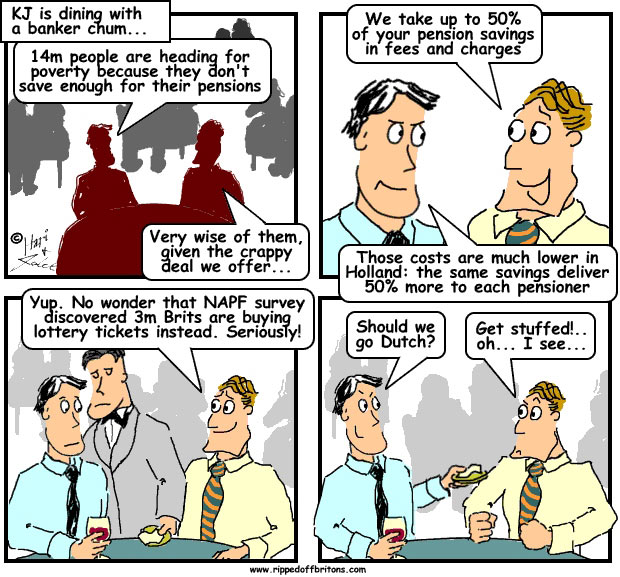
The realization that a Dutchman gets 40% more pension than an Englishman for the same investment made the news in December 2010, but has since been forgotten. Leaving the pension companies to continue ripping-off Britons with high charges and rubbish annuities, consigning many to poverty stricken old-age.
It is when the story is no longer ‘news’ that the real ripping happens. Under the cover of ‘business as usual’ - which, sadly, for many organisations is exactly what ripping-off is. Business as usual.
The FSA, OFGEM, and others have regretted the failure of those they regulate to learn from past mis-selling. Hector Sants, chief executive of the FSA, said in a speech in June 2011:
I would like to take the opportunity to make some personal remarks on the challenges the FCA faces.
''The biggest disappointment of my time at the FSA has been the failure of firms, in particular their senior management, to learn the lessons of past mis-selling. Sadly the recent history of the British retail financial services industry is proof of the adage that those who fail to understand the mistakes of the past are condemned to repeat them.''
Hector Sants, CEO of the FSA, 28th June 2011
If the rippers-off fail to learn, then the next best thing is for us ripped-off Britons to learn.
Looking back over the first half of this year, our articles and cartoons have shown where companies and government have sought to rip us off. We devote this post to reminding you.
To help, we have categorised the rip-offs:
Banking Scams: Excessive charges; Bonuses; Dodging jailtime; Puny regulation; Minimal fines; Fraud...
Government Scams: Pensions; Benefits; Tax avoidance; Inflation; Public Spending; MPs...
Pensions rip-offs: Charges draining pensions; Rubbish annuities; The trick of inflation..
Gas & Electricity Bills rip-offs: Excessive bills; The lack of linkage between wholesale and retail prices
Targeting the vulnerable: Tricking, misleading, and why in Britain it is legal.
The Liebrary: Well used lies exposed.
- Bankers escape punishment for their misdeeds: Neither admit nor deny wrongdoing - when nobody is responsible, anything is acceptable
- Evidence from company accounts that bonuses are paid for mediocre performance: Pay for performance – Lloyds, RBS, Annual General Meetings and UK Government cowardice
- Banks trick customers into handing over their dividends: Beware bankers bearing Structured Products – the Great Dividend Robbery
- Banks fight to the last to get away with PPI rip-off: Payment Protection Insurance: bankers appeal to protect their right to do wrong
- The scam of dropping interest rates: Cash ISAs: How banks can pinch 92% of your savings income, and the OFT says it's ok
- Confirmation that fines are a fraction of ill-gotten gains: Regulatory Fines – the most lucrative investment a bank (or any financial services company) can make
- The problem with the banks is not the level of bonuses, but the level of profits that pay for the bonuses: Take care of excessive banking profits, and the excessive bonuses will take care of themselves.
- How pay has spiraled, inspite of mediocre returns: Who pays for the "top talent"?
- Excessive bonuses: Cuckoos In The Nest Egg - As we approach Banking Bonus Season, consider how top bankers manage to pay themselves so magnificently, and get away with it.
- Evidence to the contrary: Liebrary: Massive bonuses incentivise fund managers to perform consistently well
- Evidence to the contrary: Liebrary: If bank regulation were anything other than 'light touch' then companies would move to other jurisdictions. This would have a catastrophic impact on taxes
- Evidence to the contrary: Liebrary: Financial Services corporation tax makes a major contribution to overall UK tax
Government Scams
- Public sector pensions: a politician will grasp at any straw so long as someone else is drowning
- Benefits Fraud: would the taxpayer save money by giving every citizen their due, not a penny more, not a penny less? Actually, it would cost £12.7 billion EXTRA!
- Inflation: How "the price of this financial crisis is being borne by people who absolutely did not cause it"
- Election reform: Forget ELECTION reform! It is EJECTION reform that really matters
- Corporation Tax: “A fat policeman chasing a speeding Ferrari” – Her Majesty’s Taxmen versus corporate tax departments
- Parliamentary Expenses: Westminster Gravy Train's return journey
- Public spending cuts: how the poor subsidise the rich
Pensions rip-offs
- The effect of inflation: Pensions – the monstrous truth about the inflation indexation change from RPI to CPI
- Annuity Scams: Pensions - having already swiped 50% of your savings in charges, how pension providers grab another 20% from you with your annuity
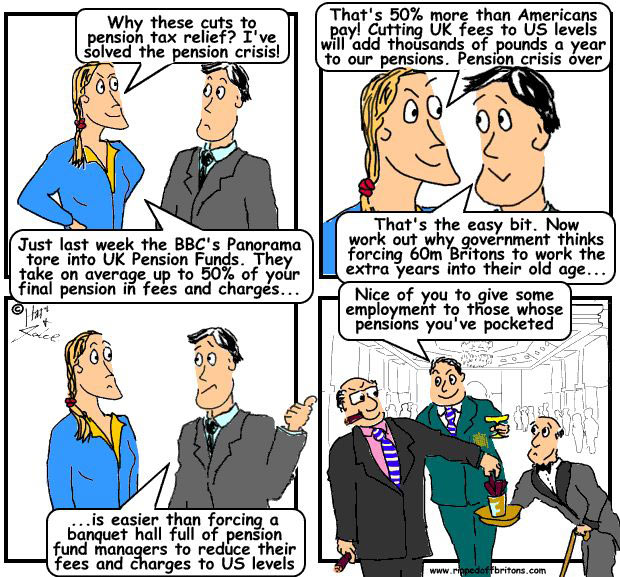
- Excessive charges: Pensions - how fund management charges swipe 50% of your pension
Gas and electricity bill rip-offs:
- Energy company bonuses and profits: Electricity and gas bill ripoffs - to see what is happening, look at the company accounts
- What's happening to wholesale energy prices?: British Gas' claim that wholesale energy price is pushing up bills is not true: the evidence
Targeting the vulnerable
- Spending by the poor: Why companies don't just target the rich - because the poor have most of the cashflow
- The Consumer Protection Act: The law that makes it quite legal to rip off 50% of Britons
- A good salesman: Why we should love Estate Agents
- Who really gets the money?: Fairtrade - the good reason, and the real reason
- Companies' excuses: From tobacco to banks to television - don't blame us, its all been a horrible misunderstanding.
- The law lets off the bad guys: Wishing you a better new year than the last one.
The Liebrary
- Evidence to the contrary:Liebrary: Massive pay packages compensate CEOs for the high price for failure
- Evidence to the contrary:Liebrary: Massive bonuses incentivise fund managers to perform consistently well
- Evidence to the contrary: Liebrary: If bank regulation were anything other than 'light touch' then companies would move to other jurisdictions. This would have a catastrophic impact on taxes
- Evidence to the contrary: Liebrary: Financial Services corporation tax makes a major contribution to overall UK tax
Monday, 1 August 2011
Monday, August 01, 2011
Posted by Jake
No comments
Labels: budget cuts, credit crunch, inequality, leisure
Follow Us
Search Us
Trending
Labels
advertising
Article
Austerity
Bank of England
banks
benefits
Big Society
BIJ
Bonus
British Bankers Assoc
budget cuts
Cameron
CBI
Clegg
Comment
credit crunch
defence
education
elections
energy
environment
executive
expense fraud
FCA
FFS
FSA
Gove
Graphs
Guest
HMRC
housing
immigration
inequality
Inflation
insurance
jobs
Labour
leisure
LibDems
Liebrary
Manufacturing
media
Miliband
MP
NHS
OFCOM
Offshore
OFGEM
OFT
Osborne
outsourcing
pay
pensions
pharma
police
politicians
Poll
Priority
property
protests
public sector
Puppets
Ready
regulation
retailers
Roundup
sales techniques
series
SFO
sports
supermarkets
taxation
Telecoms
the courts
the government
tobacco
Tories
transport
UK Uncut
unions
Vince
water
Powered by Blogger.