TOP STORIES
CARTOONS
GOOD DEBT
PENSION CRAZY
BANKSTER PAY
MPs' 2nd JOBS
TAX IS THEFT?!
FAILING SCHOOLS
AFFORDABLE NHS
1m WORK IN POVERTY
JAIL THE ACCOUNTANTS
RICKETS IS BACK
UN-NATIONALISED RAIL
LOW WAGE BRITAIN
BANK OF MUM & DAD
UK: A PRISONER OF CUTS
TAXING LIES
WATER CANNON BORIS
UNIVERSAL C.. OCKUP
FULL TIME JOBS? WHERE!

Friday, 18 May 2012

Friday, May 18, 2012 Posted by Jake No comments Labels: , , , , , ,
Why the London 2012 Olympic Games will be just a sideshow this summer

Thursday, 17 May 2012

Thursday, May 17, 2012 Posted by Jake No comments Labels: ,


Major UK-based firms cut secret tax deals with authorities in Luxembourg to avoid millions in corporation tax in Britain.
The BBC's Panorama focuses on GlaxoSmithKline and media company Northern & Shell (owners of Channel 5, the Express, OK! Magazine and others). The secret tax deals were devised by accountancy firm PriceWaterhouseCoopers. BBC

It's the same train at the same time, the difference is you've four tickets covering the journey rather than one and the total price drops from £264 to £40, says Moneysavingexpert.
According to Moneysavingexpert.com instead of buying a single ticket from departure to destination, you can save by buying tickets for parts of your journey. "To show how this works, we unearthed this cracking example. For a London to Penzance return, the cheapest ticket was an anytime return at £264. Yet the train stopped in Plymouth, so instead we found four singles. The total cost for those tickets was just £40, a saving of £224:
Split Ticketing

Phil Clarke, Tesco's chief executive, wrote to 5,000 middle managers warning them annual performance-based rewards would be cut by 80%. Workers are waiting to see if there will be a similar cut in boardroom pay. 
Clarke had his base salary pruned to £1.1m last year, but can still receive a maximum total pay package of £6.9m. DAILY MAIL

Government 'failing to get enough homes built,' leading to rising rental levels, growing homelessness, overcrowding, and a sustained property bubble. Number of completed homes in 2011 less than half what government admits is required annually to meet demand.
A building programme would also be a much-needed and powerful stimulus to economic growth GUARDIAN


Axa Sun Life sell their Over-50s Plan to cover funeral expenses, fronted by TV's Michael Parkinson: guaranteed fixed lump sum on death, no medical required, free Parker Pen! But millions will find it'll pay out less than you paid in. DAILY TELEGRAPH

Care home providers pocket millions as they continue to charge sick residents £700 a week when they are in hospital.  DAILY MAIL

New child benefit plan will be a disaster, says Institute of Chartered Accountants.
Ian Duncan Smith's attempts to simplify the benefits system will make it more complex, and unfair. DAILY TELEGRAPH

Ministers accuse business of not doing enough to revive the economy. Business accuse the government of the same thing, which is why they're holding back. Who will blink first?
Reports in April said large corporates were sitting on a cash pile of £750bn, afraid to spend it because of  all the uncertainty. DAILY TELEGRAPH

Tuesday, 15 May 2012

Tuesday, May 15, 2012 Posted by Jake No comments Labels: , , , , , ,
Fee tells KJ why she's hot-footing it to Greece

Saturday, 12 May 2012

Saturday, May 12, 2012 Posted by Jake 6 comments Labels: , , ,
Many companies duck and dive to avoid accusations that their charges are too high and their profits excessive. From plumbers to car repairmen to bankers, they all have a perfectly incomprehensible reason why they charge so much. Few do this more than the Big Six energy companies (British Gas, SSE, EDF, Scottish Power, Npower and EON). 

To expose the degree of profiteering that may be happening the energy companies would have to be transparent about both their operating costs and the profits they make on their wholesale energy sales. Something that has as much chance of happening as a snowball surviving in a working gas-fired boiler. The energy companies know keeping their businesses incomprehensible provides them with most excellent protective insulation from the chill wind of the free market. A mantle they weren't going to shed without a struggle.

In a rare show of courage OFGEM, in August 2011, decided to do something about all the obfuscation. OFGEM commissioned BDO, the accountancy firm, to conduct a forensic investigation and make recommendations on how to improve transparency. BDO duly made a set of eight proposals (see table on right).

Regrettably, by January 2011 OFGEM's courage was wavering. By May 2012 OFGEM had reverted to the same old obsequious poodle. This act of rank surrender by OFGEM was in spite of the Hills Report on fuel poverty, published by the Department of Energy and Climate Change in March 2012, which stated


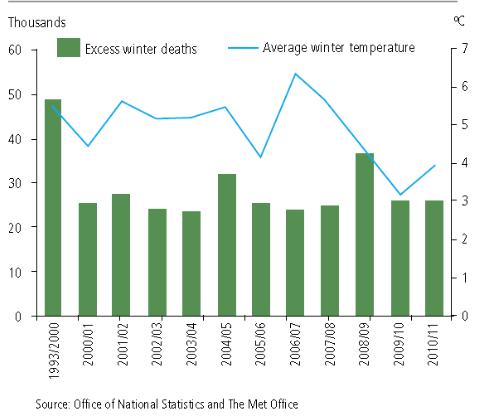
"From a health and well-being perspective: living at low temperatures as a result of fuel poverty is likely to be a significant contributor not just to the excess winter deaths that occur each year (a total of 27,000 each year over the last decade in England and Wales), but to a much larger number of incidents of ill-health and demands on the National Health Service and a wider range of problems of social isolation and poor outcomes for young people."

Final report of the Fuel Poverty Review, Professor John Hills


OFGEM dropped six out of the eight BDO recommendations, and 'varied' the remaining two.

Profits are hidden by the vertically integrated energy suppliers by splitting themselves into two businesses. The Wholesale Business generates electricity, and the Retail Business sells it to domestic and business customers. The Retail Business uses high Wholesale prices to justify high prices to its customers. When buying electricity from itself, a vertically integrated company has every reason to keep Wholesale prices high, so they can claim their Retail profit margin is low and sometimes can even pretend to sell at a loss (and earn a little sympathy). 

This is all equivalent to a baker, whose cost per loaf of bread is 50p, selling it to customers for £1, and claiming a margin of 2p. How is this done? The bakery splits itself into two businesses - the baking business at the ovens and the retail business at the counter. The baking business, run by Mr Baker, 'sells' the bread to the counter business, run by Mrs Baker, for 98p - giving Mr Baker a markup of 48p. Mrs Baker then takes £1 from the customer, claiming to have a markup of just 2p. Mr & Mrs Baker then go home with a tidy 100% markup between them - bonuses and cream buns all round!

This dodgy story is supported by OFGEM, which publishes the energy companies' "net margin" - by which they mean net retail margin - without disclosing what their wholesale margin is (because the companies won't say, and OFGEM is too shy to ask).

OFGEM's methodology document for producing this graph admits the wholesale margin is left invisible, stating: 

1.17. Gross margin is calculated as the difference between the average customer bill and the sum of wholesale costs and other supply costs.
1.18. The net margin is calculated as the difference between gross margin and operating costs. Operating costs include customer service staffing, IT, sales and marketing, billing and bad debt costs.

Consumer Focus' commented, after OFGEM's initial response to BDO in January 2012
"In our view, the failure to take forward BDO’s recommendations for the reporting of  trading activities will mean that the CSS continue to give a misleading picture of the value of generation assets....

There still appears considerable scope for companies to under-report profitability, principally due to the continued opaqueness of trading arms, which represent something of an information black hole....

There is a risk that CSSs could introduce misleading information into the public sphere, which will ultimately serve to erode, rather than rebuild, consumer confidence in energy companies."
[CSS=Consolidated Segmental Statements]

The energy companies are famed for tricking and misleading their customers, most of whom are unable to see through the smoke and mirrors of the various deals they are offered. Richard Lloyd, executive director of Which? responded after SSE Plc was fined for mis-selling:

As SSE Plc is fined of £1.25M after being found guilty of using doorstep sellers to trick people into switching energy supplier, Which? executive director, Richard Lloyd, says:

“It’s right that SSE has been punished for this bad practice, but this fine will not help all those customers who may have been signed up with their misleading script."

“SSE should waste no time in contacting all those customers who were affected, and compensate them for any financial loss they may have suffered.”

At the end of April 2012 SSE promised to offer all its generated electricity on the open market - available to any wholesale purchaser. The idea is to encourage competition from smaller retail-only companies selling to end consumers. Of course this is a further burst of obscurantist hot air. In the open market the goods go to the highest bidder. The Big Six vertically integrated energy companies have every reason to bid high to buy their own electricity because the high price goes into their own pockets and disguises their retail margins.

It is disappointing, though characteristic, that OFGEM seems unwilling to clear away all the smoke being puffed around by the Big Six to provide cover for continuing price hikes.

Thursday, 10 May 2012

Thursday, May 10, 2012 Posted by Jake No comments

Water bills rise above inflation, yet almost a quarter of all water supply is still lost in leaks. Are water firms actually using that extra money to fix the leaks, or make profits? The regulator Ofwat seems incapable of finding out. DAILY MAIL

Paying a living wage is affordable for big companies in UK banking, construction, computing and food production sectors, according to a new report by the think tanks Resolution Foundation and IPPR. The average increase in the wage bill for listed companies in these sectors would be about 1 per cent or less. The living wage is currently set at £8.30 an hour in London and £7.20 outside London. More than 6 million people earn less than the Living Wage - around one in four UK workers.  GUARDIAN

High cost "payday" lender Wonga launches business loans service. Loans of up to £10,000 will be available for up to a year but critics say costly borrowing for small firms is 'irresponsible.' GUARDIAN

Almost all fund management companies refuse to disclose which way they vote in shareholder ballots e.g. CEO pay, strategy. Yet that's our money they're investing (pensions, ISAs, etc)! DAILY MAIL


Summary of shareholder revolts against fat cat pay. Mentions Aviva, Trinity Mirror and Astrazeneca (where the CEOs subsequently resigned) and UBS, Barclays, Inmarsat, Man Group, Citigroup, the New York Stock Exchange, Goldman Sachs (where the CEOs didn't!) DAILY TELEGRAPH

People die from hunger while speculators make a killing on trading in food commodities. Traders include Goldman Sachs, JP Morgan Chase, Barclays and Deutsche Bank, but it's nearly impossible to figure out who is betting how much. 
 GUARDIAN 

Shaming rogue lawyers: List of Britain's worst solicitors to be published for the first time this July. The most common complaint is about cost (a quarter of all cases), while the most commonly complained area of law is family law (18 per cent), residential conveyancing (17 per cent), probate (14 per cent) and then personal injury and litigation (both 9 per cent). DAILY MAIL

One in five wills are faulty, and may lead to litigation and higher inheritance tax bills. Reasons include "sloppiness" and actual fraud (unregulated "will writing" services that charge a cheap fee to write your will, without knowing how to do it). DAILY TELEGRAPH

MPs to ask how taxpayer subsidies helped UK arms firms to sell to dictators. Beneficiaries included Mugabe, Mubarak, and Argentina's 1970s dictators. Another "world beating" UK sector that only succeeds through huge subsidies?
  GUARDIAN

Banks try to blame card fraud on you. Customers are increasingly being refused a refund after their plastic was stolen or accounts hacked. GUARDIAN


Wednesday, 9 May 2012

Wednesday, May 09, 2012 Posted by Jake 1 comment Labels: , ,
Chris, Fee and KJ on the departure of Aviva boss Andrew Moss

Friday, 4 May 2012

Friday, May 04, 2012 Posted by Jake No comments Labels: , , , , , ,
Fee, Chris and KJ ponder a solution to the economic slowdown

Thursday, 3 May 2012

Thursday, May 03, 2012 Posted by Jake 13 comments Labels: , , ,
To understand a rip-off of this scale, designed to be incomprehensible to customers, regulators and lawmakers, you need an insider's insight. Provided by our guest author Honestly Banking, the undercover banker.


At Honestly Banking we wanted to have a look inside the workings of Swaps, Hedging, Caps and Collars and throw some light into this obscure and complicated world. There has been a remarkable amount of media interest around the Swap mis-selling scandal. Inevitably it is hard to capture the real complexities of this involved area without over simplifying matters or getting highly technical.


A brief background: Banks have been selling Interest Rate Derivatives under the guise of ‘risk management’ for many years, firstly to big corporates, then to smaller companies and then when the greed got the better of them to anyone they could. You may think this sounds a lot like the sub-prime mortgages. Back then banks sold mortgages to unsuitable clients. Now they are selling swaps to unsuitable clients. Different product, same motivation – a quick profit.

With lower Interest Rates many people are discovering that they have been sold something that actually increases their risk. Additionally the banks have not been sticking to the rules and have been profiteering at the expense of small businesses and individuals. This is a completely different order of magnitude to PPI mis-selling. Homes, businesses, farms and livelihoods are being lost. Families are being ripped apart. Barclays have tried to gag their clients from even talking to the regulator, the FSA, about it.

Banks have developed this area into a highly profitable multi-million pound industry. It’s so profitable they have set up many regional sales centres to peddle their wares. They are staffed typically by smooth talking ‘risk advisors’ who bamboozle the unsuspecting client into something that will possibly be the worst decision of their lives.

Interest Rate Hedges (we will call them Hedges for brevity) fall into two main sorts. Those made of barriers and Swaps. They are all constructed out of Derivatives called Interest Rate Options. We will concentrate on the barrier type in this article as Swaps are really a series of barriers.

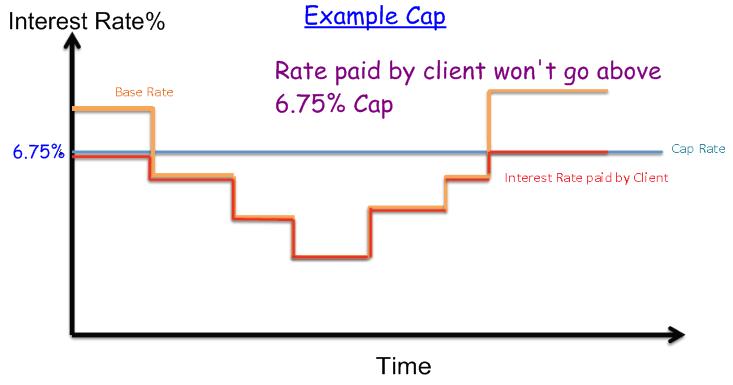
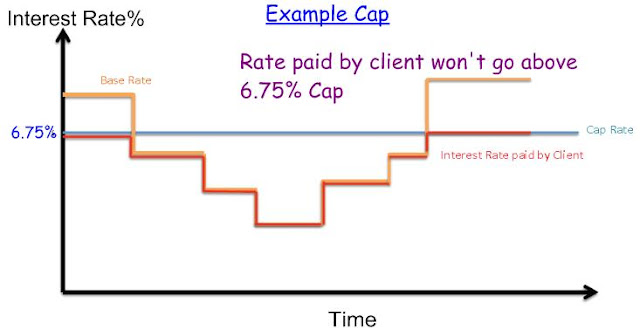
The simplest and most effective ‘Hedge’ is the Interest Rate Cap.  Here the client never pays more than the Cap level that they can choose to match their needs best. They get the full benefit from any falls in Interest Rates and there’s no break (penalty for ending the contract) cost as the premium is paid straight away up front. It’s a bit like  having a cap on your mortgage interest rate. Remember, no SME buys a hedge to make a profit – they just want to get protection from surprise interest rate hikes. It’s also the one banks sell the least of and are mostly likely not to mention to you. The simple reason is they make the smallest profit on them.

A development of the Cap is the Collar where the bank makes the client agree to a floor (below which the interest rate won’t fall whatever happens to the base rate), ostensibly to reduce the premium. In reality the value of the Floor far outweighs the cost of the Cap and the bank slyly pockets the difference. This also introduces new risks to the business of falling Interest Rates and means that the client is now speculating on Interest Rates - they are becoming Derivative Traders. If the interest rate falls beneath the floor then the client doesn’t benefit from the lower rate.


In reality they are often far more complex than this. A real life example: Mr Paul Adcock, of Adcock’s Electrical, who has been widely covered in the media, was sold a ‘Structured Collar’ by Barclays. In a Collar your Interest Rates float between two barriers. They have their risks, but the ‘structured’ bit is a nasty twist of the Investment Banker’s knife. In Mr Adcock’s case, this can mean as Interest Rates drop, the rate he pays actually goes up! More of a ‘Structured Noose’ really – the trouble starts when the floor drops!

In the example below, which is similar to Mr Adcocks’ toxic hedge, the floor is 4.7%. However much the Interest Rate falls beneath Floor Barrier, the client pays the bank the difference between the Interest Rate and the Floor, plus an equal amount above the Floor. This means as Interest Rates go down, the rate the Client pays actually increases. This isn’t risk management – it’s gambling. That’s what banks do, not SMEs.

As we can see in the example below, when Interest Rates drop to 2% the client is paying 2.7% below the floor and 2.7% above the floor giving the client an Interest Rate of 7.4%!

The effect on Mr Adcock is that he has had to lose 2 members of staff and this toxic structure has cost him over £175,000, in addition to the original £970,000 loan. Of course Barclays have made a fat profit out of Mr Adcock’s misfortune.

As can be seen in this example, a Structured Collar is a very poor Hedge against Interest Rate movements as there is only a narrow benefit within the collar; thereafter it increases the risk to the client. There are many other toxic Hedges being sold, often including the bank (only) having the option to cancel or extend the structure. These are Hedges, they are roulette.

The banks are not explaining all the risks and clients are pressurised into agreeing to these Hedges without fully understanding them. The banks know that they are required by legislation not to trade these products if the client doesn’t understand them – this is breached on a daily basis.

There is another hidden feature of Interest Rate Hedges that the banks have liked to keep quiet, and that is the cost of getting out of them. These are known as the exit or break costs. Banks like to use jargon to confuse their customers so they call this ‘mark to market’. Banks typically tell clients that there may be a cost or indeed a benefit when you exit your Hedge, but normally don’t give you any idea of how big this can be.

The break costs depends on market conditions and is a real cost to the bank as it goes and incurs this cost in the Interest Rate market. On a typical fixed rate loan this is a pre-agreed amount, often a percentage of the loan from 1-5%. On a Hedge it will fluctuate, but currently exit costs are varying from 25%-50% of the loan. This is because the Hedges are made up of Derivatives that derive their value from an underlying market. A small movement in this market can be magnified many times over, creating a huge liability. The way many of these trades are structured means that low interest rates have caused these high exit costs which the clients are stuck with if they want to exit. This is in addition to the loan repayment, the interest, and the fees. If you are confused by this, then you are in good company: not only the ripped-off SME businesses, but also many bankers. This is precisely why complex products like this are not permitted to be sold to unsophisticated customers. What this means is a business that borrows £1,000,000 may have to find another £500,000 to get out of the Hedge. As many clients are now saying, ‘if they told me that up-front I never would have agreed to it’.

Inside the bank’s Swap Sweat Shops there are legions of sales people, all getting bonuses, and they all have targets. It’s in their interests to sell the clients the most complex and costly Hedge possible. One rule is clear from the world of Hedging, that we would advise clients to keep in mind next time the sales man comes to call. The more complex the name of the Hedge, the more profitable it is for the bank and the worse it is for the client.

Despite the esoteric nature of the Hedging world, there’s been a notable up swell of activity by those affected. Probably the best known is Bully-Banks, which orchestrated a meeting of MPs on the issue. The FSA are slowly looking at the area and there have been some court cases settled already. The other concerning development is the plethora of claims management firms advertising in this area. This is a far more complex area than PPI and most of these claims companies do not have the relevant experience or required regulatory licences to advise on these Hedges. We may be selling another scandal developing in the claims management world.

Warren Buffet famously described Derivatives as being ‘weapons of financial mass destruction’ in 2003, some 5 years before the current financial crisis started. He also warned that Derivatives can push companies into a "spiral that can lead to a corporate meltdown". This is now happening across the nation of shopkeepers that is Britain. Why did the banks push people into unsuitable and dangerous contracts that will destroy their lives? It wasn’t banks providing prudent risk management, it was avarice.


[Authors Note: Interest Rate Hedges, Swaps, Caps, Collars and Derivatives are a very complex area. This article inevitability over-simplifies some of the issues. For more in-depth discussion, please visit www.HonestlyBanking.co.uk]


[Note from Jake: in June 2012 the FSA completed its investigation and instructed the banks to compensate their "unsophisticated" customers, stating the "sophisticated" customers are not covered. The FSA, in the judgement, defined "sophisticated" as being a customer who met "at least two of the following: (i) a turnover of more than £6.5 million; or (ii) a balance sheet total of more than £3.26 million; or (iii) more than 50 employees." This is the EU definition of a 'small business', letting the banks off compensating any medium sized businesses. So the battle is still on.]
Thursday, May 03, 2012 Posted by Jake No comments Labels: ,

Child benefit claimants paying higher tax rates than millionaires. DAILY TELEGRAPH

One in four in David Cameron's Business Advisory Group avoids tax. Includes BT chairman Sir Michael Rake, Sir James Dyson, Chairman of Google Eric Schmidt, CEO of WPP Sir Martin Sorrell. 
DAILY MAIL

"Slow-motion bank robbery" say MPs. Banks pay savers virtually no interest, whilst inflation stays high. By still charging much higher interest on loans, the banks have made £43bn since the crisis began.  DAILY TELEGRAPH

Wealth of UK's richest 1,000 has grown in the last year.
 DAILY MAIL

Rover workers get £3 redundancy pay compensation after seven-year battle. Owners and MD pocketed £42m after buying Rover. When Rover collapsed they set up a fund telling staff it will have 'millions' for them. 
GUARDIAN


A summary of shareholder revolts, including Barclays. Mentions Vince Cable's proposal that bosses' pay deals must need 75% in favour (currently shareholders only have an "advisory" vote). GUARDIAN

Future Quantitative Easing money (currently the Bank of England has printed £325bn) should be pumped into infrastructure, not just given to the banking sector. DAILY MAIL

Lloyds slams 'fraudulent' PPI compensation claims, after the state-backed lender revealed a quarter turned out to be false. The bank had to set aside £3.2bn to compensate customers it mis-sold PPI cover to. DAILY TELEGRAPH

The Electoral Commission said there was "no evidence" rules had been breached by Peter Cruddas. He quit his post as Tory co-Treasurer after being filmed by undercover reporters suggesting major donors could gain access to No 10 and have ideas fed into policy committees. BBC NEWS

Ofgem, the energy watchdog, paid staff more than £1m in bonuses in the past two years despite household bills rising sharply, and accusations of failure to regulate energy firms suspected of profiteering. DAILY TELEGRAPH

Sir Mervyn King, Governor of the Bank of England,  says  that without the massive taxpayer bailout almost all banks, not just Lloyds and RBS, would have failed. He accepts some of the blame, but blasts banks for bringing UK to brink of ruin. Recommends "ringfencing" banks "sooner rather than later." Warns of vested interests opposing reform and pay restraint. DAILY TELEGRAPH

Tuesday, 1 May 2012

Tuesday, May 01, 2012 Posted by Jake No comments Labels:
Fee, Chris and KJ discuss the Royal Mail's struggles with price and reliability

Share This

Follow Us

  • Subscribe via Email

Search Us