TOP STORIES
CARTOONS
GOOD DEBT
PENSION CRAZY
BANKSTER PAY
MPs' 2nd JOBS
TAX IS THEFT?!
FAILING SCHOOLS
AFFORDABLE NHS
1m WORK IN POVERTY
JAIL THE ACCOUNTANTS
RICKETS IS BACK
UN-NATIONALISED RAIL
LOW WAGE BRITAIN
BANK OF MUM & DAD
UK: A PRISONER OF CUTS
TAXING LIES
WATER CANNON BORIS
UNIVERSAL C.. OCKUP
FULL TIME JOBS? WHERE!

Monday, 9 July 2012

Monday, July 09, 2012 Posted by Jake 3 comments Labels: , ,
The wriggling and wiggling of UK political and regulatory authorities trying to avoid taking criminal action against individual bankers for LIBOR rate fixing was just more of the same. The latest excuses and obfuscations by those who should be protecting us but would rather protect the bankers included:
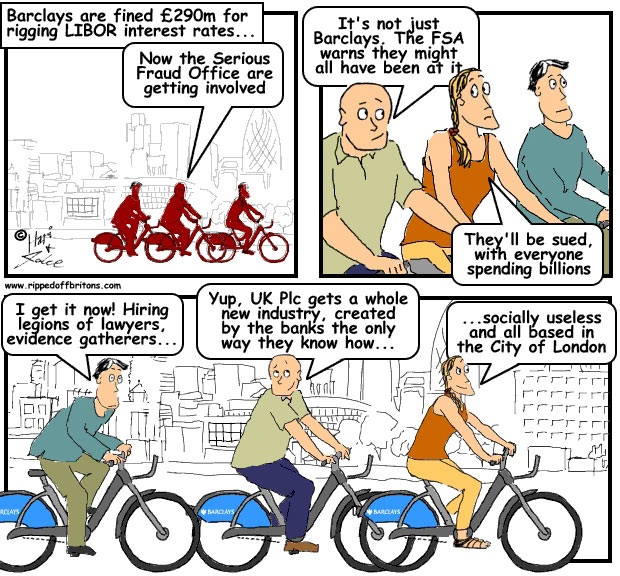
Ripped-off Britons: Cern and the city

  • The Serious Fraud Office (SFO) does have the power, but is too useless. [We shall see]
The FSA has an uniquely abysmal record on regulation and enforcement. FSA fines are a miniscule tiny fraction of bank profits, making them nothing more than a cost to the banks of doing business as usual – like paying their electricity bills. In any case the fines imposed by the FSA are used to subsidise the fees paid by the banksto the FSA – the fines are effectively recycled back to the perpetrators. 


Angst at being held in contempt even in comparison to the FSA eventually brought out the lion in the SFO. Having said on the 2nd July 2012 they were


they managed to come to their conclusion much quicker, in just four days, issuing a single sentence press release on 6thJuly 2012:


The humiliation of not pursuing this would have been too much for the SFO in circumstances where:
a)      Barclays had admitted its fault, paid its fine, ejected its CEO & COO, and has its Chairman’s resignation.
b)      The US Department of Justice had collected the evidence on Barclays and a slew of other leading banks
c)      The Fraud Act 2006 left little doubt that the law to prosecute was in the statute books and waiting to be thrown.

In fact, so precisely relevant is Chapter 35 Sections 1 to 6 of the Fraud Act that it could be the basis of a job description for a bank trader – see the addendum to this post for details.

The battle is not yet over. Politicians and regulators do not really want to have to travel to one of the bleak open prisons to visit their Best Forever Friends. They have a record of doing what is necessary behind the scenes to avoid this inconvenience. And the SFO’s tentative little roar may yet turn into the usual mewling and puking one expects when it comes to regulators versus the Financial Services Industry.

To understand whether this case deserves criminal prosecution, some insight is provided in Bob Diamond’s letter to Barclays staffjust before he decided to resign in July 2012:

“It is important to bear in mind that this behaviour stopped nearly three years ago. The documents released last week represent part of an industry-wide investigation and are the result of investigations which we carried out in cooperation with three different regulatory Authorities over three years.”

a)      Diamond himself was in charge of the “behaviour” three years ago, and many years prior to that.
b)      He states that the investigation with “three different regulatory Authorities” started three years ago, when the “behaviour” stopped.
c)      You may call senior bankers many things, but ‘stupid’ is not one of them. Even a stupid burglar would work out that if the cops are investigating him on suspicion of burglary it would be a good idea to cease the burglarising.

“on the majority of days, no requests were made at all. Even when made, the requests were not always accepted by the submitter"

a)      It is reasonable to assume that Diamond, with the greatest veracity he is able to muster, would want to minimise the number of days the scam took place. “Majority” means greater than 50%. With approximately 260 business days a year, presumably this “behaviour” was happening on 129 of them.

b)      If your spouse promised they were faithful on the 'majority of days', and even when they were out carousing their chat-up lines were "not always accepted", does that make it all ok?)

“the attempted adjustments were, on average, small - typically less than one basis point."

a)       “On average” means that roughly half (depending on which ‘average’ the slippery fellow meant – Mean/Median/Mode) were more than one basis point. Actually, if he meant Modal average – which maybe implied by Diamond’s use of the word “typically” - the truth could be far worse. For example, if Barclays submitted a half base point adjustment three times, then so long as no other adjustment was used three times or more than this half base point would be the 'modal average'. Even if every other adjustment was much more.

b)      “one basis point” is 0.01 of a percent. Doesn’t sound like much? Well, in the US Department of Justice’s Statement of Facts a Barclays trader states, for every quarter of a basis point he stood to lose US$154,687.

“for every 0.25 bps tomorrows [sic] fix is below 4.0525 we lose 154,687.50 usd [United States Dollars]...if tomorrows [sic] fix comes in at 4.0325 we lose 618,750 usd”

One basis point is worth hundreds of thousands of dollars to this one derivatives trader in one day. The evidence suggests there are many of these traders from many banks doing the same thing. These dollars are being fraudulently ripped from the counter-party, who holds the other side of the derivatives contract. The Department of Justice’s submission goes on to say:
  
“In the instances when the published rates were manipulated in Barclays’s favor due to Barclays’s manipulation of its submissions, that manipulation benefitted Barclays swaps traders, or minimized their losses, to the detriment of counterparties, …Certain Barclays swaps traders and rate submitters who engaged in efforts to manipulate LIBOR and EURIBOR submissions were well aware of the basic features of the derivatives products tied to these benchmark interest rates; accordingly, they understood that to the extent they increased their profits or decreased their losses in certain transactions from their efforts to manipulate rates, their counterparties would suffer corresponding adverse financial”

“Those United States counterparties included, among others, asset management corporations, retirement funds, mortgage and loan corporations, and insurance companies.”

The defrauded counter parties held our savings, our pensions, our loans. In short, we the public were the defrauded ripped-off counter parties.

Those of us, including me, who throw stones at the banks due to the corrupt practices of some of their staff should ask ourselves – if we were tempted with a bonus earned in one year big enough to retire on would we not dive into the dirt? Do we not manage to maintain our sanctimonious positions precisely because we are never tempted?

Of course this is a very good reason to continue throwing stones and maintaining our sanctimonious position. Not because nobody every bothers to tempt us, but because those temptations of millions paid in pay and bonuses to bankers are swiped from us in the form of rotten returns on our savings and investments, high charges on our banking services, higher taxes to fill the hole left by their expert tax dodging, scams like Interest Rate Swaps, and unadulterated fraud like LIBOR manipulation.


ADDENDUM:

Job Description: Bank Trader
Should have the substantial skills and character flaws to contravene the following sections of The Fraud Act 2006:

CHAPTER 35


Fraud

(1)A person is guilty of fraud if he is in breach of any of the sections listed in subsection (2) (which provide for different ways of committing the offence).
(2)The sections are—
(a)section 2 (fraud by false representation),
(b)section 3 (fraud by failing to disclose information), and
(c)section 4 (fraud by abuse of position).
(3)A person who is guilty of fraud is liable—
(a)on summary conviction, to imprisonment for a term not exceeding 12 months or to a fine not exceeding the statutory maximum (or to both);
(b)on conviction on indictment, to imprisonment for a term not exceeding 10 years or to a fine (or to both).
(4)Subsection (3)(a) applies in relation to Northern Ireland as if the reference to 12 months were a reference to 6 months.


Fraud by false representation

(1)A person is in breach of this section if he—
(a)dishonestly makes a false representation, and
(b)intends, by making the representation—
(i)to make a gain for himself or another, or
(ii)to cause loss to another or to expose another to a risk of loss.
(4)A representation may be express or implied.
(5)For the purposes of this section a representation may be regarded as made if it (or anything implying it) is submitted in any form to any system or device designed to receive, convey or respond to communications (with or without human intervention).


Fraud by failing to disclose information

A person is in breach of this section if he—
(a)dishonestly fails to disclose to another person information which he is under a legal duty to disclose, and
(b)intends, by failing to disclose the information—
(i)to make a gain for himself or another, or
(ii)to cause loss to another or to expose another to a risk of loss.


Fraud by abuse of position

(1)A person is in breach of this section if he—
(a)occupies a position in which he is expected to safeguard, or not to act against, the financial interests of another person,
(b)dishonestly abuses that position, and
(c)intends, by means of the abuse of that position—
(i)to make a gain for himself or another, or
(ii)to cause loss to another or to expose another to a risk of loss.
(2)A person may be regarded as having abused his position even though his conduct consisted of an omission rather than an act.

Sunday, 8 July 2012

Sunday, July 08, 2012 Posted by Jake 6 comments Labels: , , ,
The author of this guest post is a member of Bully-Banks, an alliance of small and medium businesses that were victims of the Interest Rate Swaps scandal that has ruined many UK businesses.
Imagine a situation of Little Red Riding Hood discovering she had been rescued by the woodman only to then be put into the custody of the Big Bad Wolf! That’s how the thousands of small businesses like me feel after the announcement by the Financial Services Authority (FSA) on the mis-selling of Interest Rate Swap Agreements (IRSA’s)


The FSA for the first time recognised that the banks had been ripping off small businesses and we, like everyone other than the banks, celebrated. Somehow an injustice was recognised and was going to be put right, so we thought. The FSA’s announcement stated:

"Our review has found serious failings in the sale of interest rate hedging products to small and medium sized businesses (SMEs). We have evidence which raises concerns about the sales we have reviewed in certain banks. These concerns include
(i)           inappropriate sales of more complex varieties of interest rate hedging products (such as structured collars) and
(ii)         a number of poor sales practices used in selling other interest rate hedging products.
(iii)       We also found that sales rewards and incentive schemes could have exacerbated the risk of poor sales practice."

It went on to say:

"In order to provide a swift solution for customers, we have reached agreement with Barclays Bank Plc (“Barclays”), HSBC Bank Plc (“HSBC”), Lloyds Banking Group (“Lloyds”) and The  Royal Bank of Scotland Plc and National Westminster Bank Plc (collectively “RBS”) banks to provide appropriate redress where mis-selling has occurred. We have agreed with Barclays, HSBC, Lloyds and RBS that they will: 
(i)           provide fair and reasonable redress to non-sophisticated customers who were sold structured collars;
(ii)         review sales of other interest rate hedging products (except caps or structured collars) for non-sophisticated customers; and
(iii)       (iii)  review the sale of caps if a complaint is made by a non-sophisticated customer during the review.

The exercise for each bank will be scrutinised by an independent reviewer and overseen by the FSA."

The banks however are not that stupid. We now face a reality that we won the war, but are in danger of losing the peace. Worrying words in the FSA judgement are:

a)      It only covers “non-sophisticated customers”. The FSA defines as financially "sophisticated" a customer who met at least two of the following:
(i)         a turnover of more than £6.5 million; or
(ii)        a balance sheet total of more than £3.26 million; or
(iii)       more than 50 employees.
b)      “independent reviewer” – The proposed use of major firms of accountants to act as ‘independent’ adjudicators is fundamentally flawed. Each of them has significant commercial relationships with the banks and have previously been used by the banks to close down or put into administration  businesses damaged by the mis-selling of IRSAs.

Do you know of any other situation where someone is robbed and then the system which is supposed to look after you appoints the criminals to resolve your dispute?

We have serious misgivings about the decision by the Financial Services Authority (FSA) to appoint the guilty parties - the banks - as judge and jury  by giving financial accountants and consultants who are very likely to have other business with them to decide whether a mis-sale of an IRSA has occurred. And the definition of “non-sophisticated” seems intended to let the banks off what are likely to be their larger mis-selling cases. A “sophisticated” company, as defined by the FSA, is likely to be in a bigger hole as it is likely to have entered into a bigger IRSA – but is just as unlikely to include a sophisticated finance specialist able to deal in swaps.  


I know of a Bully-banks member who after a 25 year career as an ambulance driver had a business based around a property portfolio - and this meant, according to one recent judgment that he should have the knowledge of a 'property specialist'. I also know of a few printers who exceed this turnover but their sophistication is in their trade, their ability to make a business out of their craft, not in having an expertise in what are called 'non-vanilla financial products.


The banks look like they will ultimately win, via the back door, because they are being put in charge of deciding whether there was mis-sale in each case. Small businesses like me are also concerned that:


·         There are no clear criteria, definition, or guidelines as to what constitutes a ‘mis-sale‘.
·         There is no urgent timescale to provide immediate help to businesses currently struggling as a result of the mis-selling. (The banks know how to drag out the compensation process - as they did with Payment Protection Insurance)

The FSA proposed resolution is not only bad news for small businesses like me, but will encourage litigation and will primarily benefit lawyers and claims firms. Yet, there is an alternative. A better way forward to ensure justice can be done.

There has evidently been a compromise agreement between the FSA and the banks - of which we were not party to. Sadly, in the same way the banks hoodwinked thousands of decent hard-working small businesses in mis-selling toxic products, they have used the same tricks at this stage.

One positive to come out of this saga has been the example of small people standing up for themselves. In our instance, we have created a campaign group Bully-Banks: a commercially and politically independent group of the little people realising that enough’s enough, and we are fighting back.
We have put forward a 14 point plan which we believe provides a just, fair and reasonable way forward to ensure justice is done and urgently resolve the estimated 28,000 cases of mis-selling, while avoiding the unsavoury aspects of the recent PPI mis-selling debacle.


We carried out a detailed survey of our members (there are now over 550 of us, and rising). We used the survey results and our experiences and collected these in a report called  ‘The Case Against the Banks – The Mis-selling of IRSA’s’ – you can get a free copy downloaded from www.bully-banks.co.uk/survey-results(Hard copies are also available by sending a large stamped addressed envelope to: Bully-Banks c/o Wakefield Media Centre, 19, King Street, Wakefield WF1 2SQ)

Our survey revealed a damning story of high street banks misleading and mis-selling ‘toxic products’ to small businesses across the UK which has led to them facing crippling costs with exorbitant break charges.

Our study also reveals how this mis-selling has made the downturn far worse for the wider economy and how it is actually a hidden brake on economic recovery. I think the average is about 5 jobs lost; multiply that by the 28,000 business affected – and that’s a staggering 140,000 plus jobs - and that’s probably a massive under-estimate.

So you’re probably wondering how is it that so many small businesses were taken for mugs?

Our story seems fairly typical – although we probably must have bought one of the smallest IRSAs in the country.

I run a Media Centre business. The idea was to create a hub for creative industries in a former mining area. It’s a good little business and we have won awards for our regeneration work.

Our bank had done a good job: we originally chose them as we trusted the local manager. 

Several years on, our local manager has since retired but the bank in up-dating its arrangements for us provides a new overdraft facility, some adjustments to the mortgage, oh, and by the way, we are concerned about rising interest rates and we think you need to be protected, so as a condition of keeping things going, you will need this Cap and Collar product.

No indication that there could actually be a negative cost. Yes, the small print mentions there would be a break cost, but no indication of how much.

Sure, we’re grown-up business people. We did ask about the size of the break cost and we got this very mumbled response; and looking back it was like stealing candy from a baby. We trusted them, and they abused that trust royally.

It now emerges the banks knew interest rates were going to go down, but approached its customers to sell them a product to guard against rising interest rates.

In fact these cap and collar products - it’s only now we discovered they were what are called IRSAs - are so complex and complicated they are designed for multi-million pound transactions.

We, like the other businesses affected, have been held captive by our banks. When we wanted to change banks - we were fed up with our bank for other reasons -  the big shock was discovered; for a business with an annual turnover of just £32,000 they wanted nearly £40,000 as a break cost.

Boy have we struggled to keep our Media Centre alive. We have hung in there and just kept going with it. Me and my business partner have had to use our life savings to keep the Media Centre business afloat.

We sometimes get people saying ‘well you took a gamble, and it’s only when you lost you are complaining’. My response is that there isn’t a single casino or betting shop on this planet that does not tell you that first you are making a bet, and secondly, the cost of your bet.

Talking with every other member of Bully Banks – these are small businesses ranging from chip shops to restaurants to property businesses – and we all seem to say the same: we weren’t looking to make a gamble or place a bet. We just wanted the financial products to run our businesses.

Our battle continues. It looks like the Big Bad Wolf might still get me and thousands of other small businesses (why do I get the image of Jack Nicholson in 'The Shining’ in my head?).

Our fight continues. Even if you’re not a small business affected by a mis-sale, our plight is causing a serious brake on your economic recovery.

And everyone has to fight injustice wherever it takes place.

And are you going to let the banks get away with it yet again?

For more details visit www.bully-banks.co.uk

Friday, 6 July 2012

Friday, July 06, 2012 Posted by Jake No comments Labels: , , , ,
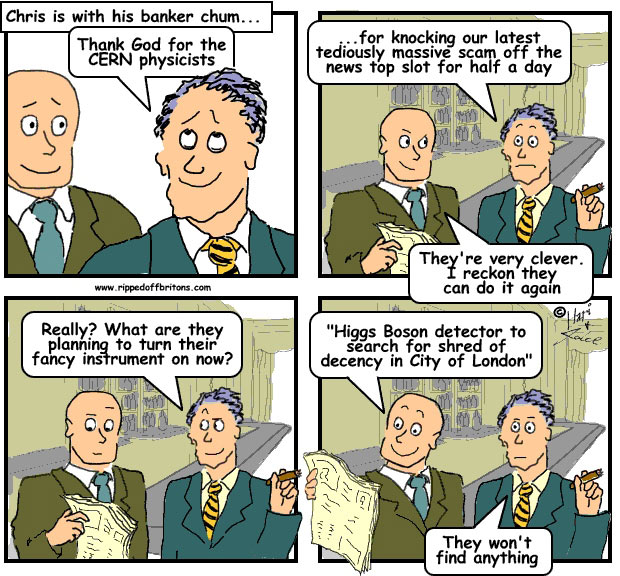
Chris and a banker chum discuss a new experiment for the Higgs Boson detector...

Thursday, 5 July 2012

Thursday, July 05, 2012 Posted by Jake 5 comments Labels: , , , , , , ,

Riposte: an occasional series that responds to the comments posted by those who don’t like what we’re saying.

Riposte arms readers with the facts and the references. Never again find yourself stumped because someone’s one or two facts trump your better instincts.

Inevitably, some of the questions overlap. We apologise for any repetition in the answers.

Here are the comments...
  • “Banks pay £55bn in taxes. We’ll lose that if the banks leave the UK!”
  • “Regulation will shrink the banking sector, losing jobs and tax revenue. What will replace it?”
  •  “A lot of other sectors depend on banking: legal services, consulting, and all those shops and restaurants in the city. They will suffer too.”
  • “The UK earns £40bn in foreign exchange from overseas. If banks leave, we’ll lose that. The costs of squeezing the banks outweigh the benefits.”
  • “Regulation won’t work. The banks will always find ways around it.”
  • “The banks were de-regulated in the 1980s, but there were big banking crises before then when regulation was stiffer. So regulation won’t stop banking crises.”
  • “Stiffer regulation means we lose our place as the global leader in banking.”

Here are the answers...

Q. Banks pay £55bn in taxes. We’ll lose that if the banks leave the UK!


We’ll only lose £3bn.

That £55bn figure for 2009-2010 includes corporation tax (£6bn), payroll taxes (£25bn), other business taxes like VAT and rates (£11bn), other taxes like stamp duty and interest rate tax (£13bn). In April 2011 the Independent Commission on Banking predicted just£3bn in taxes will be lost if banks relocate. Most UK banking activity makes its money from the UK domestic market, so only some banking activities can actually leave, which means most of the money the UK gets in taxes will remain here.

Q. Regulation will shrink the banking sector, losing jobs and tax revenue. What will replace it?


Money we previously spent on banking will not simply stay in British consumer pockets. It will be spent on other parts of the economy, creating new jobs and new tax revenues.

This is a vitally important point. If the financial sector shrinks, other parts of the economy will surely grow. This is because banking falls into the category of an essential service. Turn it round: if and when essential services like banking, utilities, water, telecoms and transport raise their prices then other parts of the economy immediately shrink. Why? Because the money we once spent on non-essentials like extra clothes, nights out, and the money spent by a business on its othe expenses, will have to be spent on these essential services – we’d have no choice. No one can avoid spending money on essential services, unlike non-essential good that we simply stop buying if their prices rise too high. Therefore, overpriced essential services place a lid on other sectors of the economy in a way over-priced non-essentials don’t. That is why essential service sectors are all regulated (although not always properly!) and, in some cases, their pricing is enforced.

How much money are we talking about? One consequence of proper regulation will be to increase competition between banks and reduce their fees. Currently, banks overcharge us due to poor competition, costing us billions.

Here are just three examples that directly hit the pockets of virtually every citizen:
  1. Savings and pensions: Retail banking makes £12bn by “trapping” people in poor low-interest savings accounts (this was happening well before the current credit crunch’s low interest rates).
    http://www.telegraph.co.uk/finance/personalfinance/8087165/Average-saver-losing-out-on-322-a-year.html
  2. Pension fees: Dutch and US pensions pay out 50% more for the same amount invested solely due to their lower fees. A very modest UK pension pot of £250k will pay us only £8k per annum. With lower fees all pensioners will have extra thousands per annum to spend. This will also go some way to solving all our pension problems.
    http://www.telegraph.co.uk/finance/personalfinance/pensions/7921505/American-savers-have-smaller-charges-on-personal-pensions.html
    http://www.telegraph.co.uk/finance/personalfinance/pensions/7921524/Charges-and-fees-cutting-50-per-cent-from-British-savers-pension-pots.html
  3. It costs the taxpayer £50bn a year to insure our poorly regulated banks against failure, according to the Bank of England.
These are just three well documented rip-offs that are perfectly legal. For illegal rip-offs where the banks got caught see “Regulation won’t work. The banks will always find ways around it” below. End these rip-offs and this money will be spent on other parts of the economy, generating new jobs and new tax revenue.
What is the size of our financial services industry? For 2010 the total contribution of banks to the UK is: jobs=3.6%; Gross Value Add=8.9% (peaking at 10% in 2009).

For comparison, manufacturing’s contribution is: jobs=8%; Gross Value Add=10%.
“The financial sector’s contribution to the UK economy” – House of Commons Library, SN06193

Note that the number of people employed in financial services has stuck at around 1m since 1991. It is not the job creator that they want us to think it is.

Q. A lot of other sectors depend on banking: legal services, consulting, and all those shops and restaurants in the city. They will suffer too.


The money we don’t spend on overpriced banking services will be spent elsewhere: it won’t just sit in our pockets. Leisure? Education? A new kitchen? These are all industries ready to take our money and add real value.

So other supporting sectors and unrelated sectors can continue and some will grow. Legal and consulting may shrink permanently.

Ripped-off Britons: Libor and BarclaysOverpriced rip-off banking services stopped us spending our money on, and creating jobs in, other parts of the economy. The banking crisis has now added a huge cost on top of that. Already, as a result of the credit crisis alone, the banks have cost us around £130bn in direct bank bailouts and £375bn (as of July 2012) in Quantitative Easing (i.e. printing money). Estimates of the total cost of “supporting” the banking sector (including borrowing guarantees and liquidity support, as well as depositor savings protection) range from £300bn to £850bn. This total figure includes guarantees to support the banks, so varies depending on their health at any one time. Stiffer regulation will mean not having to bear all that cost again.
Finally, the Bank of England estimates that taxpayers have always paid a £50bn “insurance policy” subsidy every year to insure the banks against collapse. It is difficult to see how they could ever generate a profit without this taxpayer subsidy.

Q. The UK earns £40bn in foreign exchange from overseas. If banking shrinks, we’ll lose that. No other UK sector is able to earn that amount of valuable foreign exchange.


It costs the taxpayer £50bn a year to insure the banks against failure,
accordingto the Bank of England. If we subsidised any other sector with that amount, we’d soon be a global leader in that, earning valuable foreign exchange.

Don’t forget that stiffer regulation will not wipe out the £40bn in foreign currency earnings via the city, just reduce it.

Q. Regulation won’t work. The banks will always find ways around it.


The “policing” side of regulation does work; not often, not always, and not fast enough, but that’s a reason to improve it.

Here are just a few examples:
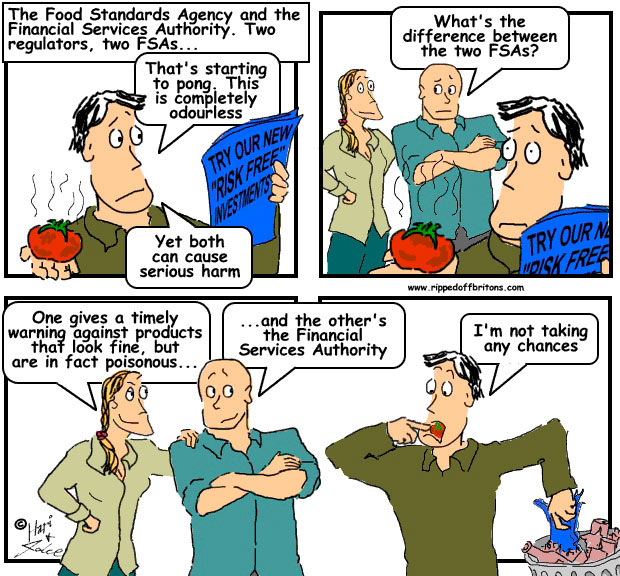
food and financial standardsNote that all these big rip-offs were unearthed after the banking crisis, as if the regulators and the government (both Labour and Coalition) didn’t have the guts to do anything when the funny money was rolling in. What’s missing is not decent plans for effective regulation but the will to use it in good times, not just in bad.

Q. The banks were de-regulated in the 1980s, but there were big banking crises before then when regulation was stiffer. So regulation won’t stop banking crises.


Those earlier crises were much smaller than this one.

Try naming one that is nearly as big as this one. The current crisis has needed a direct (i.e. not including all the other hundreds of billions required to insure banks against further calamity,  print money, stimulate the economy to soften the recession, etc.) bailout of $700bn in the US, £130bn in the UK, and Europe’s bailout fund currently stands at around €1 trillion and just keeps on growing. Note that these figures do not include the cost of shrinking economies, the UK printing £375bn to keep its economy afloat, etc. etc.

Note that the US Savings & Loans crisis of the late 1980s, costing them $150bn, came after that sector was deregulated. The Asian Crisis of 1997/8, which needed an IMF bailout of $40bn, was partly because newly modernising economies were using old banking regulations.

Anyway, nobody is suggesting proper regulation will stop all banking crises, only that it will reduce their impact drastically (just as nobody expects the police to catch all criminals, not doctors to cure all ills).

Q. Stiffer regulation means we lose our place as the global leader in banking.


We all want the UK to be global leaders in banking, but at the moment we are simply global leaders in the
poor regulation of banking.

We could also lead the world in, for example, energy services and pharmaceuticals by de-regulating those sectors (like we did the banks in the 1980s) so that they could sell energy that did not exist, or medicines that cured nothing. But that would not be a good idea.

Just because a business makes money it doesn’t mean that is always good for UK Plc. Every pound ripped off consumers and businesses is a pound not spent by them on useful and innovative parts of the economy. When it is done by an entire sector, and is an essential service like banking, it needs regulating.

Finally, consider the huge amounts spent by the taxpayer on insuring the banks against failure, estimated by the Bank of England at a minimum of £50bn a year. If we subsidised any other sector with that amount, we’d probably soon be a global leader in that.

Thursday, July 05, 2012 Posted by Jake No comments Labels:
GlaxoSmithKline to pay $3bn in US drug fraud scandal
"The sales force bribed physicians to prescribe GSK products using every imaginable form of high-priced entertainment, from Hawaiian vacations [and] paying doctors millions of dollars to go on speaking tours, to tickets to Madonna concerts," said US attorney Carmin Ortiz. BBC

Barclays claim Chief Operating Officer misunderstood CEO's interpretation of a conversation with Deputy Governor of Bank of England allegedly giving them permission to rig LIBOR rates.
COO then passed on those instructions to staff. PRESS ASSOCIATION

Libor scandal: How I manipulated the bank borrowing rate
An anonymous insider from one of Britain's biggest lenders – aside from Barclays – explains how he and his colleagues helped manipulate the UK's bank borrowing rate. Neither the insider nor the bank can be identified for legal reasons. TELEGRAPH


Bank of England's money printing blamed for pensions 'meltdown' as annuity payouts dive 27% in four years

Tom McPhail, head of pensions research at Hargreaves Lansdown stockbrokers, said the UK's pension annuity rates have been in ‘meltdown’ for the past four years. DAILY MAIL


Personal injury claims soar despite fall in accidents
A report from the Actuarial Profession reveals that despite an 11% fall in the number of road accidents in 2011, personal injury claims rose by 18%. BBC.

Police Cutbacks 'To Put Services At Risk'
Three police forces may not be able to provide an "effective service" in the face of austerity cuts a report has warned. SKY NEWS

Consumer borrowing jumps to £732m in May

Unsecured debts have almost doubled, according to the Bank of England, raising concerns that households are borrowing to fund everyday spending. GUARDIAN
London's homeless face being sent to Yorkshire
Councils say they cannot afford to house them in the capital. They could be sent to Hull, Yorkshire or run-down seaside towns on the south coast because cuts to housing benefit will leave them unable to afford London rents. EVENING STANDARD
RBS admits Ulster Bank fiasco will not be fixed for all until 'mid-July' as small business owner lifts lid on 'lost £50k' nightmare
Prime Minister blasted the bank in the House of Commons. DAILY MAIL

Cold caller firms ignore 'blocked numbers' database

Telemarketing firms continue to bombard consumers with cold calls, despite 17.5m phone numbers being registered with the government's telephone preference service. GUARDIAN

Tuesday, 3 July 2012

Tuesday, July 03, 2012 Posted by Jake No comments Labels: , , , , ,
Bob Diamond's Barclays and the other big banks were rigging LIBOR interest rates? Jail the CEOs!

Sunday, 1 July 2012

Sunday, July 01, 2012 Posted by Jake 4 comments Labels: , , ,
The banking scandals of June 2012 were shocking. In spite of a consistent record of financial services rip-offs (PPI; excessive overdraft charges; excessive investment charges; pension annuity rip-offs;…) two FSA judgements confirmed how low banks were prepared to go to turn a profit remain shocking.


Equally stunning, certainly to its customers and its customers own customers and business partners, was the crippling of the Royal Bank of Scotland’s banking business for over a weekcaused by the failure to invest in its IT.

However, hidden among all the shocks was a huge revelation which risks going unnoticed. A revelation far more important than the rip-offs themselves. 

It is a revelation that shines a light on why these people who run the banks have their consistent record of rip-offs in the first place. It starts to explain why intelligent people with families, many of them with children and pets that love them, are prepared to rip off and consign to financial distress and ruin their fellow humans. And it’s not just for the money!

As penance for these mishaps Bob Diamond (CEO of Barclays) and Stephen Hester (CEO of RBS) have said they would not take bonuses this year. They rejected calls for their resignations and proposed no further sanction for their failures. [update 3rd July 2012: Diamond has resigned, stating as his reason: "The external pressure placed on Barclays has reached a level that risks damaging the franchise – I cannot let that happen". External pressure, not pressure from the board, nor the pressure of his own conscience?]  And herein lies the great revelation.

In all the storm and stress of what in any other industry would be desk-clearing defenestrating events there is an eye-opening insight here into the thinking of bank bosses. With Diamond and Hester’s response to their, or should that be our, misfortunes we get an insight into what bank bosses see their basic jobs to be, and what earns them their bonuses. 

“Bonus” is a reward for excellence. For doing more than your job requires. Evidently Diamond believes that it was beyond his normal duties to prevent his bank indulging in activities described by the FSA as:

“Barclays’ misconduct was serious, widespread and extended over a number of years….[its] behaviour threatened the integrity of the rates with the risk of serious harm to other market participants.”

Barclays not lying, Diamond presumably believes, is him ‘going that extra mile’ deserving of a bonus. Lying is therefore presumably just basic business as usual, deserving of his basic pay and perquisites. 
Hester too stands firmly behind and alongside himself, confident that ensuring his bank provides basic banking services to customers is not part of his normal duties. Keeping the basic banking functions going, he presumably believes, is ‘that extra mile’ that wins him his bonus. A bank unable to process customer transactions is sufficient for him to earn his basic pay and perquisites. Actually letting your customers withdraw money is above and beyond the call of duty, and worthy of a bonus.

At first glance, one may have some sympathy for Diamond. The lying in question was done by a subsidiary, Barclays Investment Banking (formerly called Barclays Capital), and stopped in June 2010 when the FSA and the Department of Justice got interested. Diamond has only been CEO of Barclays since October 2010 – surely that gets him off the hook? Before 2010, when the lying was going on, he was….oh dear… CEO of Barclays Capital for 14 years.

So here is the great revelation, clearing up what has been a chronic misunderstanding of bankers by the rest of us. What most people think is basic banking - obeying the law and giving people access to their money - is actually the stuff of bonuses. The banking culture, encouraged by nodding regulators and winking governments, has never seen honesty nor working for the benefit of customers as anything more than ‘nice to haves’. If society was signalling its disapproval, would it have showered peerages and knighthoods and invitations to dine on them?

The British Bankers’ Association too, who manage LIBOR, have been waffling when asked what they will do about Barclays lying to them. They are constrained perhaps by the fact that the chairman of the BBA at the time was Marcus Agius, who also happened to be Chairman of Barclays.

So what is to be done? The bulldog courage of formerministers needs to be regarded through the lens of their poodle behaviour when in office. They all follow the principle “With no responsibility comes great power”. But they do sometimes have a point. Lord Myners, former City Minister, commented:

Taking away bankers' money in fines deprives them of a tiny bit of the one thing they have stashed most of and would miss least. In evidence taken by the US Senate in 2003, investigating dodgy tax evasion tactics, it was stated that a senior KPMG tax professional calculated just how excellent an investment paying fines is.


Jail time takes away their liberty, which they value as much as the rest of us. Ed Miliband, another former minister and current leader of the Labour Party, trying his best to stay in front of the running herd, has made his contribution with the disingenuous suggestion:


No systematic look? Where has he been? Turner Review? Walker Review? Independent Banking Commission? There have been many systematic looks. Each taking long enough to complete for the heat to dissipate, so the public doesn't notice when proposals are watered down. And each resulting in nothing that would be too distasteful to the banks. Nothing that would prevent the banks continuing with business as usual.

Another inquiry? If you want to improve something, you should not take the advice of those with a serial record over decades of failing to improve that thing. Whatever Basil Fawlty might say, adding more waldorfs is not the secret to a tasty Waldorf Salad. To improve the culture of the Financial Services Industry the FSA would join the Government in proposing a ‘city grandee’ as chairman of a public inquiry. One of the city grandees proposed led an inquiry into banks’ corporate governance, the “Walker Review of Corporate Governance of UK Banking” which predictably turned out to be a pedestrian affair. Remember this report published in 2009?  Probably not. Such things are made to be forgotten. They follow Sir Humphrey Appleby’s observation, “the purpose of a public inquiry is not to make things clear, but to put you in the clear”. Public inquiries led by the grandees of those being inquired into are intended to close down a subject, not open it up to scrutiny. 

To tell you a secret, while we at Ripped-Off Britons are not so keen on MPs as a species and will continue to take pot-shots at them, we love our Parliament. We admire some of its debates, many of its committees, and several of its members. MPs, like most bottom feeders (crude innuendo not intended, but is it our fault if you spotted it?), do sometimes serve a useful purpose digesting the trash. 

*Note: Barclays’ early admission was probably driven not by fear of the FSA but of the US Department of Justice who were also investigating the scam. In the US Department of Justice’s judgement condemning Barclays, it says


Evidently Barclays’ confession was driven by the notion that when a group is being chased by a bear it isn’t necessary to outrun the bear, so long as you can outrun the group.

Share This

Follow Us

  • Subscribe via Email

Search Us