TOP STORIES
CARTOONS
GOOD DEBT
PENSION CRAZY
BANKSTER PAY
MPs' 2nd JOBS
TAX IS THEFT?!
FAILING SCHOOLS
AFFORDABLE NHS
1m WORK IN POVERTY
JAIL THE ACCOUNTANTS
RICKETS IS BACK
UN-NATIONALISED RAIL
LOW WAGE BRITAIN
BANK OF MUM & DAD
UK: A PRISONER OF CUTS
TAXING LIES
WATER CANNON BORIS
UNIVERSAL C.. OCKUP
FULL TIME JOBS? WHERE!

Thursday, 21 February 2013

Thursday, February 21, 2013 Posted by Jake No comments Labels:
Tax avoiders should be named and shamed
The Commons public accounts committee said tax avoiders - those not breaking the law but abusing legal loopholes - should be "named and shamed" to discourage others. HMRC lost £5bn a year from legal tax dodging. Tax avoidance firms were "running rings" around HMRC. Labour leader Ed Miliband says companies in the UK should publish the amount of tax they pay in the country. BBC NEWS
(“Ummm... How about naming and shaming tax avoidance firms? You can start with ours,” said the director of marketing at every tax avoidance firm, eager for some delicious free advertising...)

Energy watchdog OFGEM warns of higher energy bills as the UK becomes more reliant on energy imports
Older power stations are closing before renewable energy has grown to replace them. Longer-term solutions to the UK's energy needs, such as new nuclear power stations or domestic shale gas reserves, have yet to be given the final go-ahead by the government. "We cannot afford to be complacent," said the Department of Energy and Climate Change. BBC NEWS
(“Oh yes we can,” said the UK’s cartel of over-charging energy firms that sneakily pass their profits to their parent companies.)

Treasury urges tougher action on banks that mis-sold “rate-swap” loans to small businesses
Banks have set aside money to compensate small businesses that were mis-sold complex interest-rate hedging products. But because the compensation procedures have not been finalised, thousands of small businesses are still having to make the crippling monthly payments. The Treasury says they should have their payments suspended. Together, the largest banks have put aside just over £1.1bn for compensation. But some experts believe this figure is too low, and the bill could eventually exceed the more than £12bn compensation costs for the mis-selling of Payment Protection Insurance to consumers. TELEGRAPH
(“Small businesses, consumers, energy firms, other banks, whole nations… is there anyone these banks haven’t yet screwed?” said one nervous inhabitant of the planet Venus…)

Are six water firms - Northumbrian, Yorkshire, Anglian, Thames, South Staffordshire and Sutton and East Surrey Water - dodging tax?
Corporate Watch says the water firms are artificially passing their profits to their owners. They are reducing their profits by taking high interest loans from their owners through the Channel Islands stock exchange. The interest payments reduce their taxable profits in the UK and, thanks to a regulatory loophole, go to the owners tax-free. Water bills are rising by 3.5pc to an average of £388-a-year per household. CORPORATE WATCH
(Water flowing upstream defies all laws of physics. Profits flowing upstream defies no laws at all, thank you very much UK government…)

Poorest 40% suffering disproportionately from the financial squeeze
Those with incomes of £15k-£23k are reporting worse financial straits than at any time in the last four years. Those below £15k recorded the sharpest deterioration. Households in higher income brackets saw the deterioration in their finances slow down. People working in retail, construction, education, health and social services are the most downbeat about their finances, while those working in IT and finance were the least pessimistic. DAILY MAIL
(“We, however, are fully employed and busier than ever,” said every spin doctor we spoke to...) 

£17m bonus bonanza for top Barclays bosses despite string of scandals
Five top bosses at Barclays will share a jackpot worth up to £17m despite being tainted by a string of scandals. Those in line for the ‘wildly misjudged’ bonanza include chief executive Antony Jenkins and Rich Ricci, the controversial investment bank boss. They could pocket up to £2.2m and £6m respectively from deferred shares bonuses awarded in 2010. DAILY MAIL

Tuesday, 19 February 2013

Tuesday, February 19, 2013 Posted by Jake No comments Labels: , , ,
Is the UK prime minister David Cameron listening?..


SOURCE REUTERS: Germany's Merkel calls for G8 fight against tax havens
The OECD said multinational companies were increasingly dodging taxes by reporting profits in countries other than where their main revenues were generated. “We're going to fight to finally put an end to tax havens at this year’s G8 meeting hosted by Great Britain," says German Chancellor Angela Merkel.


OUR RELATED STORIES:

Sunday, 17 February 2013

Sunday, February 17, 2013 Posted by Jake 2 comments Labels: , ,
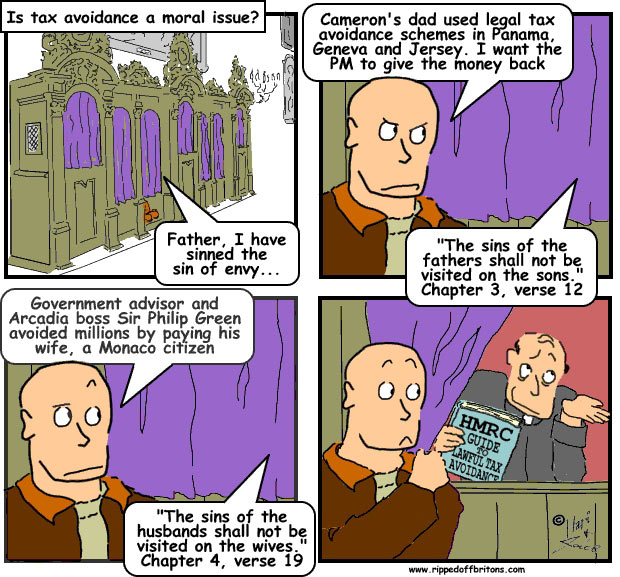
Tax avoidanceThe spectacle of David Cameron and George Osborne calling for an international crackdown on tax avoidance brings to mind an old school teacher of mine. A few decades ago my former French teacher, who had earlier served in the British Army during WWII, enlivened the class with tales of the crafty methods used by the Germans. One was a method to test whether a prisoner was a true Frenchman or a British spy wearing a beret. The German would stamp on the suspect's foot to see whether he said "Ow!" (British) or "Ai!" (French). 

The cry of pain is an instinctive reaction and difficult to feign, with the "Ow!" heralding a quick march for the presumed spy to a firing squad.


When David Cameron had his foot stamped on during Prime Minister's Questions of February 13th 2013, we got an insight into his instinctive reaction:

Q12. [142834] Stephen Pound (Ealing North) (Lab): Further to the Prime Minister’s rather acerbic exchange with the Leader of the Opposition earlier, will he tell the House whether he will personally benefit from the millionaires’ tax cut to be introduced this April?
The Prime Minister: I will pay all the taxes that are due in the proper way. 

There is a spooky similarity between Cameron's statement and that of Mr.Troy Alstead of Starbucks, when Alstead was being grilled by a parliamentary select committee on Starbucks' tax dodging shenanigans


"we strive to follow the letter of the law and have done so in the case of our tax obligations. All taxes owed to the UK have been timely and fully paid"

And also with that from Mr. Matt Brittin of Google, also on the tax dodgers' naughty step in the same select committee:

"We pay all the tax you require us to pay in the UK."

Messrs Alstead (Starbucks), Brittin (Google) and also Cecil (Amazon) were being grilled by the UK Parliament's Public Accounts Committee (PAC) looking into the near absence of corporation tax paid by their companies
http://www.parliamentlive.tv/main/Player.aspx?meetingId=11764


“Because some people say to me, ‘Well, it’s all within the law; you’re obeying the law, it’s okay'. Well, actually there are lots of things that are within the law [that] we don’t do because actually we have some moral scruples about them and I think we need this debate about tax too."

That statement was made not by a frustrated member of the Public Accounts Committee. It was made by  David Cameron. The same Cameron who answered, in Prime Minister's Questions, "I will pay all the taxes that are due in the proper way".

What a frustrated member of the Public Accounts Committee did say about Mr.Cecil of Amazon, one of the witnesses:


All rather like Cameron's evasive response to the perfectly legitimate question of "whether he will personally benefit from the millionaires’ tax cut to be introduced this April".


Google, one of the companies being grilled by the Public Accounts Committee, claimed in its evidence that

 "The 17,000 engineers in California who build and continue to invest in developing the technology create the economic value for Google."


Presumably the sweat of those 17,000 Californians mean the US Treasury would get a bonanza in taxes from Google? However, according to a report by Bloomberg

"Google Inc. cut its taxes [payable in the USA] by $3.1 billion in the last three years using a technique that moves most of its foreign profits through Ireland and the Netherlands to Bermuda. Google’s income shifting helped reduce its overseas tax rate to 2.4 percent, the lowest of the top five U.S. technology companies by market capitalization."

This whole "through Ireland and the Netherlands to Bermuda" escapade is known in tax and boardroom circles as the "Double Irish Dutch Sandwich". Best explained by a tax specialist:


Could it have escaped Cameron's notice that Bermuda is a British Overseas Territory operating under the jurisdiction of the UK? And the fact that providing tax dodging services is one of the UK's most successful industries.

http://www.economist.com/news/special-report/21571549-offshore-financial-centres-have-taken-battering-recently-they-have-shown-remarkable
Cameron may condemn tax avoidance to please the crowds. But when his foot gets stamped on by his tax-dodging friends his baser instincts will come to the fore.

Friday, 15 February 2013

Friday, February 15, 2013 Posted by Jake 2 comments Labels: , , , ,
Chris shows his wife how much he cares...


SOURCE DAILY MAIL Real earnings are back to 2003 levels and millions may ‘never see their finances recover from the economic downturn'
Real earnings peaked in 2009 (average wage £12.25/hour), but since then pay increases have been outstripped by inflation, knocking the average back down to where it was in 2003 (£11.21/hour), the Office for National Statistics said.

BBC NEWS Pope Benedict resigns

OUR RELATED STORIES

Thursday, 14 February 2013

Thursday, February 14, 2013 Posted by Jake No comments Labels:
Horse meat scandal: cuts have weakened food standards enforcement system
Public analyst for West Yorkshire Joint Services, Dr Duncan Campbell says the fragmentation of the Food Standards Agency (FSA) responsibilities and cuts in local authority budgets have led to weakening of the food standards enforcement system. The latest news revealed that Findus beef lasagne is 100% horsemeat. TELEGRAPH
(...and the government's justification for cuts to food monitoring is 100% horse sh*t...)

Barclays closes down “industrial scale” tax dodging service
The new boss of Barclays has attempted to break from the bank's scandal-ridden recent past by announcing plans to pull out of controversial businesses that speculate on food prices, specialise in "industrial scale" tax avoidance schemes and use the bank's money to bet on markets. GUARDIAN
(“An end to betting up the price of your food will be particularly painful as we’ve just put a big bet on that horsemeat,” said our thoroughly reformed Barclays insider.)

Real earnings are back to 2003 levels and millions may ‘never see their finances recover from the economic downturn'
Real earnings peaked in 2009 (average wage £12.25/hour), but since then pay increases have been outstripped by inflation, knocking the average back down to where it was in 2003 (£11.21/hour), the Office for National Statistics said. The economy is stagnant, but CBI boss John Cridland tried to be upbeat, saying: 'We are beginning to see the return of organic growth.” DAILY MAIL
(I think that’s just mould, John...)

Judges rule that most “back-to-work” schemes are unlawful
Cait Reilly, 24, has won her Court of Appeal claim that requiring her to work at Poundland for free to keep her unemployment benefits was unlawful. If you are 18-24, nine months after you start to claim jobless benefits you must attend the Work Programme. If you are above 25 years old, it is 12 months. Ministers expect half a million jobseekers to join the Work Programme each year. But the judgment meant nobody could be forced to participate under threat of losing benefits. Critics described the policy as a return to slavery. TELEGRAPH
(“Can I stop turning now?” said William Wilberforce, speaking from his grave.)

Germany's Merkel calls for G8 fight against tax havens 
The OECD said multinational companies were increasingly dodging taxes by reporting profits in countries other than where their main revenues were generated. “We're going to fight to finally put an end to tax havens at this year’s G8 meeting hosted by Great Britain," she said. REUTERS
(Sorry, that translation should read: “We're going to fight to finally put an end to tax havens hosted by Great Britain at this year’s G8 meeting, hosted by Great Britain.”)

RBS CEO underpaid, says chairman
RBS CEO Stephen Hester gets £1.1m salary and up to £6m a year from bonuses. The RBS chairman defended the sums, saying Hester was paid "well below the market rate of people working in banking" because some of his bonuses had been withheld. MPs grilled the executives after RBS was fined £390m last week for rigging Libor, the interbank lending rate. Some MPs doubted the promise that the fine would be recovered from bonuses. GUARDIAN

Secret watchdog probe finds banks are STILL not giving fair advice - and Santander faces possible fine over failings
Investigators masquerading as ordinary customers were sent to uncover what advice they would be given by staff at major banks and building societies. The FSA said in some instances advisers gathered all the right information but still recommended an unsuitable product. One adviser told the customer "you don’t pay me a penny [and] you don’t pay the bank a penny for this advice," but this was a lie. Santander replied that they were committed to looking after their customers’ well-being. DAILY MAIL

Women 'will get rotten pensions for years to come', says minister
Steve Webb, the Liberal Democrat pensions minister, says Government reforms to even out payments for men and women will take a long time to work through the system. "The state pension system was based around the idea of the 1940s that men needed pensions and women needed husbands," he said. "Even incredibly, one or two generations on, there are still traces of that coming through the pensions system so women who've brought up kids or whatever don't get as good a pension.” TELEGRAPH

A&E waits 'highest for a decade'
The number of people in England facing long A&E waits has risen by a fifth in a year - and is now at its highest level for a decade. The King's Fund, a leading healthcare think tank, found from October to December 2012 more than 232,000 patients waited more than four hours. BBC NEWS

Tuesday, 12 February 2013

Tuesday, February 12, 2013 Posted by Jake 1 comment Labels: , , ,
It takes a prime minister to turn this one around...


SOURCE: TELEGRAPH Horse meat scandal: cuts have weakened food standards enforcement system


OUR RELATED STORIES

Sunday, 10 February 2013

Are right-leaning policies the price a nation must pay for maximising growth? The nanny state may be all nice and cuddly, but surely it’s not so good at growing wealth. Even the New Labour government behaved as though this was a given. 

But the answer is no. Over the long term, left-leaning nations have performed as well as right-leaning ones, if you are simply measuring economic growth.


Left/right policies are not about how to grow the cake, but how it is divided. The exception is the US, where growth as measured by GDP does pull ahead of other large developed nations. But it’s not the whole story (see final paragraph).


...But first, let’s look at how the UK cake has been divided

Before we go over those growth stats, let’s take a quick look at growing inequality in the UK.

The “Gini coefficient” is an internationally used measure of inequality, where zero corresponds with perfect equality (where everyone has the same income) and 1 corresponds with perfect inequality (where one person has all the income, and everyone else has zero income).

Source: Institute of Fiscal Studies http://www.ifs.org.uk/publications/4637

Gini doesn’t break down the details of precisely who is getting what. So what this graph doesn’t reveal is that since the mid-1990s (the flatter part of the graph) the very richest - the top 1% - have seen their incomes (before taxes and benefits have been taken into account) double, whilst the income of the bottom 90% has remained virtually unchanged. Yes, that all happened under New Labour.

Source organisation: Paris School of Economics http://topincomes.g-mond.parisschoolofeconomics.eu/#Database:

Finally, let’s look at the last few years under the Tory/LibDems. Surely the worst recession since the 1930s has put a brake on the runaway pay of our captains of industry. Dream on. The Manifest/MM&K Executive Director Total Remuneration Survey for 2012 showed bosses of FTSE 100 companies enjoyed an average 12% rise in their take home pay last year, while their employees barely received any pay increases at all. Even when growth is zero the richest are getting more cake.

The big question: do right-leaning policies outperform left-leaning ones?

Different nations comparable to the UK, both left and right, have grown at roughly the same rate over the last 50 years. I’ve included little Sweden because it is taken as a role model for a strong welfare state.

GDP per capita, constant 2000 US$ (Source organisation: World Bank). Data downloaded from Gapminder

The US – a model for right-leaning policies – is pulling away from the rest when measuring GDP/capita in constant US$ (although it is followed by nanny state Sweden). But when you measure it in Purchasing Power Parity (PPP: where the cost of living is factored in, i.e. it adjusts for the fact that $1,000 buys less in one country than it does in another), then all the Europeans – both left and right – are doing the same. The US is gently pulling ahead – we’ll look at that at the end.

Gross Domestic Product per capita by Purchasing Power Parities (in international dollars, fixed 2005 prices). The inflation and differences in the cost of living between countries has been taken into account. Source organisation: World Bank. Data downloaded from Gapminder

Is left-leaning growth boosted by debt: borrowing from the future to keep up with the rest?

Here’s a graph for those of you who think those centre and leftist governments have been pumping up their GDP figures by borrowing from future generations. Left-leaning nations may take on more government debt than right-leaning ones, but to get the true measure of a nation’s debt you have to include all private debt, not just government debt. Do that, and the US, France, Germany and Italy are all clumped together.

Total domestic private and public sector debt as % of GDP. Source: page 18 of “Debt and Deleveraging”, McKinsey Global Institute report 

Private debt includes debt owed by households, businesses and banks, and it makes up the majority of total national debt for these nations.

And who has been the most naughty in over-borrowing to fuel growth? It’s fat cat Britain, under both left and right governments, where most of it has been private debt: as of today, UK private debt is four times government debt. In other words, of total UK debt, the breakdown is: government debt=19%; household=19%; non-financial corporations=22%; financial corporations=40%.

Too many politicians and commentators quote only government debt, without mentioning the much greater private debt that all countries have. But both matter: if your banks, partner businesses and millions of your customers are in deep debt then you will have to deal with it just as you’ll have to deal with government debt.

You’ll have noticed that all countries have been borrowing more and more over the last few decades. Funny, eh? During the late 20thcentury face-off between state control and liberal capitalism, the winner by a knockout was liberal capitalism. What happened next? Alone and unchallenged in the middle of the ring, liberal capitalism somehow managed to knock itself out.

The right cannot pour scorn on the left for taking on perilous amounts of government debt when its own solution is to do the same with private debt.

If debt has been used to fuel growth, it’s been used by both right and left.

The American dream

How come the US is richer, and getting slowly richer still? Do they prove that unbridled capitalism  - the sort no European dare try – really works?

As everyone knows, the Americans typically get only two weeks holiday a year. That alone can account for between 10% (the UK) and 20% (Germany) of the difference. Note how a graph of the working hours per week across our sample countries shows how since the 1980s France, Germany and the UK are spending less time in the workplace than the US. So one reason the US is pulling away is because they are working longer hours – hardly a miracle of the free market!

Working hours per week. Total amount of yearly working hours divided by 52 weeks. Source organization: International Labour Organization. Via Gapminder

If we want to get closer to American GDP/capita or PPP/capita, one way is for our great leaders to apply their brilliant minds to the problem and... force everyone to stay at work for longer.

Where the US scores is in its ability to create jobs: usually, there are fewer unemployed Americans. Unlike Europe, the US likes to let private companies do business wherever they can find it. This comes at the cost of fewer safety nets. Maybe that’s a worthwhile trade-off. Maybe not. But it's always worth noting that, on healthcare, the US spends $8,362/head compared to the UK’s $3,480/head for similar aggregate results. In this case the wrong kind of privatisation delivers more jobs and more money, but at a higher cost and without delivering better healthcare. Does this apply to all the extra business and money the Americans have? Perhaps the greatest President America never had, Bobby Kennedy, can tell us:

“Our gross national product...if we should judge the United States of America by that - counts air pollution and cigarette advertising, and ambulances to clear our highways of carnage. It counts special locks for our doors and the jails for those who break them. It counts the destruction of our redwoods and the loss of our natural wonder in chaotic sprawl. It counts napalm and the cost of a nuclear warhead, and armored cars for police who fight riots in our streets. It counts Whitman's rifle and Speck's knife, and the television programs which glorify violence in order to sell toys to our children.

Yet the gross national product does not allow for the health of our children, the quality of their education, or the joy of their play. It does not include the beauty of our poetry or the strength of our marriages; the intelligence of our public debate or the integrity of our public officials. It measures neither our wit nor our courage; neither our wisdom nor our learning; neither our compassion nor our devotion to our country; it measures everything, in short, except that which makes life worthwhile. And it tells us everything about America except why we are proud that we are Americans.”
― Robert F. Kennedy, US senator. March 18th 1967

So next time you hear a new policy that shifts the burden of cost from one group to another, claiming it’ll improve the prospects of the UK as a whole, then beware. Over the long term, left- and right-leaning nations perform much the same. The difference is in the distribution of those costs and the distribution of the wealth it creates. In other words, it’s about how the cake is divided. 
Are right-leaning policies the price a nation must pay for maximising growth? The nanny state may be all nice and cuddly, but surely it’s not so good at growing wealth. Even the New Labour government behaved as though this was a given. 

But the answer is no. Over the long term, left-leaning nations have performed as well as right-leaning ones, if you are simply measuring economic growth.


Left/right policies are not about how to grow the cake, but how it is divided. The exception is the US, where growth as measured by GDP does pull ahead of other large developed nations. But it’s not the whole story (see final paragraph).


...But first, let’s look at how the UK cake has been divided

Before we go over those growth stats, let’s take a quick look at growing inequality in the UK.

The “Gini coefficient” is an internationally used measure of inequality, where zero corresponds with perfect equality (where everyone has the same income) and 1 corresponds with perfect inequality (where one person has all the income, and everyone else has zero income).

Source: Institute of Fiscal Studies http://www.ifs.org.uk/publications/4637

Gini doesn’t break down the details of precisely who is getting what. So what this graph doesn’t reveal is that since the mid-1990s (the flatter part of the graph) the very richest - the top 1% - have seen their incomes (before taxes and benefits have been taken into account) double, whilst the income of the bottom 90% has remained virtually unchanged. Yes, that all happened under New Labour.

Source organisation: Paris School of Economics http://g-mond.parisschoolofeconomics.eu/topincomes/

Finally, let’s look at the last few years under the Tory/LibDems. Surely the worst recession since the 1930s has put a brake on the runaway pay of our captains of industry. Dream on. The Manifest/MM&K Executive Director Total Remuneration Survey for 2012 showed bosses of FTSE 100 companies enjoyed an average 12% rise in their take home pay last year, while their employees barely received any pay increases at all. Even when growth is zero the richest are getting more cake.

The big question: do right-leaning policies outperform left-leaning ones?

Different nations comparable to the UK, both left and right, have grown at roughly the same rate over the last 50 years. I’ve included little Sweden because it is taken as a role model for a strong welfare state.

GDP per capita, constant 2000 US$ (Source organisation: World Bank). Data downloaded from Gapminder

The US – a model for right-leaning policies – is pulling away from the rest when measuring GDP/capita in constant US$ (although it is followed by nanny state Sweden). But when you measure it in Purchasing Power Parity (PPP: where the cost of living is factored in, i.e. it adjusts for the fact that $1,000 buys less in one country than it does in another), then all the Europeans – both left and right – are doing the same. The US is gently pulling ahead – we’ll look at that at the end.

Gross Domestic Product per capita by Purchasing Power Parities (in international dollars, fixed 2005 prices). The inflation and differences in the cost of living between countries has been taken into account. Source organisation: World Bank. Data downloaded from Gapminder

Is left-leaning growth boosted by debt: borrowing from the future to keep up with the rest?

Here’s a graph for those of you who think those centre and leftist governments have been pumping up their GDP figures by borrowing from future generations. Left-leaning nations may take on more government debt than right-leaning ones, but to get the true measure of a nation’s debt you have to include all private debt, not just government debt. Do that, and the US, France, Germany and Italy are all clumped together.

Total domestic private and public sector debt as % of GDP. Source: page 18 of “Debt and Deleveraging”, McKinsey Global Institute report 

Private debt includes debt owed by households, businesses and banks, and it makes up the majority of total national debt for these nations.

And who has been the most naughty in over-borrowing to fuel growth? It’s fat cat Britain, under both left and right governments, where most of it has been private debt: as of today, UK private debt is four times government debt. In other words, of total UK debt, the breakdown is: government debt=19%; household=19%; non-financial corporations=22%; financial corporations=40%.

Too many politicians and commentators quote only government debt, without mentioning the much greater private debt that all countries have. But both matter: if your banks, partner businesses and millions of your customers are in deep debt then you will have to deal with it just as you’ll have to deal with government debt.

You’ll have noticed that all countries have been borrowing more and more over the last few decades. Funny, eh? During the late 20thcentury face-off between state control and liberal capitalism, the winner by a knockout was liberal capitalism. What happened next? Alone and unchallenged in the middle of the ring, liberal capitalism somehow managed to knock itself out.

The right cannot pour scorn on the left for taking on perilous amounts of government debt when its own solution is to do the same with private debt.

If debt has been used to fuel growth, it’s been used by both right and left.

The American dream

How come the US is richer, and getting slowly richer still? Do they prove that unbridled capitalism  - the sort no European dare try – really works?

As everyone knows, the Americans typically get only two weeks holiday a year. That alone can account for between 10% (the UK) and 20% (Germany) of the difference. Note how a graph of the working hours per week across our sample countries shows how since the 1980s France, Germany and the UK are spending less time in the workplace than the US. So one reason the US is pulling away is because they are working longer hours – hardly a miracle of the free market!

Working hours per week. Total amount of yearly working hours divided by 52 weeks. Source organization: International Labour Organization. Via Gapminder

If we want to get closer to American GDP/capita or PPP/capita, one way is for our great leaders to apply their brilliant minds to the problem and... force everyone to stay at work for longer.

Where the US scores is in its ability to create jobs: usually, there are fewer unemployed Americans. Unlike Europe, the US likes to let private companies do business wherever they can find it. This comes at the cost of fewer safety nets. Maybe that’s a worthwhile trade-off. Maybe not. But it's always worth noting that, on healthcare, the US spends $8,362/head compared to the UK’s $3,480/head for similar aggregate results. In this case the wrong kind of privatisation delivers more jobs and more money, but at a higher cost and without delivering better healthcare. Does this apply to all the extra business and money the Americans have? Perhaps the greatest President America never had, Bobby Kennedy, can tell us:

“Our gross national product...if we should judge the United States of America by that - counts air pollution and cigarette advertising, and ambulances to clear our highways of carnage. It counts special locks for our doors and the jails for those who break them. It counts the destruction of our redwoods and the loss of our natural wonder in chaotic sprawl. It counts napalm and the cost of a nuclear warhead, and armored cars for police who fight riots in our streets. It counts Whitman's rifle and Speck's knife, and the television programs which glorify violence in order to sell toys to our children.

Yet the gross national product does not allow for the health of our children, the quality of their education, or the joy of their play. It does not include the beauty of our poetry or the strength of our marriages; the intelligence of our public debate or the integrity of our public officials. It measures neither our wit nor our courage; neither our wisdom nor our learning; neither our compassion nor our devotion to our country; it measures everything, in short, except that which makes life worthwhile. And it tells us everything about America except why we are proud that we are Americans.”
― Robert F. Kennedy, US senator. March 18th 1967

So next time you hear a new policy that shifts the burden of cost from one group to another, claiming it’ll improve the prospects of the UK as a whole, then beware. Over the long term, left- and right-leaning nations perform much the same. The difference is in the distribution of those costs and the distribution of the wealth it creates. In other words, it’s about how the cake is divided. 
Are right-leaning policies the price a nation must pay for maximising growth? The nanny state may be all nice and cuddly, but surely it’s not so good at growing wealth. Even the New Labour government behaved as though this was a given. 

But the answer is no. Over the long term, left-leaning nations have performed as well as right-leaning ones, if you are simply measuring economic growth.


Left/right policies are not about how to grow the cake, but how it is divided. The exception is the US, where growth as measured by GDP does pull ahead of other large developed nations. But it’s not the whole story (see final paragraph).


...But first, let’s look at how the UK cake has been divided

Before we go over those growth stats, let’s take a quick look at growing inequality in the UK.

The “Gini coefficient” is an internationally used measure of inequality, where zero corresponds with perfect equality (where everyone has the same income) and 1 corresponds with perfect inequality (where one person has all the income, and everyone else has zero income).

Source: Institute of Fiscal Studies http://www.ifs.org.uk/publications/4637

Gini doesn’t break down the details of precisely who is getting what. So what this graph doesn’t reveal is that since the mid-1990s (the flatter part of the graph) the very richest - the top 1% - have seen their incomes (before taxes and benefits have been taken into account) double, whilst the income of the bottom 90% has remained virtually unchanged. Yes, that all happened under New Labour.

Source organisation: Paris School of Economics http://g-mond.parisschoolofeconomics.eu/topincomes/

Finally, let’s look at the last few years under the Tory/LibDems. Surely the worst recession since the 1930s has put a brake on the runaway pay of our captains of industry. Dream on. The Manifest/MM&K Executive Director Total Remuneration Survey for 2012 showed bosses of FTSE 100 companies enjoyed an average 12% rise in their take home pay last year, while their employees barely received any pay increases at all. Even when growth is zero the richest are getting more cake.

The big question: do right-leaning policies outperform left-leaning ones?

Different nations comparable to the UK, both left and right, have grown at roughly the same rate over the last 50 years. I’ve included little Sweden because it is taken as a role model for a strong welfare state.

GDP per capita, constant 2000 US$ (Source organisation: World Bank). Data downloaded from Gapminder

The US – a model for right-leaning policies – is pulling away from the rest when measuring GDP/capita in constant US$ (although it is followed by nanny state Sweden). But when you measure it in Purchasing Power Parity (PPP: where the cost of living is factored in, i.e. it adjusts for the fact that $1,000 buys less in one country than it does in another), then all the Europeans – both left and right – are doing the same. The US is gently pulling ahead – we’ll look at that at the end.

Gross Domestic Product per capita by Purchasing Power Parities (in international dollars, fixed 2005 prices). The inflation and differences in the cost of living between countries has been taken into account. Source organisation: World Bank. Data downloaded from Gapminder

Is left-leaning growth boosted by debt: borrowing from the future to keep up with the rest?

Here’s a graph for those of you who think those centre and leftist governments have been pumping up their GDP figures by borrowing from future generations. Left-leaning nations may take on more government debt than right-leaning ones, but to get the true measure of a nation’s debt you have to include all private debt, not just government debt. Do that, and the US, France, Germany and Italy are all clumped together.

Total domestic private and public sector debt as % of GDP. Source: page 18 of “Debt and Deleveraging”, McKinsey Global Institute report 

Private debt includes debt owed by households, businesses and banks, and it makes up the majority of total national debt for these nations.

And who has been the most naughty in over-borrowing to fuel growth? It’s fat cat Britain, under both left and right governments, where most of it has been private debt: as of today, UK private debt is four times government debt. In other words, of total UK debt, the breakdown is: government debt=19%; household=19%; non-financial corporations=22%; financial corporations=40%.

Too many politicians and commentators quote only government debt, without mentioning the much greater private debt that all countries have. But both matter: if your banks, partner businesses and millions of your customers are in deep debt then you will have to deal with it just as you’ll have to deal with government debt.

You’ll have noticed that all countries have been borrowing more and more over the last few decades. Funny, eh? During the late 20thcentury face-off between state control and liberal capitalism, the winner by a knockout was liberal capitalism. What happened next? Alone and unchallenged in the middle of the ring, liberal capitalism somehow managed to knock itself out.

The right cannot pour scorn on the left for taking on perilous amounts of government debt when its own solution is to do the same with private debt.

If debt has been used to fuel growth, it’s been used by both right and left.

The American dream

How come the US is richer, and getting slowly richer still? Do they prove that unbridled capitalism  - the sort no European dare try – really works?

As everyone knows, the Americans typically get only two weeks holiday a year. That alone can account for between 10% (the UK) and 20% (Germany) of the difference. Note how a graph of the working hours per week across our sample countries shows how since the 1980s France, Germany and the UK are spending less time in the workplace than the US. So one reason the US is pulling away is because they are working longer hours – hardly a miracle of the free market!

Working hours per week. Total amount of yearly working hours divided by 52 weeks. Source organization: International Labour Organization. Via Gapminder

If we want to get closer to American GDP/capita or PPP/capita, one way is for our great leaders to apply their brilliant minds to the problem and... force everyone to stay at work for longer.

Where the US scores is in its ability to create jobs: usually, there are fewer unemployed Americans. Unlike Europe, the US likes to let private companies do business wherever they can find it. This comes at the cost of fewer safety nets. Maybe that’s a worthwhile trade-off. Maybe not. But it's always worth noting that, on healthcare, the US spends $8,362/head compared to the UK’s $3,480/head for similar aggregate results. In this case the wrong kind of privatisation delivers more jobs and more money, but at a higher cost and without delivering better healthcare. Does this apply to all the extra business and money the Americans have? Perhaps the greatest President America never had, Bobby Kennedy, can tell us:

“Our gross national product...if we should judge the United States of America by that - counts air pollution and cigarette advertising, and ambulances to clear our highways of carnage. It counts special locks for our doors and the jails for those who break them. It counts the destruction of our redwoods and the loss of our natural wonder in chaotic sprawl. It counts napalm and the cost of a nuclear warhead, and armored cars for police who fight riots in our streets. It counts Whitman's rifle and Speck's knife, and the television programs which glorify violence in order to sell toys to our children.

Yet the gross national product does not allow for the health of our children, the quality of their education, or the joy of their play. It does not include the beauty of our poetry or the strength of our marriages; the intelligence of our public debate or the integrity of our public officials. It measures neither our wit nor our courage; neither our wisdom nor our learning; neither our compassion nor our devotion to our country; it measures everything, in short, except that which makes life worthwhile. And it tells us everything about America except why we are proud that we are Americans.”
― Robert F. Kennedy, US senator. March 18th 1967

So next time you hear a new policy that shifts the burden of cost from one group to another, claiming it’ll improve the prospects of the UK as a whole, then beware. Over the long term, left- and right-leaning nations perform much the same. The difference is in the distribution of those costs and the distribution of the wealth it creates. In other words, it’s about how the cake is divided. 

Share This

Follow Us

  • Subscribe via Email

Search Us